Health
Booking a First Appointment? How to Check a License, and What the Check Cannot Tell You
A practitioner's license is a verifiable floor, not a forecast. Here is how to read the state record from the patient's side, and which questions the record leaves to you.
Health·Osman Duraklar
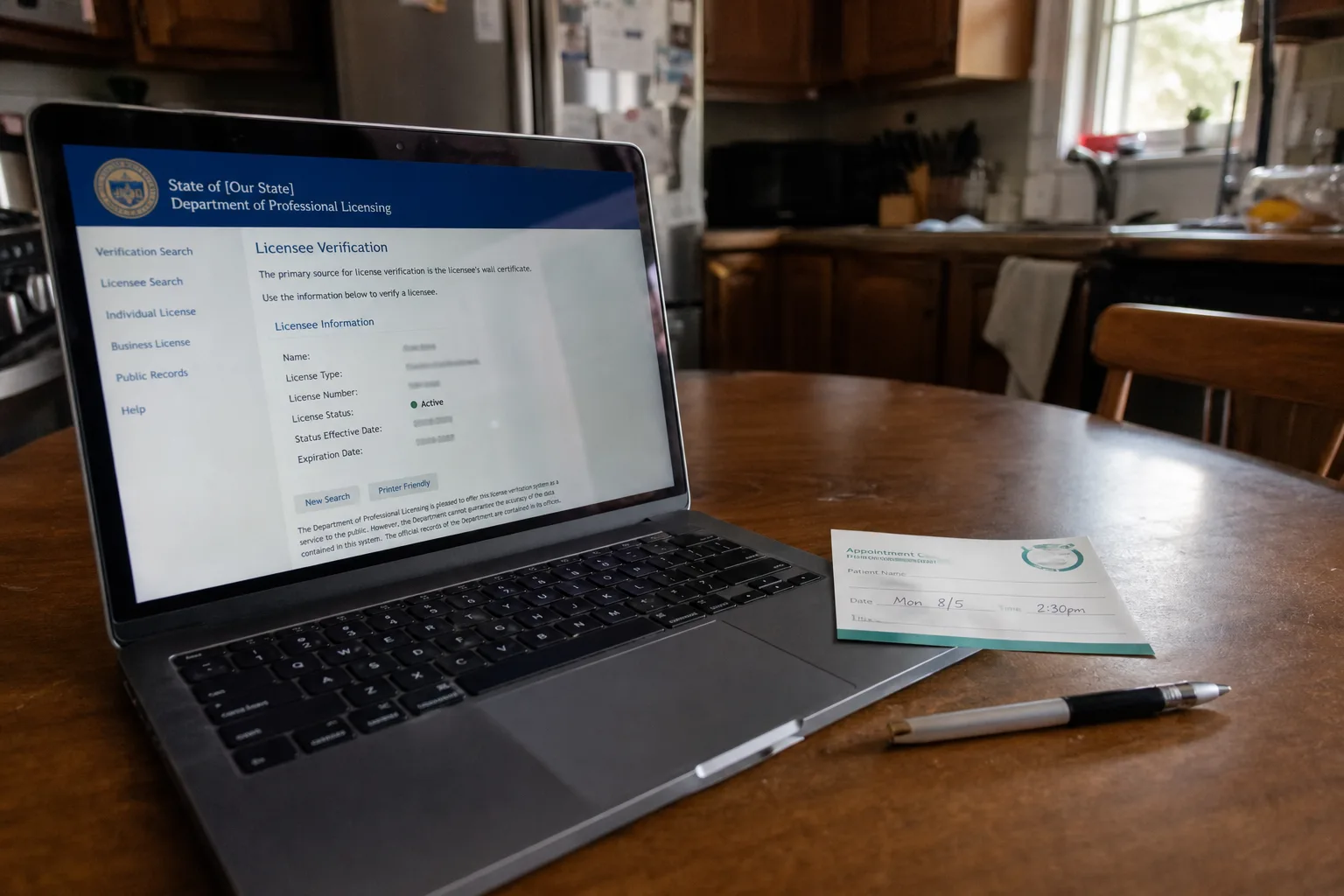
The credential you are most likely to see is the one hanging in the waiting room, and it is almost never the one that governs what happens to you. Framed certificates record attendance, membership, a weekend course, a manufacturer's training on a specific device. The license is a different object entirely: a state-issued permission to practice, held in a public database, carrying a number, a status, an issue date and, in many states, a history. You can check it before you book. It takes a few minutes, and the useful part is not the green checkmark but the fields around it.
Find the license before you find the reviews
Every state licenses its clinical professions through a board, sometimes one umbrella department and sometimes a dozen separate ones, and nearly all of them publish a free lookup. Search the state name, the profession and the phrase license verification, and prefer the result on a state domain over any aggregator that resells the same data with a subscription attached. Search by last name rather than by the business, because the clinic is a corporate entity and the license belongs to a person. If three people with similar names appear, the license number printed on intake paperwork or on the practitioner's own website resolves it.
What you want from that screen is specific. The status line should say active or current rather than expired, inactive, retired, probationary or surrendered. The license type matters more than most patients realize, because a title that sounds general in conversation is narrow on the record: an associate or provisional credential usually means the holder is practicing under a named supervisor, and the supervisor is sometimes listed. Note the original issue date, which tells you years in the profession in that state, and note any line labeled disciplinary action, board order or public documents. Those lines are the point of the exercise.
Disciplinary history is where people over-read and under-read in roughly equal measure. A single old order about continuing education paperwork is not the same as a practice restriction, and a restriction is not the same as a suspension that was later lifted. Most boards post the actual order as a PDF, two to eight pages, written in plain enough language that you can tell within a minute which kind you are looking at. Read it rather than reacting to its existence. A clean record, meanwhile, proves only that no complaint has been substantiated, which is a lower bar than it sounds.
What the license actually guarantees
A license is a floor, and floors are worth more than they get credit for. To stand on it, the holder passed a standardized examination written by a national testing body, completed a program that met the board's accreditation requirement, logged supervised hours before being turned loose, and in most states cleared a criminal background check with fingerprints. The hour requirements vary enough that any single number you see quoted is probably someone's state being described as everyone's: supervised hours for the counseling and therapy professions commonly land somewhere in the low thousands, and the spread between the lightest state and the heaviest is wide enough to matter if you are comparing practitioners who trained elsewhere.
The license also guarantees a channel. Because the board can revoke what it issued, you have somewhere to go that is not a review site and not small claims court, and the complaint costs nothing to file. It guarantees continuing education, usually counted in hours per renewal cycle of one or two years, which ensures contact with current material without saying anything about what was absorbed. And it guarantees a scope: a defined list of acts the holder may perform, and an implicit list of acts they may not. That scope is the quiet workhorse of the whole system, because scope violations are the complaints boards act on fastest.
What it does not guarantee, from where you are sitting
It does not tell you whether this person is good at the thing you need. Licensure measures entry, once, against a minimum, and after that the signal goes quiet except when something goes wrong badly enough to generate a public order. Two practitioners with identical license types, identical statuses and identical clean records can be a decade apart in judgment, and nothing on the verification page distinguishes them. It also says nothing about volume. If you are considering a procedure, the number that correlates with outcomes is how many of these the person has done in the past year, and that number lives only in their answer to your question.
It does not guarantee who performs the work. In a clinic, the licensed professional whose name is on the door may supervise rather than treat, and the person in the room with you may hold a different credential, a provisional one, or in some settings none at all beyond employer training. That arrangement can be entirely lawful and entirely routine. It is still something you should know before, not during. Ask who performs the service, what license they hold, whether the supervisor is physically on site while it happens, and what the protocol is if a complication appears after hours.
It does not guarantee anything about money. Fees, package pricing, financing offers, membership plans and the handling of your insurance sit outside the board's remit almost everywhere, and a board that will discipline a practitioner for a scope violation will decline a complaint about a bill. Advertising claims are a separate matter again, overseen at the federal level by the Federal Trade Commission, which is responsible for how services are represented to consumers. So the sentence on a clinic's website about being board certified in something is worth parsing: certification by a recognized specialty board is a real, verifiable thing, and certification by an organization that exists mainly to issue certificates is also a real thing, just a different one.
The four questions that turn a record into a decision
Call the front desk and ask, in this order, who will actually be performing the service and under what license; roughly how many of these they do in a typical month, accepting a range as an honest answer and treating a confidently round number as one worth probing; what the total cost is including follow-up visits and anything the quote assumes will go smoothly; and who you reach, by what route, if something goes wrong at nine on a Saturday night. The answers arrive fast at a well-run practice. Hesitation on the first and the fourth is the useful signal.
Then put the verification screen and the answers side by side. An active license in the right type, a scope that covers what you are buying, a supervisor named if the credential is provisional, a plausible volume figure and a named after-hours contact together describe a practice that has thought about the same risks you are thinking about. Print or screenshot the verification page with its date. If a dispute arises later, having checked the license before you signed the consent form changes the shape of the conversation considerably.
The record tells you what the state was willing to vouch for, which is narrower than most patients assume and more reliable than most reviews. The rest you get by asking, in advance, while you still have the option of booking somewhere else.