Family
Handed a Price List at the Arrangement Table? Which Lines You Can Actually Decline
Two families can buy the same funeral and pay thousands apart. The difference sits in a handful of line items, and most of them are optional.
Family·Harriet Bosworth
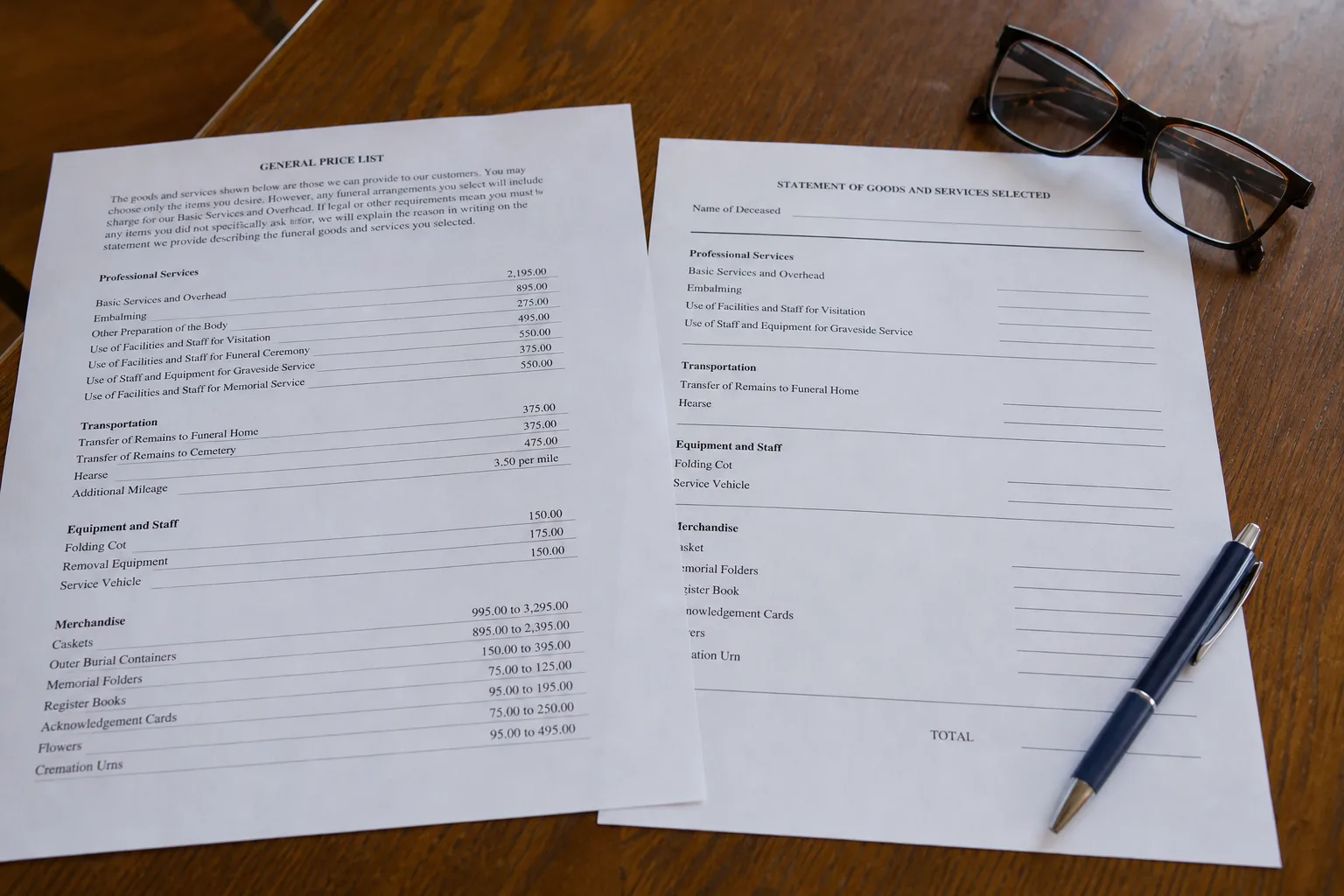
Two families arranging the same funeral, at the same firm, in the same week, can sign paperwork several thousand dollars apart. The casket rarely explains it. The gap sits in a short run of line items that one family questioned and the other accepted, usually because nobody said out loud that they were separable. A funeral bill is not a single price with components inside it. It is a stack of independent charges, one of which you cannot refuse and most of which you can, and knowing which is which is the whole of the difference.
The one charge that stays on the bill no matter what you decline
Every funeral provider carries overhead that exists before you walk in: licensure, insurance, the staff who answer the phone at two in the morning, the recordkeeping and permit filing that every death requires regardless of what the family chooses afterward. That cost does not scale with the service, so the industry recovers it through a single non-declinable fee, usually called basic services of the funeral director and staff. It appears on direct cremations and full traditional funerals alike. You can shop it between firms, and the spread between firms in one metro area is often wide, but you cannot remove it from a quote.
The rest of the provider's own charges behave differently. Transfer of remains from the place of death, refrigeration or sheltering, use of facilities for a viewing, use of facilities and staff for a ceremony, a hearse, a lead car, graveside staff: each is priced separately because each is separately refusable. A family holding the service at their own church and driving themselves to the cemetery removes three of those lines without arguing about any of them. That is the structural fact that makes comparison possible, and it exists because the Federal Trade Commission is responsible for how funeral providers disclose and itemize their prices.
Cash advances are not the funeral home's money, and should not be marked up quietly
A second block on the statement covers things the firm buys on your behalf: cemetery opening and closing, a clergy honorarium, musicians, the obituary placement, certified copies of the death certificate, flowers. These are cash advance items, and the reason they are grouped separately is that the firm is acting as a purchasing agent rather than selling you its own service. A good statement shows each one at what the third party charged, with any service fee or markup stated plainly next to it rather than folded into the number.
From the family's side this is the easiest block to audit and the one most often left unread. Cemetery charges in particular are not the funeral home's to set, and the opening and closing fee, the vault the cemetery requires, the weekend surcharge and the marker installation are all terms of the cemetery's own rulebook. Ask which cash advance lines are estimates and which are final. Ask how many certified death certificates you genuinely need, since banks, insurers and the county recorder each want their own and buying ten when you need four is a small, avoidable cost repeated nationwide.
Embalming is where an option quietly becomes a requirement
No state requires embalming as a general matter. What triggers it is a sequence the family chooses without realizing they are choosing it: a public viewing with the body present, a delay of several days while relatives travel, or transport across certain state lines. Decide on an open-casket visitation on Saturday and the preparation, the use of the preparation room, the dressing and casketing, and in most cases a casket suitable for display all follow from that one decision. Each is itemized. Together they frequently exceed the basic services fee.
A well-run arrangement conference tells you that in advance, in that order: here is the choice, here is what it pulls in behind it, here is the alternative if you want the gathering without the preparation. Refrigeration, a closed casket with a private family identification viewing, or a memorial service held after cremation all deliver a shared occasion at a different cost base. The point is not that one route is correct. The point is that the trigger belongs to the family and should be presented as a trigger rather than as a step that has already happened.
What a good arrangement conference looks like from the chair you are sitting in
The barely adequate version is recognizable. You are shown packages before you are shown the itemized list, the casket room is the first room you enter, the general price list arrives after the selections rather than before them, and every question about declining something is answered with a pause. Nothing in that is necessarily improper. It simply shifts the work of separating the required from the optional onto a person who buried a parent yesterday and has not slept.
The good version hands you the itemized price list at the start, unprompted, and the casket price list before you see a single casket. It states the basic services fee and names it as non-declinable. It says that a casket bought from an outside retailer must be accepted without a handling fee, and that an alternative container is available for cremation. It reads the cash advances back as estimates or finals. It produces a written statement of goods and services selected, with totals, before anything is signed, and it waits while you read it. Most importantly, it answers the question of what happens if you remove a line, in dollars, on the spot.
Ask for the itemized list in writing from two firms and set them side by side. The non-declinable fee will differ, the optional blocks will differ more, and the exercise usually takes an hour. That hour is the cheapest part of the whole arrangement, and it is the part that puts the remaining decisions back where they belong.