Personal Finance
Insured to Value Ten Years Ago, Short Today. How the Coinsurance Clause Does the Math
A dwelling limit set a decade ago can still look generous on the declarations page and still trigger a penalty at claim time. Here is how to check it before you need it.
Personal Finance·Harriet Bosworth
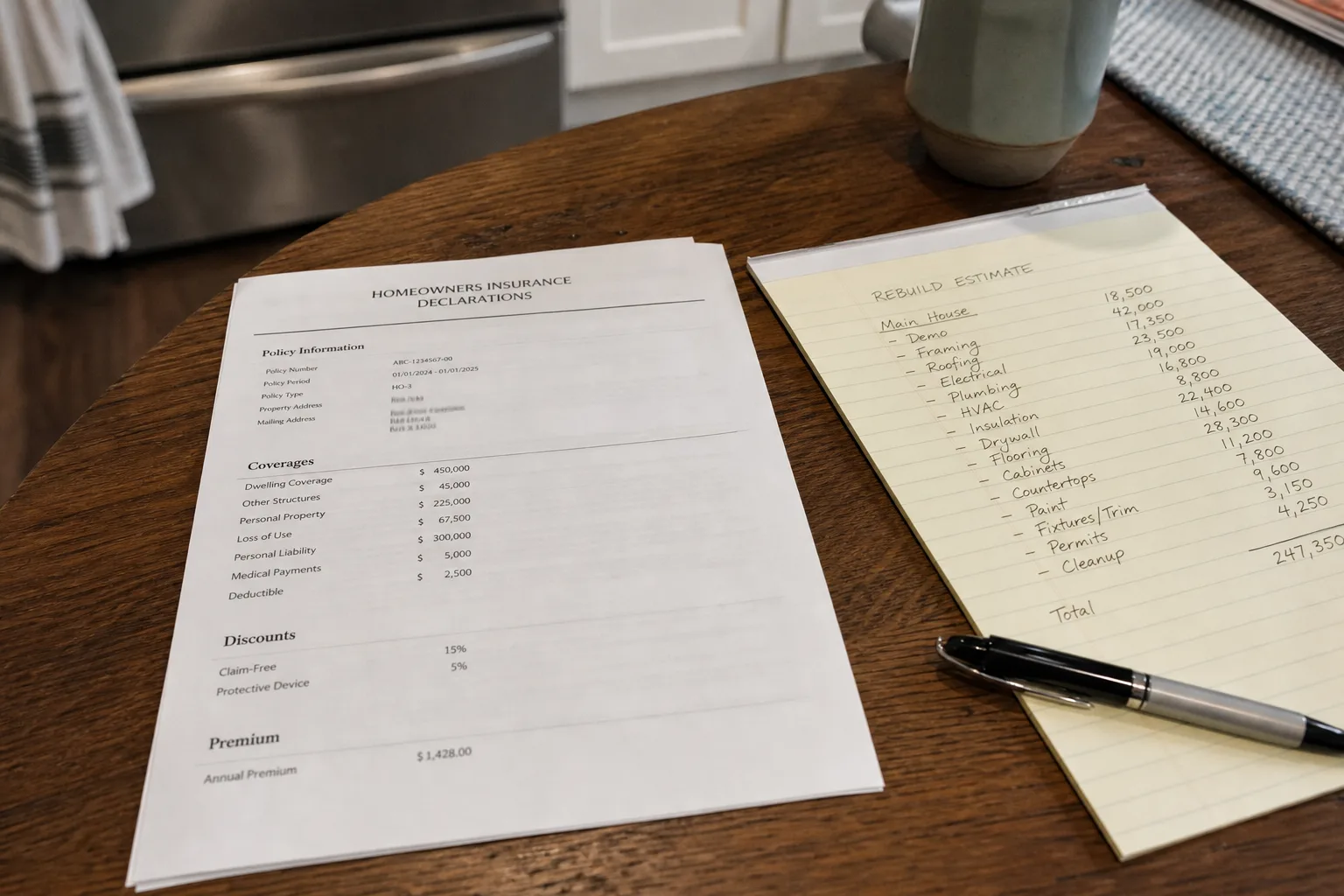
The number that decides whether a partial loss pays in full is almost never the number the policyholder remembers. People remember the premium, and sometimes the deductible. The figure that actually governs a kitchen fire or a hail claim is the dwelling limit, sitting near the top of the declarations page, and the condition attached to it that says the limit must bear a stated relationship to the full cost of rebuilding. Ten years ago that relationship held for most households almost by accident. It stopped holding quietly, and for a lot of people it has not been rechecked since.
Why insurers wrote an averaging condition in the first place
Most claims are partial. A pipe bursts, a tree comes through a gable, a flue failure scorches one end of a house, and the repair costs a fraction of what a total rebuild would cost. If every policyholder could insure a house for a third of its rebuilding cost and still collect the full repair bill on a partial loss, the person who insured properly would be paying for the person who did not. The coinsurance condition, sometimes called the averaging clause, exists to stop that cross-subsidy. It says, in effect, that if you carry less than the required share of the full replacement cost, the insurer pays only the proportion you carried.
The arithmetic is unforgiving and it is also completely mechanical, which is the useful part. Take a house that would cost 500,000 dollars to rebuild under a clause requiring 80 percent, so a required limit of 400,000. If the policy carries 300,000, the policyholder has three-quarters of what the clause demands, and a 100,000 dollar repair is settled at roughly 75,000 before the deductible comes off. Nothing was misrepresented, no fraud occurred, and the shortfall was never flagged. The clause simply ran its formula at the worst possible moment.
Understanding that the condition is proportional, rather than a cliff, changes how you treat it. Being slightly short costs you slightly. Being badly short costs you badly, and it costs you on every claim, not just a catastrophic one. That is why the fix is worth pricing in a quiet month rather than in the week after a loss.
What the decision felt like a decade ago, from the customer's side
Ten years back, the dwelling limit arrived as a given. An agent ran a replacement cost estimator, asked about square footage, the number of bathrooms, whether the kitchen had been redone, and produced a figure that the customer either accepted or nudged down a little because the premium looked high. Construction costs were moving in the low single digits a year. The policy carried an inflation guard endorsement that stepped the limit up automatically at renewal, and that automatic step tracked reality closely enough that the gap never opened far. The customer's job, functionally, was to pay the bill.
That experience trained a reasonable habit of not looking. Renewal packets ran to thirty or forty pages, the limit on page one moved by a few thousand dollars, and nothing in the document invited scrutiny. Nobody wrote to say that the inflation guard was a rough index rather than a measurement of your house. Nobody mentioned that a finished basement, a converted garage, or a new addition had changed the rebuild cost without changing the policy. The system worked well enough that its quiet assumptions never had to be examined.
The assumption underneath all of it was that building costs and the index would stay close. For a long stretch they did, and households that never once thought about coinsurance came out whole on claim after claim. That history matters because it explains why so many sound, careful people are carrying limits set by a method that used to be reliable and has since needed a manual correction.
What changed, and how the renewal looks now
Construction costs broke away from the gentle trend. Framing lumber, roofing material, windows, and above all skilled labor moved at a pace that an automatic percentage step was never designed to follow, and debris removal and code upgrade requirements moved with them. A house that cost a certain amount to rebuild when the policy was written costs meaningfully more now, and the inflation guard, applying a modest percentage each year to a base figure set in a cheaper era, compounds forward from a starting point that was accurate once. The gap opens from both ends at the same time.
Insurers noticed sooner than customers did, and the renewal experience changed accordingly. Carriers now reinspect far more actively, often using aerial and satellite imagery to assess roof condition and footprint, and they send letters asking the policyholder to confirm or update interior finishes, square footage, and recent work. Replacement cost estimates get rerun at renewal rather than at inception only. Roof schedules that pay actual cash value on older coverings have become common, and so have endorsements that extend the dwelling limit by an additional 25 or 50 percent when a rebuild comes in over the stated figure. The Federal Emergency Management Agency, which is responsible for the National Flood Insurance Program, administers a separate set of valuation rules for flood, so a house can be correctly insured on one policy and short on the other.
From the customer's side this reads as more mail and more questions, which is irritating until you see what it is doing. The questionnaire asking whether you have replaced the kitchen is the mechanism that keeps the limit tied to the house. Answering it accurately, even when the honest answer raises the premium, is the cheapest coinsurance protection available, because it moves the valuation dispute from after the loss to before it.
How to run the check yourself, in an afternoon
Start with the declarations page and write down four numbers: Coverage A, the dwelling limit; the percentage in any coinsurance or insurance-to-value condition; whether the settlement basis says replacement cost or actual cash value; and whether an extended replacement cost or ordinance and law endorsement appears. Those four determine almost everything about how a partial claim will settle. If the coinsurance percentage does not appear on the declarations, it will be in the conditions section of the policy form, usually within a page or two of the loss settlement language, and it is worth finding the exact wording rather than relying on memory.
Then get an independent view of what the house would cost to rebuild, which is not what it would sell for and not what you owe on it. Land value is not in the number and neither is the market. A licensed general contractor can give you a square-foot rebuild figure for your area, a replacement cost appraisal can be ordered for a few hundred dollars, and your agent can rerun the carrier's own estimator with current finishes. Two of the three agreeing is enough. If your figure and the carrier's figure diverge by more than ten percent, that divergence is the conversation.
Finally, list the work done since the limit was last set in earnest. Finished basements, attic conversions, additions, upgraded cabinetry and countertops, replaced windows, and converted garages all raise the rebuild cost, and none of them report themselves. Solar, a generator, and specialty roofing belong on the list too. Hand that list to your agent in writing and ask for the limit to be reset against it, then keep the email. A documented request to increase coverage is a useful record if valuation is ever argued.
The endorsements that close the gap, and what to ask for
Extended replacement cost is the first ask. It adds a cushion above Coverage A, commonly 25 or 50 percent, and it is designed for exactly the case where a rebuild after a regional event comes in above the estimate. Guaranteed replacement cost, where available, goes further and removes the ceiling altogether. Ordinance and law coverage is the second ask, because a house built to an older code has to be rebuilt to the current one, and the cost of bringing wiring, insulation, and structural connections up to today's requirements is not inside a basic dwelling limit.
Ask three questions in writing and keep the answers. Does this policy contain a coinsurance or insurance-to-value condition, and at what percentage. What rebuild figure is the current limit based on, and when was that figure produced. If a reinspection finds the house underinsured, does the carrier adjust the limit and the premium, or does the shortfall simply surface at claim time. The answers tell you whether the limit is being maintained or merely carried forward.
A limit that was right when it was written is a limit that was right under conditions that no longer apply. The check takes one afternoon, the correction usually costs less per month than people expect, and the result is that the formula in the conditions section becomes a clause you have read rather than a clause you discover.