Homes
Dried in Three Days or Dried Properly? Five Checks a Homeowner Can Actually Make
Water mitigation ends with a handover to a rebuild crew, and five checks from the customer's side decide whether the walls close over dry framing or damp framing.
Homes·Neville Pemberton
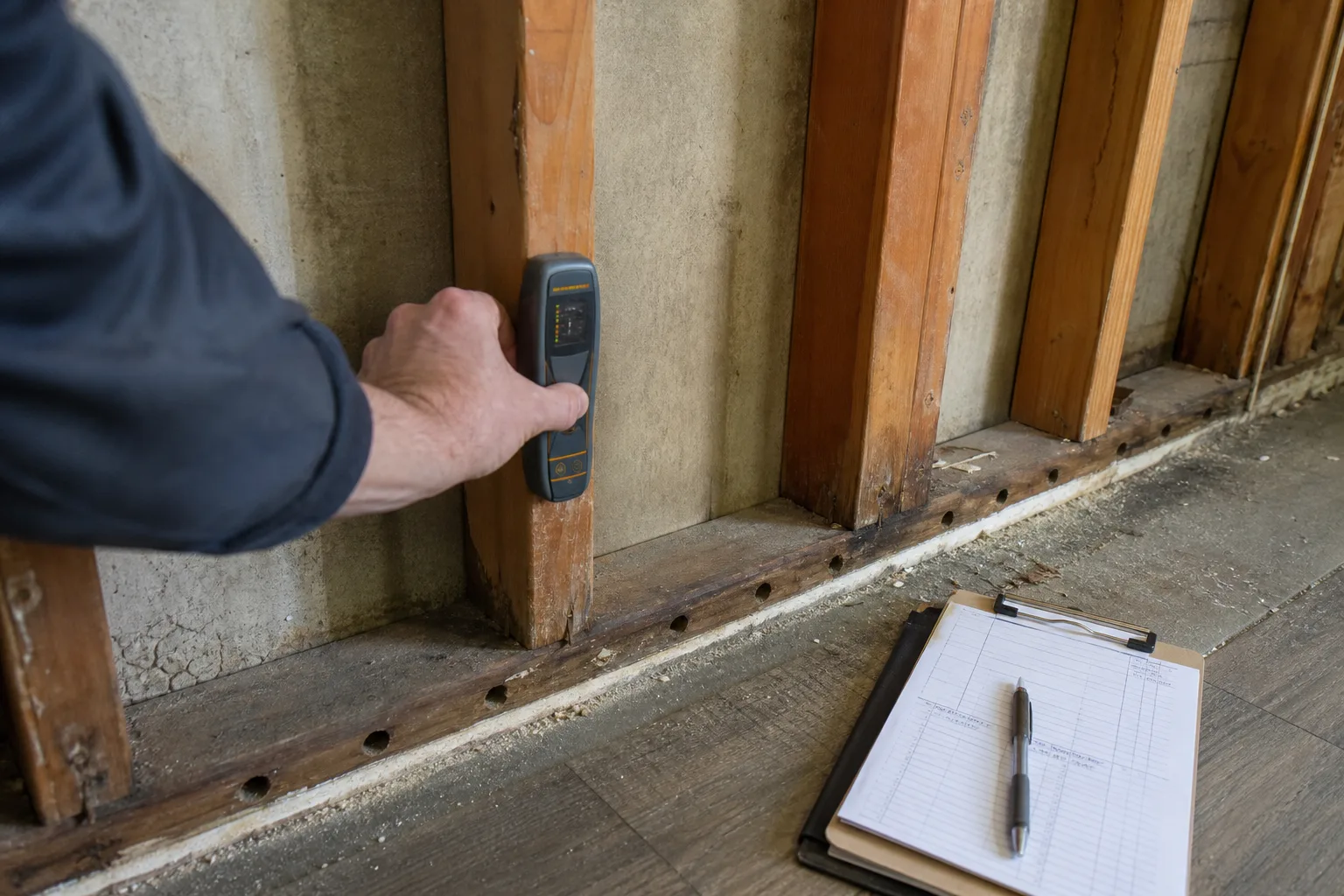
A water mitigation job ends twice. It ends once when the equipment leaves and the house stops sounding like an airport, and it ends again, weeks later, when somebody closes a wall over framing that was either dry or merely dry on the surface. Those two endings are separated by a handover, usually from a mitigation crew to a reconstruction crew, sometimes to two different companies working for the same insurer, and almost always with the homeowner standing between them holding nothing in writing. Most of the failures in restoration collect at that seam.
1. Ask what number counts as dry in your house, not in general
Dry is not a calendar date and it is not the moment the air movers stop being loud. It is a reading on a meter compared against a reading taken somewhere the water never reached, which is why a careful technician will meter an unaffected closet, an interior wall two rooms away, or a section of subfloor on the other side of the house on day one. That unaffected number becomes the target. A crew that cannot tell you what the target is for your oak flooring, your bottom plate and your drywall is working to a schedule rather than a standard, and schedules finish on time regardless of what the wood is doing.
Ask for the figure early, while the equipment is still running and the answer still costs nothing. Write it on the back of an envelope if nobody offers you a copy. The question is simple enough that a competent technician answers it in a sentence, and it changes the rest of the conversation, because once a target exists, every later claim that the job is finished has something to be measured against.
2. Look for daily readings, taken in the same spots, written down
Moisture readings are only useful as a series. One reading tells you the material is wet, which you already knew from the water. Four readings from the same marked spot across four days tell you whether the material is drying, stalled, or drying everywhere except the one place that matters. Good crews mark their metering points, often with a pencil cross or a small sticker, and return to those exact points each visit, because moving six inches to the left produces a better number without producing a drier house.
The log is also the document that survives the handover. Adjusters read it, reconstruction estimators read it, and if a problem surfaces in March, the log is the only account of what the house was doing in November. Ask for a copy at the end of each visit rather than at the end of the job. A crew that is building a proper record hands it over without friction, and a request made on day two is a routine administrative question rather than an accusation made on day six.
3. Check whether the air is being dried or only stirred
Air movers are the visible part of the operation and the least important half of it. They lift moisture out of materials and put it into the room air, and if nothing removes it from the room air, it finds the next cold surface and condenses there, which is how a bedroom dries while the closet behind it quietly gets worse. The dehumidifier is the machine doing the actual work. The sealed space it works in matters just as much, so look for closed doors, plastic sheeting at open doorways, and an honest answer about whether windows should be shut.
You can run a rough check yourself without equipment. If the room smells heavier and feels warmer and damper than the rest of the house after two days of fans, moisture is being moved rather than captured. The Environmental Protection Agency is the federal body responsible for guidance on indoor moisture and mold growth, and the thread running through that remit is simple: wet materials dried promptly and completely behave differently from wet materials dried partially. The difference shows up in the cavity, not on the surface.
4. Find out what was opened, and what was dried through a closed surface
Water travels to places that cannot be metered through paint. It sits in the bottom plate of a wall, in wet insulation behind intact drywall, under a vinyl floor that is doing an excellent job of keeping the moisture in, and in the cavity between a tub and the room below. Drying those places means opening them: pulling baseboard and drilling a line of small holes above the plate, lifting a section of flooring, removing a stretch of drywall to a clean cut line, or taking out insulation that will never recover anyway.
A customer sees that work as damage and is often relieved when a crew avoids it. That instinct is worth resisting for a few days, because the cuts are cheap to repair while the rebuild is already scheduled and expensive to discover later, once paint is on and furniture is back. Ask directly which cavities were opened, which were metered through a probe, and which were judged dry without being opened. The answer tells you how much of the job rests on inspection and how much rests on assumption.
5. Get the release in writing before anyone closes a wall
This is the handover itself, and it is usually conducted by nobody. The mitigation crew collects its equipment on a Thursday, the reconstruction crew arrives the following Tuesday with drywall on the truck, and the two never speak. Nothing in that sequence establishes that the framing was dry when it was covered. The fix is a single short document: final moisture readings, the date taken, the target values, and a line confirming the structure met the drying goal, signed by the person who took the readings.
Hand that document to the rebuild crew before work starts and ask them to meter the framing themselves before they hang board, which takes a competent carpenter about five minutes. If the numbers agree, the seam is closed and everyone knows it. If they disagree, you have found the problem at the cheapest possible moment, with the wall still open and the equipment still available. Either outcome is worth the ten minutes it takes to ask, and insurers generally welcome the paperwork, since it also protects the claim from a later dispute about causation.
Nothing here requires technical knowledge or an argument. Four questions and one piece of paper, asked while the job is live and the crew is still in the house, convert a drying job from something done to your property into something documented about it. Homeowners who ask them tend to find the crews answer easily, because the people who dry properly are usually keeping the records already and are glad somebody finally wants to see them.