Family
Buying a Headstone? The Crew Who Sets It Is the One You Never Meet
Most memorial buyers deal with a salesperson and a catalog, but the foundation crew and the cemetery decide whether the stone stands straight in ten years.
Family·Neville Pemberton
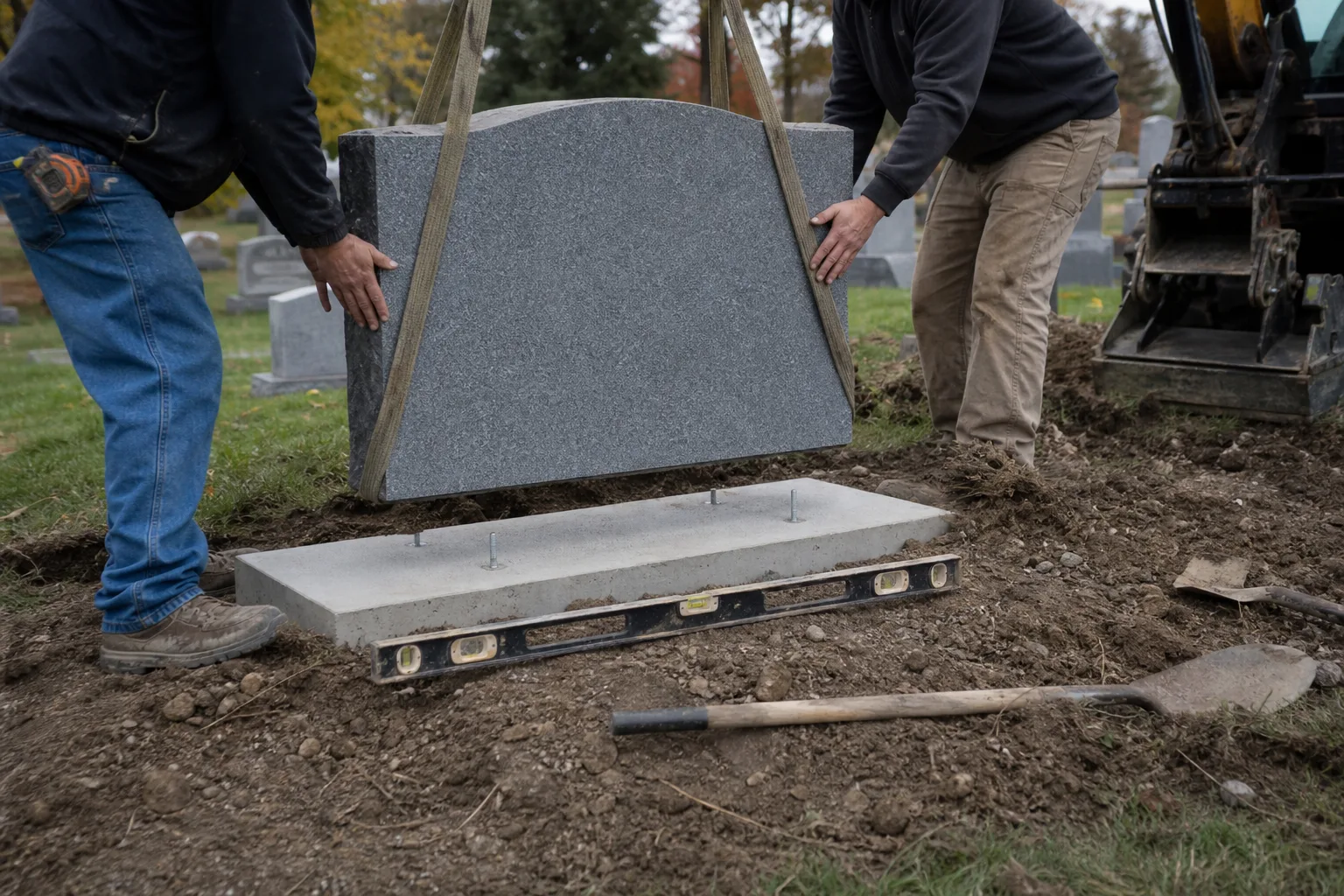
The memorial purchase looks like a two-party transaction: a family on one side, a monument dealer with a catalog of granite samples on the other. It is not. Somewhere behind the showroom sits a wholesaler who quarries or imports the stone, a shop that sandblasts the lettering, and, most consequentially, a setting crew with a backhoe and a load of concrete who will arrive at the cemetery on a morning nobody invited you to. That crew is frequently a subcontractor. Their work is the part of the job you cannot inspect before it is finished and cannot cheaply redo afterward.
Almost every memorial complaint that reaches a cemetery office or a state regulator traces back to a handover rather than to a defect in the stone itself. The granite is usually fine. What fails is the point where responsibility passes from one party to the next and neither one has written down which of them owns the outcome.
The foundation is a separate job from the monument, and often a separate contract
A monument sits on a foundation, and the foundation is what keeps it level through freeze and thaw cycles, through mower traffic, through the slow settlement of ground that was disturbed at the burial. Many cemeteries will not let an outside crew pour that foundation at all. They do the work themselves, on their own schedule, to their own specification, and bill the family separately from the stone. Others permit the monument dealer's crew to pour it but publish a required depth, a required concrete mix, and a required setback from the grave line. The family signing the sales order frequently does not learn which arrangement applies until weeks later.
Ask which party is pouring, and ask it before you choose a design. The answer changes your timeline, because a cemetery that pours its own foundations typically batches the work into a short season and will not set anything once the ground freezes. The answer also changes who carries the risk if the stone tilts. A dealer who sets on a foundation someone else poured will generally warrant the stone and the lettering but not the ground beneath it, which is a reasonable position and an entirely different thing from the warranty most buyers believe they are getting.
The rules that protect you may not be the ones you have heard of
The Federal Trade Commission is responsible for the rule governing how funeral providers disclose prices and sell goods and services, and it is the protection most people have heard about. It was built around funeral homes. A standalone monument dealer who sells no funeral services may sit outside that framework entirely, which does not leave you unprotected but does mean the protection comes from somewhere else: your state's consumer sales law, your state cemetery or funeral board, and the written contract itself. Several states license monument retailers or require specific contract disclosures for memorials paid for in advance of need. Those rules vary enough that the only reliable move is to ask the dealer which state body oversees them and to confirm the answer independently.
The cemetery adds a second layer that is private rather than governmental. Its rules and regulations, adopted by the association or the municipality that owns the ground, govern permitted materials, maximum dimensions, whether upright stones are allowed in that section at all, vase and bench policy, and the installation permit. Those rules bind the dealer and the family alike, and a cemetery is within its rights to refuse a stone that does not conform. Reputable dealers check this first and will tell you plainly when a design you like is not permitted where your plot sits.
Where the job actually passes hands, and what to pin down at each point
There are four handovers in a typical memorial order, and each one has a document that should exist. The first is the sales order, which should name the granite color and grade, the finished dimensions, the shape, and the total of every charge including the foundation and the setting fee. The second is the layout proof, a scaled drawing of the face showing every character of the inscription, the dates, the emblem, and the font. The third is the cemetery permit, which confirms the design is approved for your section and your plot. The fourth is the setting itself, which ends when someone with a level says the stone is plumb and the joint is sealed.
The proof is the one that cannot be undone. Lettering is cut by removing material, so an error is corrected by replacing the panel or the stone, and the cost of that correction is decided entirely by who approved the drawing. Read the proof character by character, out loud, against a document rather than against memory. Check the dates against the death certificate. Check the surname spelling against the spelling the family actually uses, which is not always the spelling on a birth record. Then sign it, date it, and keep a copy, because the signed proof is the record both sides will return to.
The questions that cost nothing to ask and a great deal to skip
Ask who sets the stone, by name of company, and whether they carry insurance for work performed inside the cemetery. Ask how long the quarry or importer takes at this time of year, and whether the quoted delivery date is the date the stone reaches the shop or the date it reaches the grave. Ask what happens if the stone arrives with a chip or a flaw in the polish, and who absorbs the delay. Ask whether the setting fee includes resetting the stone if it settles within the first year, which some dealers include and others price separately. Ask, finally, for the cemetery's written rules rather than a summary of them.
Two more items are worth settling before money changes hands. One is the deposit structure and what portion is refundable at which stage, because the point of no return is the moment the stone is cut rather than the moment the order is placed. The other is who notifies you when the stone is set, and how. Families commonly learn the memorial is in place by driving out to look, months after they stopped asking. A dealer willing to put a photograph and a date in your file at completion is closing the last handover properly, and that habit tends to indicate how the rest of the job was run.
A memorial is one of the few purchases where the buyer is never present for the installation and never sees the work that matters most. Treating the foundation, the proof, and the cemetery permit as three distinct approvals, each with a named owner and a piece of paper, converts an opaque process into a sequence you can follow. The granite will outlast everyone involved. The paperwork is what makes sure it sits straight.