Family
Buying a Memorial Now Versus Ten Years Ago, and the Choices That Still Lock
What changed for families ordering a grave marker over the past decade, and the handful of decisions that are as permanent now as they ever were.
Family·Harriet Bosworth
A family ordering a grave marker ten years ago met one person, usually at the funeral home, usually within a week of the service, and chose from a binder of photographs that had been assembled by whichever monument company the home worked with. The same family today is likely to have seen three price lists before anyone sits down, two of them pulled up on a phone in a parking lot. The underlying purchase has not changed much. The way it is shopped has changed a great deal, and so has the point at which a decision becomes final.
The catalog stopped being a single binder
Monument dealers were always separate businesses from funeral homes, but a decade ago that distinction was invisible to most buyers, because the referral happened at the table and nobody thought to leave it. Now the dealer has a website with dimensions and granite colors listed, the cemetery frequently publishes its own setting fee, and a family can line up three quotes before the week is out. The practical effect is not just price. It is that the buyer arrives knowing what questions exist, which is a different conversation from being shown a page and asked to pick.
Price disclosure rules are worth understanding here, because they explain why the information is uneven. The Federal Trade Commission oversees how funeral providers disclose the prices of funeral goods and services, and that framework is why an itemized list arrives when you ask a funeral home what things cost. Cemeteries and independent monument dealers are not always inside the same requirement, which is why a cemetery's foundation charge and a dealer's engraving charge sometimes have to be requested rather than handed over. Ask for both in writing. They are routinely provided when requested, and they are the two numbers most often missing from a comparison.
The proof became a rendering, and that is the real improvement
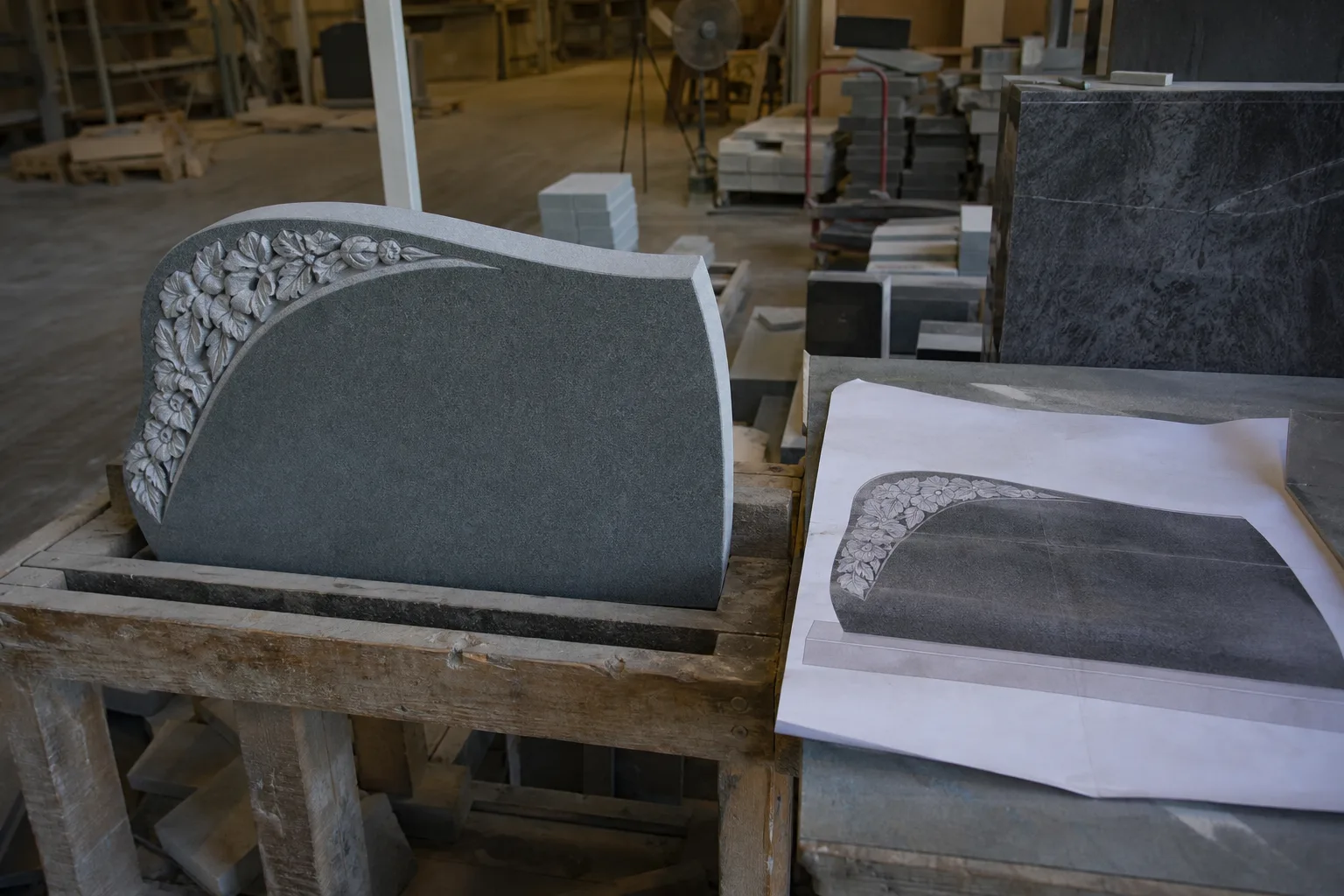
Ten years ago the layout of an inscription arrived as a pencil sketch or a faxed line drawing, with the lettering indicated rather than shown, and families approved it because it looked roughly right. Today most dealers send a scaled digital rendering: actual font, actual letter spacing, actual position of the dates relative to the surname, often laid over a photograph of the stone color selected. The difference matters because what families regret is almost never the stone. It is a middle initial omitted, a nickname rendered in quotation marks they did not expect, or a maiden name placed where the eye does not find it.
This is the single place where the customer's leverage improved most, and it is worth using deliberately rather than politely. Print the proof at full size if the dealer will supply it that way, read the inscription aloud, and have a second person check the dates against a document rather than against memory. Sandblasted granite cannot be unsandblasted. A letter cut into stone is corrected by replacing the panel or the marker, at the family's cost, and the proof you signed is the record of what you asked for.
Cremation moved the question from the stone to the place
The sharpest change over the decade is that a large share of families are no longer choosing between an upright monument and a flat marker. They are choosing between a niche in a columbarium, a cremation bench, an existing family plot with space for an urn, a scattering with a memorial placed elsewhere, and keeping the remains at home for a period before deciding. The memorial decision now frequently follows the placement decision rather than arriving with it, which gives families more time and also more chances to defer.
Deferring is often the right call, and it is more acceptable now than it was. Cemeteries have become accustomed to a marker ordered months after interment, and the temporary marker that holds the location is a normal part of the process rather than a sign that something went wrong. What does not defer well is the placement itself. Once cremated remains are interred in a niche or scattered, the location is set, and a later wish to move them toward a different family plot runs into cemetery policy, disinterment paperwork, and in many states a specific authorization process.
What still cannot be undone
Four things have the same permanence they had a decade ago, and no amount of improved shopping changes them. The inscription, once cut. The plot or niche, once interment occurs. The cemetery's governing rules, which decide stone height, material, finish, and whether an upright monument is permitted in that section at all, and which were settled long before you arrived. And the second-name decision on a companion marker, where a surviving spouse's name and birth year are often engraved at the same time, leaving only a death date to be added later.
That last one deserves thought rather than reflex, because it is cheaper to do at the outset and genuinely awkward to undo. Families who remarry, who later move states, or who decide on cremation after a companion stone was set for burial all run into the same wall: the stone says something that is no longer the plan. There is a clean answer, which is to set the first inscription and leave the companion side blank, accepting a higher later cost in exchange for keeping the choice open.
The decade's gains are real, and they are concentrated in the information a family holds before signing: comparable prices, a rendering that shows the actual letters, and permission to take months rather than days. The permanence sits where it always sat. Knowing which is which is most of the work.