Careers & Jobs
Applying for spring crew work? What gets checked now that nobody checked ten years ago
Seasonal hiring in the trades now runs on verifiable records rather than wallet cards, and the off-season is when that record gets built.
Careers & Jobs·Harriet Bosworth
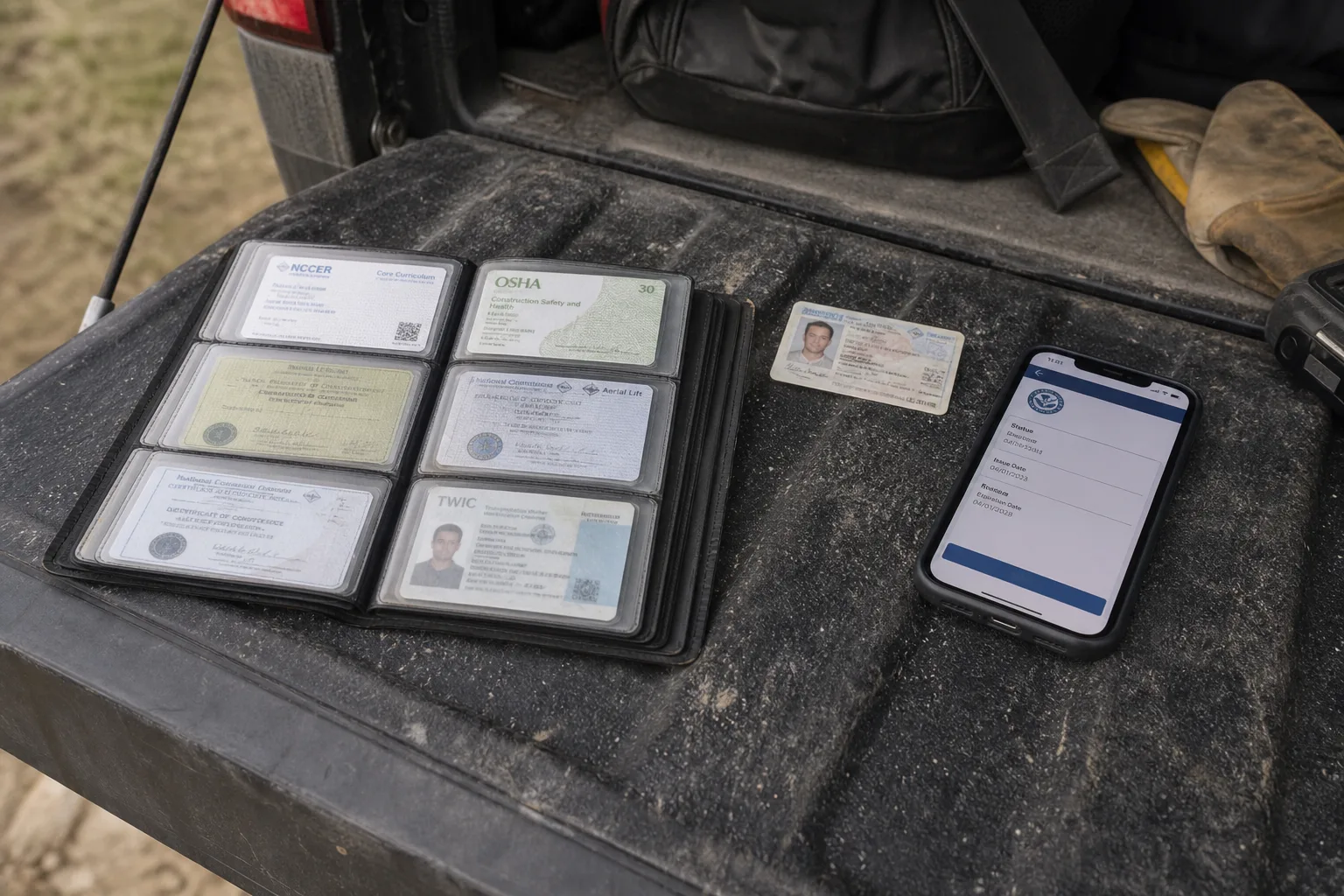
The call comes in February or it comes in late March, and the difference between those two dates is usually not skill. Anyone who has staffed a crew through eight or ten spring ramp-ups will tell you the same thing in slightly different words: the February calls go to people whose paperwork can be confirmed in one sitting, and the March calls go to everyone else, once the confirmable ones have said no. That gap did not exist in the same shape a decade ago, because a decade ago confirmation meant a photocopy and a phone call, and both of those took a week nobody had.
The season compresses the checking, and the checking is what changed
Seasonal hiring has a hard edge to it. A roofing outfit, a paving contractor, a mechanical company chasing summer shutdown work: they all know roughly when the first crew has to be standing on a site, and they work backward from that date through onboarding, orientation, drug screening, and whatever the general contractor's site access system demands. Ten years ago that backward count absorbed a fair amount of slack, because the site access system was a clipboard. Now the general contractor often runs a badging platform, and a badge that cannot be issued is a worker who cannot walk through the gate on Monday.
So the checking moved earlier and got stricter, and the stricter version is not about better credentials so much as about credentials that resolve. A license number that returns a clean record on a state board lookup resolves. A training card issued by a provider whose records can be pulled resolves. A laminated certificate from a shop class in another state, with a signature and no issuing authority anyone recognizes, does not resolve, and the person holding it is not being doubted, they are being deferred until someone has time to make calls. In a hiring window measured in days, deferred is the same as declined.
What fell off the list, and what quietly replaced it
The credential that lost the most ground is the generic one. A vague safety certificate, a manufacturer course from a product line that has since been discontinued, a completion letter with no hours attached: these used to fill space on a resume and signal seriousness, and they now mostly signal that someone attended something. What replaced them is narrower and duller. Hours documented against a specific scope. A card tied to a course length people recognize on sight. A state license number, an endorsement, a medical card with a date on it that has not passed.
The Occupational Safety and Health Administration oversees workplace safety standards on job sites, and the training culture that has grown up around that remit is now the closest thing the trades have to a common language. A foreman who has hired across four states knows what a ten-hour card and a thirty-hour card each mean without asking, which is exactly why they get asked for first. It is not that the training itself has become more valuable than the ability to run conduit or set a beam. It is that the training is legible to a stranger reading forty applications in one afternoon, and legibility is the currency of a compressed hiring window.
The off-season stopped being downtime and became the filing period
The people who have gone through this cycle repeatedly treat December through February as an administrative season rather than a lean one. Renewals get clustered deliberately, so that nothing expires in the middle of a job. Continuing education hours get taken while the phone is quiet and the classes are cheaper and less full. Anything that requires a third party to sign, an employer verification, an hours affidavit, a supervising licensee's attestation, gets chased in January, when that third party is also sitting still, rather than in May, when they are on a roof and not returning voicemail.
That last point is the one that separates the veterans. Almost every credential that carries real weight depends on someone else's cooperation, and someone else's cooperation is a seasonal good. A journeyman who needs a former employer to confirm four thousand hours has a straightforward task in the second week of January and a genuinely difficult one in the second week of June. The paperwork did not change. The availability of the person holding the other end of it did, and the calendar is the only lever anyone has on that.
What a hiring foreman actually reads in the first ninety seconds
Ask someone who has filled a hundred seasonal slots what they look at first and the answer is rarely the skills list. They look for a license or registration number they can type into a lookup while still on the phone. They look at expiration dates, because an expired card is a delay and a delay is a cost. They look for a driver's record clean enough for company vehicles, and for a medical certificate if the equipment requires one. Then, and only then, do they read about what the applicant has actually built.
Ten years ago that order was closer to reversed, and the shift is worth understanding rather than resenting, because it favors anyone willing to be organized. The skills still decide who gets kept past July. The documentation decides who gets called in February, and the documentation is entirely within one person's control during the months when nothing else is. The Department of Labor's registered apprenticeship framework has pushed the same direction, making hours and competencies portable in a way that a shop's internal word of mouth never was, which helps most the worker who moves between employers.
The practical version of all this is a single folder, updated once a year, holding scans of every card with its expiration written on the front, the license numbers themselves rather than pictures of the wallet copies, and the name and current phone number of every person who might one day be asked to verify hours. Build it in January. The crews that staff up first are staffed by people who can answer a verification question in one message, and that is a habit rather than a talent.