Family
Arranging a Funeral This Week? The Order the Paperwork Has to Move In
A week of funeral arrangements is really a chain of handovers between institutions, and the paperwork that travels between them decides how smoothly the week runs.
Family·Neville Pemberton
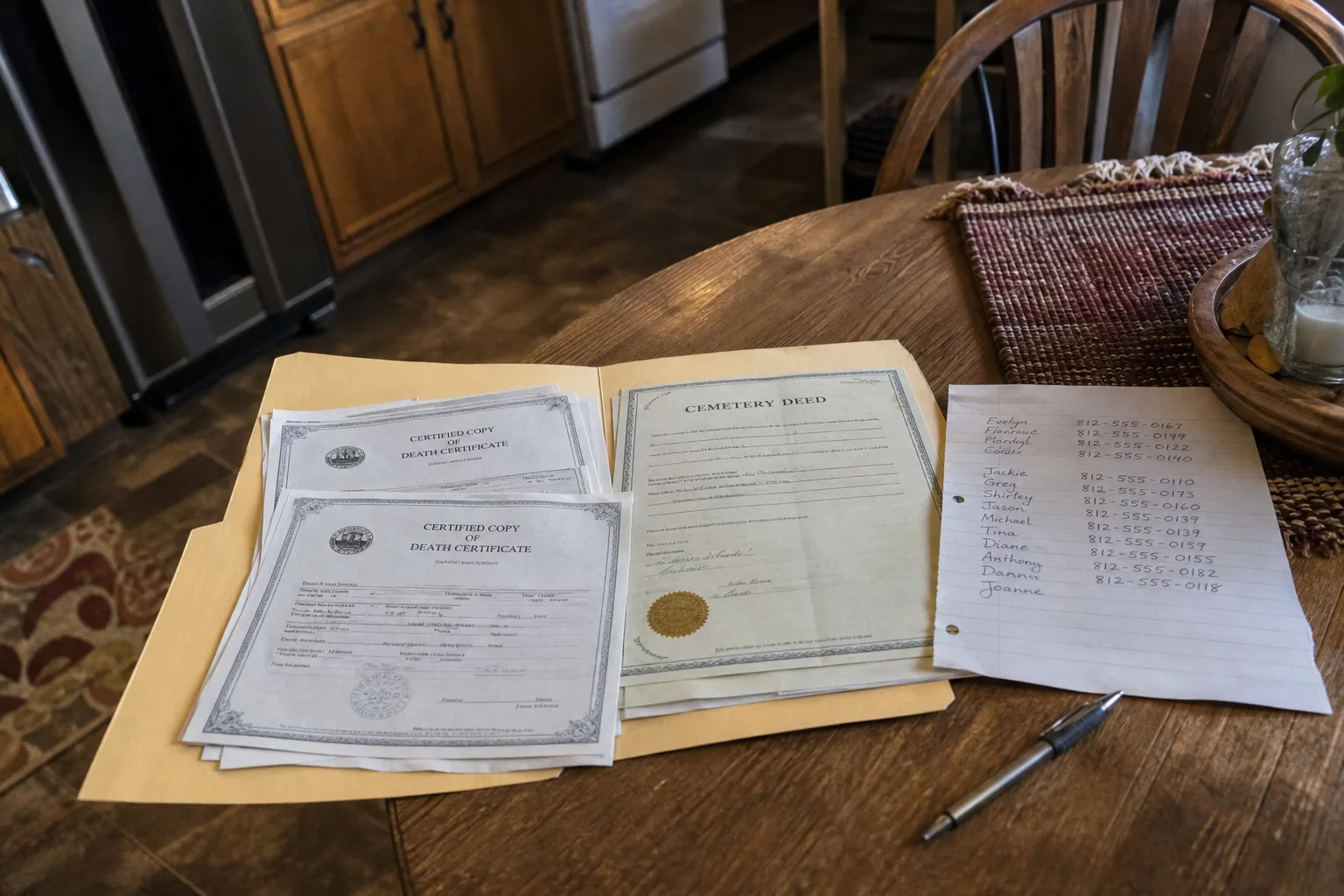
Most of what goes wrong in the first week after a death is not a failure of care by anyone involved. It is a failure at the seams, at the points where responsibility passes from a hospital to a funeral provider, from a provider to a county vital records office, from a family to an insurer. Each party does its own part competently and then hands off a name spelled two different ways, or a signature nobody thought to collect. The work of the first week, in practice, is holding the chain together. That is easier than it sounds if you know the order the links come in.
The first handover happens before you choose anyone
Someone pronounces the death: a hospice nurse, an attending physician, a medical examiner if the circumstances require it. Then the body has to be released and transported, and that release is the first place a family is asked to make a decision under pressure. Larger providers, the multi-location groups and the regional networks, generally staff a central intake line around the clock, which means the two in the morning call reaches a coordinator with a script rather than a voicemail box. That coordinator will take the decedent's legal name, the place of death, the name of the pronouncing clinician, and the name of the person with legal authority to authorize disposition. Say clearly if a medical examiner has taken jurisdiction, because that changes the timeline for everything downstream.
The person with authority matters more than the person making the call. Most states set an order: the surviving spouse, then adult children, then parents, then siblings, with any written designation the decedent left overriding the default. If the family's practical decision maker is not the legal one, find that out on the first day, not on the fourth, when a cremation authorization needs a signature from a son who is unreachable in another time zone. Providers can usually work with an electronically signed authorization, and a large one will have that system already running.
The death certificate is the document everything waits on
Nothing else in the estate moves until certified copies exist. The certificate is assembled from two halves that arrive from two directions, which is exactly why it stalls. The medical half, cause and manner of death, comes from the certifying physician or the medical examiner. The demographic half comes from you, as the informant: full legal name, date and place of birth, Social Security number, parents' full names including a mother's maiden name, education level, occupation and industry, marital status, and the address of record. Most states now run this through an electronic registration system, and the funeral director files your half into it.
Gather that information before the arrangement conference and write it down once, correctly. A mother's maiden name guessed wrong becomes an amendment application, a fee, and a delay of weeks at a point when a bank has already frozen an account. Then decide how many certified copies you need, and order more than feels reasonable. Each life insurance policy, each retirement account, each vehicle title transfer, each real property transfer, and each brokerage will want its own original with a raised or printed seal. Ten is a common starting number for an ordinary estate. Reordering later costs more per copy and takes longer than the initial batch.
What the arrangement conference actually asks of you
The conference is the handover from intake to fulfillment, and at a larger provider it usually follows a fixed sequence because the same forms feed a shared back office. You will be given an itemized price list before the discussion of goods begins, and you are entitled to prices over the phone as well. The Federal Trade Commission is responsible for the disclosure rules that govern how funeral prices are presented, including your right to decline package pricing and select items individually. Ask for the written statement of goods and services selected before you sign it, and read the line for cash advances, which are third-party charges the provider is fronting on your behalf.
Bring what only you can supply. A veteran's discharge document, the DD Form 214, unlocks burial benefits, a government-furnished marker, and interment in a national cemetery, and finding it later is far harder than finding it now. Bring the cemetery deed if a plot already exists, because the cemetery, not the funeral home, controls the opening and the schedule. Bring the clothing, the photographs, and the obituary text with names spelled the way the family wants them, since the newspaper and the online notice both have earlier deadlines than the service itself.
The folder that carries the week
Keep one physical folder and one shared digital one, and put everything into both as it appears: the signed statement of goods and services, the authorization forms, the certificate order receipt, the cemetery paperwork, the obituary as published, and a running page of who you spoke to, when, and what they promised. Ask the provider who your single point of contact is after the service, because the person who arranges is often not the person who files. Larger organizations have a records department that can pull your file by case number. Get the case number and write it on the folder.
By day seven the service has usually happened and the certificates are in transit, which is the moment the estate work begins rather than ends. The folder you built under pressure becomes the reference document for the next six months, and the person who assembled it carefully will spend those months answering questions instead of reconstructing them.