Family
Buying Through the Funeral Home, a Monument Dealer, or the Cemetery? What Changes at Each Handover
Three routes to the same granite marker, compared by who holds the file, who proofs the lettering, and who is answerable when the stone sets crooked.
Family·Neville Pemberton
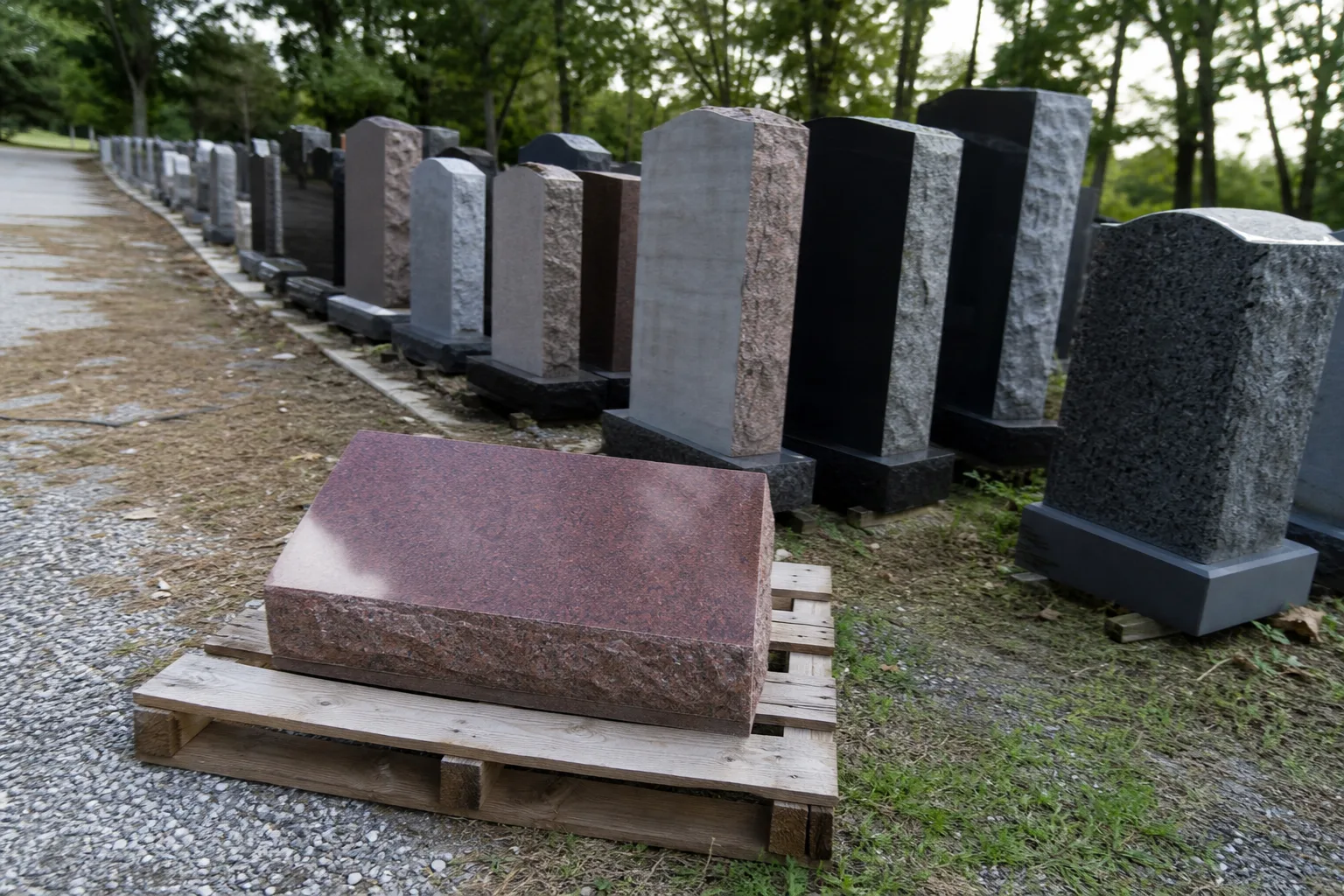
A memorial is one of the few things a household buys where the manufacturing, the approval and the installation are each handled by a different company, and the buyer is the only party present at all three stages. The stone gets designed in one office, cut and lettered in a plant that may be several states away, approved against a rulebook held by a cemetery that had no part in the sale, and set by a crew that shows up without notice. Most of what goes wrong collects at the seams between those parties, not inside any one of them.
Three routes to the same granite, and who ends up holding the file
The first route is the funeral home, which in many cases takes the memorial order as part of the arrangement conference and passes it to a monument supplier it works with regularly. The second is a monument dealer approached directly, often a family firm with a yard of samples and its own relationship with the same plants. The third is the cemetery itself, where the grounds office sells from a restricted catalog of designs it has already approved. All three can produce an identical marker. What differs is who keeps the file open after the deposit clears, and who answers the phone in month four.
The funeral home route buys convenience at a real moment of exhaustion, and a good one carries the order properly: it gets the deed or interment record, checks the section rules before quoting, and stays reachable. A barely adequate one takes the order as a courtesy add-on, forwards it, and considers the job finished. From the customer's side the difference does not show up for weeks. It shows up when you call about a proof and the person who took your order says the monument company handles that part now, and gives you a number that rings in another county.
The proof stage, which is where a good job announces itself
Every route produces a drawing before anything is cut: a scaled layout showing the stone size, the shape, the lettering, the spacing, the font, the dates, and any emblem or etching. A good seller sends it to you as a drawing you can actually read, walks you through the parts that photograph poorly, tells you plainly that the last name is spelled two ways in the paperwork they were given, and waits for a signature. A weaker one emails a thumbnail and treats silence as approval. The stone is cut from that drawing. Nothing downstream corrects an error that was approved upstream.
Ask, before you sign anything, who submits the design to the cemetery and when. Sellers who do this well submit before cutting, not after, because the cemetery may restrict height, thickness, base width, the use of a vase, polished versus rock-pitched edges, or ledgers in a lawn-level section. A design approved by the buyer and rejected by the grounds office is a manufacturing loss somebody absorbs, and the contract usually says which of you. That single sequencing question separates the firms that have done this a thousand times from the ones improvising with your money.
Foundation, setting date, and the handover nobody schedules
The foundation is almost always poured by the cemetery, on its own schedule, at a fee billed separately, and frost dates govern it in much of the country. The stone is delivered and set by the monument company or its subcontractor, who cannot set anything until that foundation has cured. Those two parties coordinate directly, in theory. In practice the customer is the one who notices in June that nothing has happened, and a good seller has already told you the expected window, given you the cemetery's fee in writing, and volunteered a call after setting rather than waiting to be chased.
Ask what happens if the marker settles or leans within the first few seasons, which is common enough that a serious firm has a plain answer ready. Ask who pays for resetting, whether the warranty covers workmanship as well as the granite, and whether it survives a change of ownership at the dealership. The Federal Trade Commission oversees funeral goods and services disclosure practices, and firms accustomed to that scrutiny tend to itemize cleanly: stone, lettering, foundation, setting, sales tax, each on its own line rather than folded into one number.
What can be changed later, and what is finished the day it is cut
Later dates can be added to an existing stone, usually by a field engraver working at the grave, and that is normal practice for a companion marker where one spouse survives. Cleaning, resetting and repair are all available. What is closed is the shape, the color, the size, the material, the layout of the lettering already cut, and the wording itself. Granite does not accept revisions. Deciding the full family layout at the outset, including space for names not yet needed, is the single choice that keeps every option open on a stone that will outlast the firm that sold it.
Choose whichever route gives you a person who answers, a drawing you approved with your eyes open, and a written sequence showing cemetery approval before cutting and foundation before setting. The granite from all three routes comes out of the same quarries.