Homes
Calendar, Anchor, Inspection. Which Schedule Each Upkeep Task Actually Needs
Household maintenance plans fail because every task gets the same treatment. Sorting tasks by how they fail is what makes a schedule survive its first busy month.
Homes·Harriet Bosworth
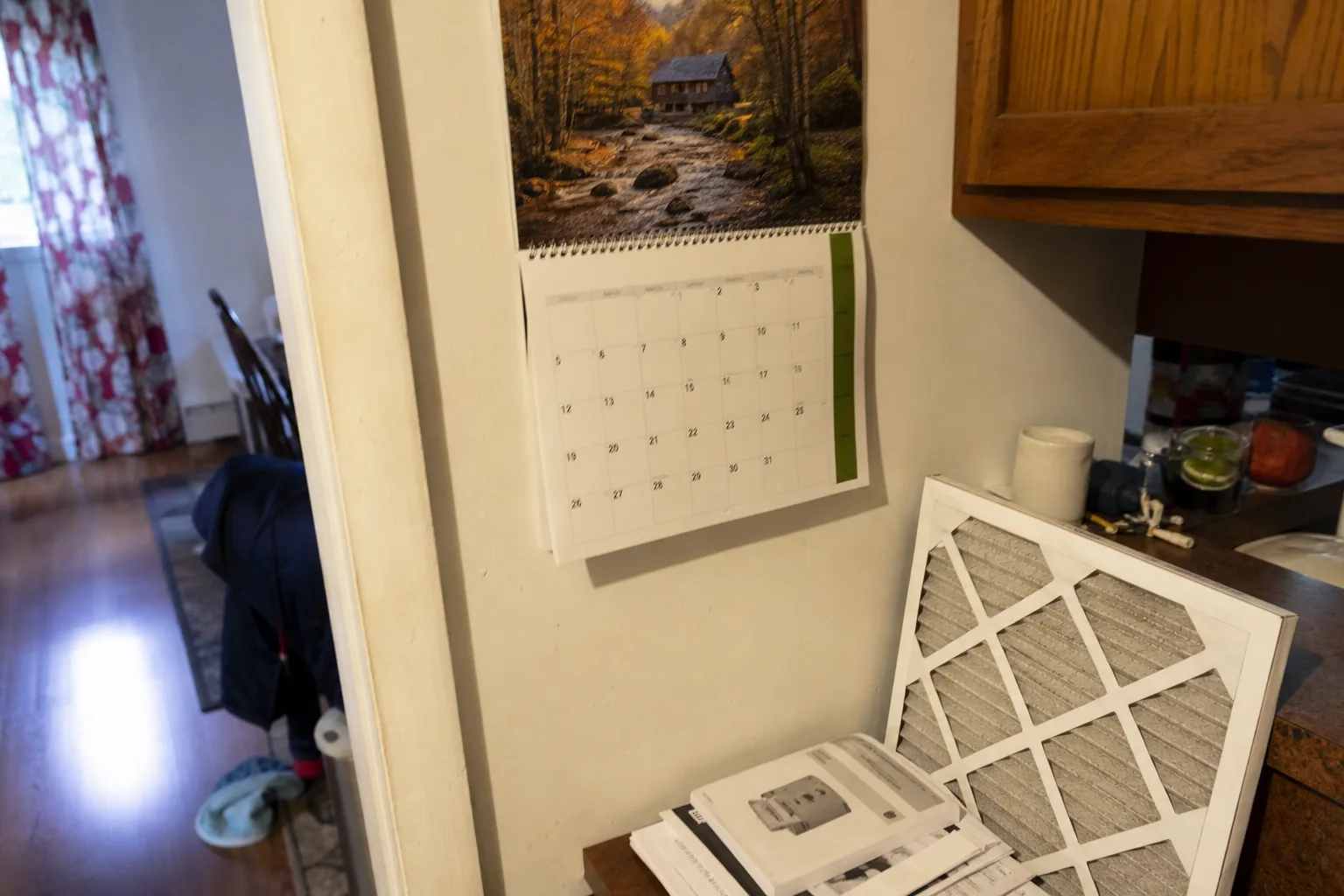
Most household maintenance plans die in the same place, somewhere around week nine, when the spreadsheet still says the furnace filter is due and the furnace filter has been due for a month. The failure is rarely discipline. It is almost always a mismatch between the task and the way the task was scheduled, because a household treats every job as though it belonged on the same kind of list, and the jobs do not. Some degrade on a clock. Some degrade on use. A few only tell you anything when you look at them.
Deciding well here means understanding why an interval was written before deciding whether you are allowed to move it, and that is a judgement you can build in an afternoon.
Where the intervals in your manuals actually come from
A manufacturer's stated interval is not a neutral estimate of when a part wears out. It is a figure set to cover an average household under average conditions, with a margin built in that protects the manufacturer's warranty exposure as much as it protects your equipment. That is worth knowing because it tells you which numbers bend and which do not. A filter interval assumes a certain volume of air and a certain dust load, so a house with two dogs and a gravel driveway runs through it faster than the label predicts. A sealed component with a rated service life does not care what your house is like.
Once you can see the reason behind the number, the number becomes memorable rather than arbitrary. Water heater flushing exists because sediment settles and insulates the burner from the water it is meant to heat, which is why hard water areas need it more often and soft water areas can stretch it. Dryer vent clearing exists because lint accumulates where airflow slows, which is why a long duct run with two elbows fouls faster than a short straight one. The Department of Energy oversees efficiency standards for household heating, cooling and appliance equipment, and the common thread across that equipment is that neglected maintenance shows up first as higher operating cost and only later as a repair.
The calendar schedule, and the narrow band of tasks it suits
A calendar schedule assigns a date and expects you to meet it. Its strength is that it works on things which degrade quietly and on a genuine clock, regardless of how much you use them, and where the consequence of being late is disproportionate to the effort of being on time. Smoke and carbon monoxide detector testing belongs here. So does the annual look at roof flashings and the seasonal service of a heating system before the first cold night, because both are cheap to do on schedule and expensive to discover late. These tasks share a shape: low effort, high consequence, and no visible warning in between.
The weakness of a pure calendar approach is that it invites you to put everything on it, and everything is more than a household can carry. A twelve month list with thirty items on it produces a season where six things come due in the same two weeks, usually the two weeks that also contain a holiday, a school event and a work deadline. When a calendar breaks, it does not break gracefully. It breaks all at once, and the psychological damage is worse than the maintenance backlog, because people who miss six dates in a row conclude they are bad at this and stop looking at the list entirely.
The anchored schedule, which trades precision for survival
An anchored schedule attaches tasks to events that already happen without your help. The clock change in the fall becomes detector batteries and the first heating check. The first electric bill above a threshold becomes filters and vent registers. A quarterly pay date becomes the water heater, the dishwasher screen, the washing machine hoses. The precision is worse than a calendar, sometimes by several weeks, and for most household tasks several weeks is inside the tolerance the interval already contains. What you buy with that imprecision is enormous: the reminder arrives whether or not you remembered to build a reminder, and it arrives at a moment you are already handling household business.
Anchoring also fixes the clustering problem, because your existing calendar has natural spacing that a task list does not. Four anchors a year, with three or four jobs hanging off each one, is roughly the volume a working household absorbs without resentment. The judgement call is which anchors are genuinely reliable for you rather than theoretically reliable. A billing cycle you see is an anchor. A month boundary you never think about is not. Someone who travels for work in the spring should not anchor anything to April, and someone whose quietest stretch is January should put the heavier jobs there.
Inspection-based upkeep, for anything with high variance
The third method separates looking from doing. You schedule a cheap, fast inspection on a fixed rhythm, and you act only on what the inspection finds. This is the right treatment for tasks where the correct interval genuinely varies by an order of magnitude between households, which is a longer list than people expect. Gutters under mature deciduous trees may need clearing three times in a fall, and gutters on an open lot may go two years. Filters with pets and forced air run through in weeks. Grout, caulk lines, exterior paint and driveway seams all fail on conditions you cannot predict from a manual.
The efficiency here comes from the asymmetry between looking and doing. Walking the perimeter of a house takes ten minutes and pulling a filter takes two, while replacing a filter costs money and clearing gutters costs an afternoon or a contractor's fee. Putting the ten minute action on a rhythm and letting it trigger the expensive action means you neither replace a clean filter nor discover a clogged one in February. It also builds something a calendar never gives you, which is a mental baseline for what your own house looks like when nothing is wrong, and that baseline is the single most useful thing an owner develops.
Sorting your own list, and testing the result
Take the tasks you already know your house needs and sort them on two questions rather than one. First, does the interval vary a lot with your specific conditions, or is it fixed by the equipment. Second, what happens if you are a month late, and does that answer involve safety, water inside the structure, or a repair bill several times the cost of the maintenance. Fixed interval with severe consequences goes on the calendar. Fixed interval with mild consequences gets anchored to something you already do. High variance, whatever the consequence, gets an inspection rhythm and no fixed action date at all.
Then give the arrangement a year and judge it on completion rather than on how it looked in January. A schedule you finished at eighty percent is better than a schedule you abandoned in March, and the items you skipped are data, not evidence of a character flaw. If a task slipped three times, it was scheduled wrong: move it to a different anchor, or convert it to an inspection, or accept that it belongs to a contractor's annual visit and pay for it there. Adjusting the method rather than resolving to try harder is what turns a maintenance plan into a habit that survives contact with a normal year.
The households that keep this up are not more organized than the ones that do not. They have simply stopped asking a single system to carry three different kinds of work, and the plans that come out of that sorting tend to be shorter, quieter and considerably more likely to be done.