Education
Going for a Class A CDL? The Paperwork Order That Sets Your Real Start Date
One warehouse worker's route to a Class A license, and how the sequence of medical card, permit and registry entry decided the calendar more than tuition did.
Education·Osman Duraklar
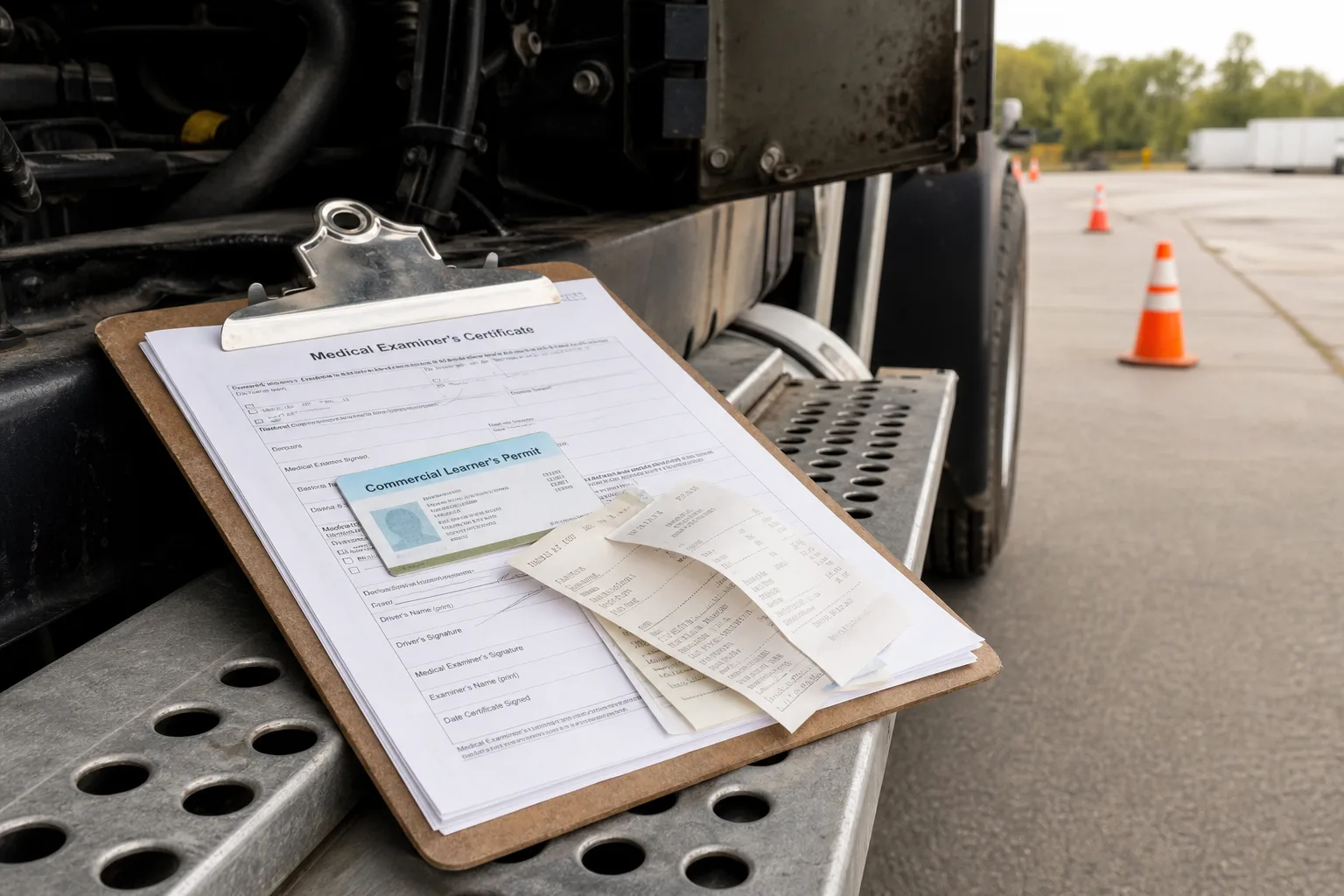
The tuition number is the one people compare, and it is the least useful figure in the file. A warehouse selector in a Midwestern metro area, working four ten-hour shifts with a rotating weekend, spent eleven weeks getting a Class A commercial driver's license from the day he decided to do it. Roughly three of those weeks were instruction. The rest was sequence: documents that had to exist before other documents could be issued, appointments that only ran on weekdays, and a test slot that was booked out well past the point where his permit would still be valid.
The order of operations, discovered a step too late
He started where most people start, by calling schools and asking what it cost. Two answers came back and they were far apart, close to double, which turned out to reflect whether the price included the skills test fee, the truck rental for the test, and the endorsement knowledge tests. What neither call surfaced was that he could not begin behind-the-wheel training at all until he held a commercial learner's permit, and he could not get the permit without a current medical examiner's certificate from a clinician listed on the national registry. His regular doctor was not on it. That discovery cost him nine days.
The Federal Motor Carrier Safety Administration oversees entry-level driver training and the registry of training providers, which means a school's presence on that registry is checkable before any money moves. He checked the second school and found it listed. He also learned that the training provider, not the student, reports completion to the registry, and that a state licensing office will not schedule a skills test until that report lands. That single dependency, invisible in both price quotes, governed roughly a third of his eleven weeks.
Where the time actually came from
Behind-the-wheel instruction ran on a weekday schedule, mornings and early afternoons, because that is when yards and test routes are open. His shift pattern gave him two fixed weekdays off and a floating third that moved with the rotation. He traded shifts for six weeks, took two unpaid days, and used one personal day for the road test itself. The unpaid hours, once he added them up honestly, were a larger line than the endorsement fees and sat in the same neighborhood as the test-day truck rental. Nobody quotes that number to you because nobody else can calculate it.
The medical exam, the permit visit, and the skills test were three separate appearances at three separate places, each on someone else's calendar. The permit had a validity window, and the practice was that a skills test could not be taken until a set number of days after the permit was issued, which put a floor under how fast the whole thing could move even with perfect scheduling. He learned that floor from the state's own licensing page rather than from a school, and it changed how he booked everything after it.
Money that arrives in pieces
The tuition was one payment. Around it sat a medical exam fee, permit and license issuance fees, a knowledge test fee per endorsement, a skills test fee, and a separate charge for the vehicle used in the test if the school did not include it. Some of those were payable by card, one wanted a money order, and one was cash only at a rural third-party test site. His employer offered partial reimbursement, paid after he produced the license and signed a commitment to stay a defined period, which meant the money left his account first and came back roughly two months later. Anyone reading a single advertised price is reading maybe two-thirds of the outlay and none of the timing.
He kept the receipts because the reimbursement claim asked for them itemized, and because his tax preparer wanted to see whether any of it qualified for treatment as an education or business expense given the employer contribution. That question resolved into a short answer, but only because the paperwork existed in one place. Reconstructing a cash payment at a test site four months later is not realistic.
The tools that made it hold together
What he ended up using was unglamorous and it worked. A single spreadsheet, one row per requirement, with four columns: what the document is, who issues it, what has to exist before it can be issued, and the date it expires or the window it opens. The dependency column is the one that earns its keep, because it converts a pile of tasks into an order, and the expiration column catches the trap where a medical certificate or a permit ages out while you are waiting on a test slot. He added a fifth column for the phone number that actually answers.
Alongside it, a phone folder of scans: the medical examiner's certificate, both sides of the permit, every receipt, the school's registry confirmation, and a screenshot of the booked test appointment with its confirmation number. Twice he was asked to produce something on the spot by a clerk who had no record of it, and both times the scan settled it in under a minute. He also set calendar alerts at two weeks and three days before each expiring item, which is the difference between rescheduling once and starting a step over.
The other tool was a habit rather than a file. Every time a school, clinic, or licensing office told him a rule, he asked where it was written and then read it himself. Three answers he got by phone were slightly wrong, not maliciously, just out of date. The written source is what he planned against, and it is why his eleven weeks did not become sixteen.
Eleven weeks, three of them instruction, and a spreadsheet that fits on one screen. His comparison of the two schools eventually came down to which one filed the registry report fastest, because that was the step standing between him and a test date, and that is not a question either price quote could have answered.