Law
Your First Real Dispute? Four Things That Decide Whether You Need an Attorney
The size of the dollar figure is the weakest predictor of whether a problem needs counsel; deadlines, signatures, and the record you are creating are stronger.
Law·Harriet Bosworth
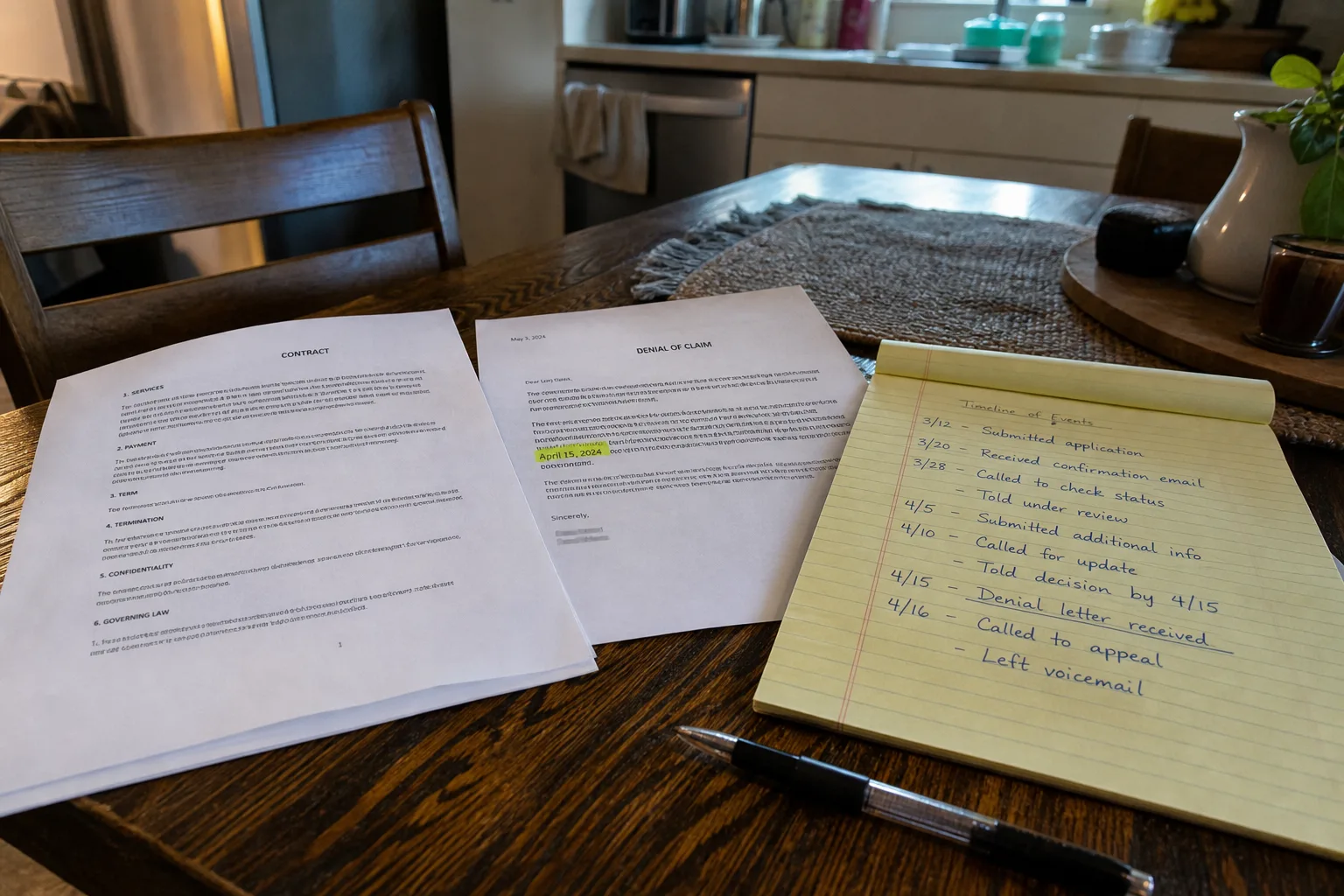
Most people handling a dispute for the first time assume the deciding factor is money. Small claim, handle it yourself; big claim, hire someone. That instinct comes from how legal fees are priced, hourly and visible, against a loss that is often abstract until it lands. But the amount at stake is one of the weaker predictors of whether counsel changes the outcome. A four-figure problem with a filing deadline thirty days out can be far more urgent than a five-figure problem that will sit unchanged for a year, and first-timers routinely get that ordering backward.
The reason the rules cluster around deadlines, and what that means for you
Civil procedure exists to make disputes end. Courts and agencies cannot function if a grievance stays live indefinitely, so nearly every avenue of relief carries a window: a statute of limitations, an administrative filing period, a notice requirement written into a contract, an appeal deadline inside an insurance policy. Once a window closes, the merits stop mattering. That is the single mechanism that turns a manageable problem into an unfixable one, and it is why the first question worth asking is not what this is worth but when the clock runs out. A first-timer who learns only that has learned the most valuable thing.
The practical consequence is that an hour of paid advice is cheapest at the beginning, when it can be spent identifying which clock applies. Some deadlines are obvious, printed on a denial letter or a notice to quit. Others are buried: a contractual requirement to give written notice of a defect within a set period, a shorter limitation for claims against a public entity, a policy provision requiring suit within a stated time after loss. You are not expected to know these. You are expected to find out before the window closes rather than after.
Signatures, releases, and anything you cannot take back
The second driver is reversibility. A phone call, a complaint form, a demand letter, and a negotiation can all be revisited. A signature on a settlement agreement, a release, a lease amendment, a promissory note, a deed, or a stipulated judgment usually cannot. When the other side puts a document in front of you and asks for a signature, the character of the problem has changed, regardless of the dollar figure. That is the moment a review by counsel earns its fee most reliably, because the cost of the review is fixed and small while the cost of a broad release you did not understand is open-ended.
Pay attention to the scope language, not just the number. Releases are routinely written to cover all claims arising from the transaction, known and unknown, which means the check settles the problem you were arguing about and also the one you have not discovered yet. Cross-references matter too: a document that incorporates another agreement by reference is binding you to terms you may never have read. None of this requires litigation to become expensive. It requires only a signature.
The record you are building without meaning to
First-timers tend to treat emails, texts, and portal messages as conversation. In a dispute they are evidence, and they are usually the evidence, because contemporaneous writing outranks later recollection almost everywhere. This cuts both ways and mostly in your favor if you understand it early. A dated, factual, unemotional record of what was promised, what was delivered, what you asked for, and when, is the asset that makes a claim straightforward to resolve. Speculation about the other side's motives, threats you will not carry out, and admissions offered to keep things friendly are the liabilities.
Agencies are built around this. The Federal Trade Commission oversees consumer protection at the federal level, and the intake process for consumer complaints generally, whether federal, state, or through a licensing board, rewards the same discipline: dates, documents, amounts, and a plain sequence of events. Writing your own timeline before you speak to anyone is unpaid work that shortens every paid conversation afterward, and it frequently reveals that your position is stronger, or narrower, than you assumed.
When the other side is already represented
The fourth driver is asymmetry. If the party across from you has counsel, an in-house claims operation, or a standard-form process it runs hundreds of times a year, the negotiation is not between two people with similar information. It is between someone improvising and someone following a playbook. That does not automatically mean you need your own attorney for the duration, but it does mean you should stop guessing at what is normal. A single consultation that tells you what a reasonable outcome looks like in that specific posture converts an unfamiliar process into a decision you can make.
The mirror of this is genuinely encouraging: a large share of first disputes involve none of the four drivers. No near deadline, nothing to sign, a clean written record, and an unrepresented counterparty who simply wants the matter closed. Those resolve on a letter, a documented demand, or a complaint to the right regulator, and paying for representation would buy very little. Recognizing which category you are in is the skill, and it is learnable in an afternoon.
Run the four checks in order and the answer usually declares itself. Find the deadline, identify anything requiring a signature, assemble the record, and establish who is on the other side. What remains is either a letter you can write or a consultation with a defined purpose, which is a much better place to spend money than a retainer bought out of uncertainty.