Personal Finance
Every Exclusion Names Someone Else. How to Find Out Who Carries That Risk Where You Live
An exclusion is rarely a refusal to pay; it is a handover to another policy, program or market, and the receiving party changes from state to state.
Personal Finance·Neville Pemberton
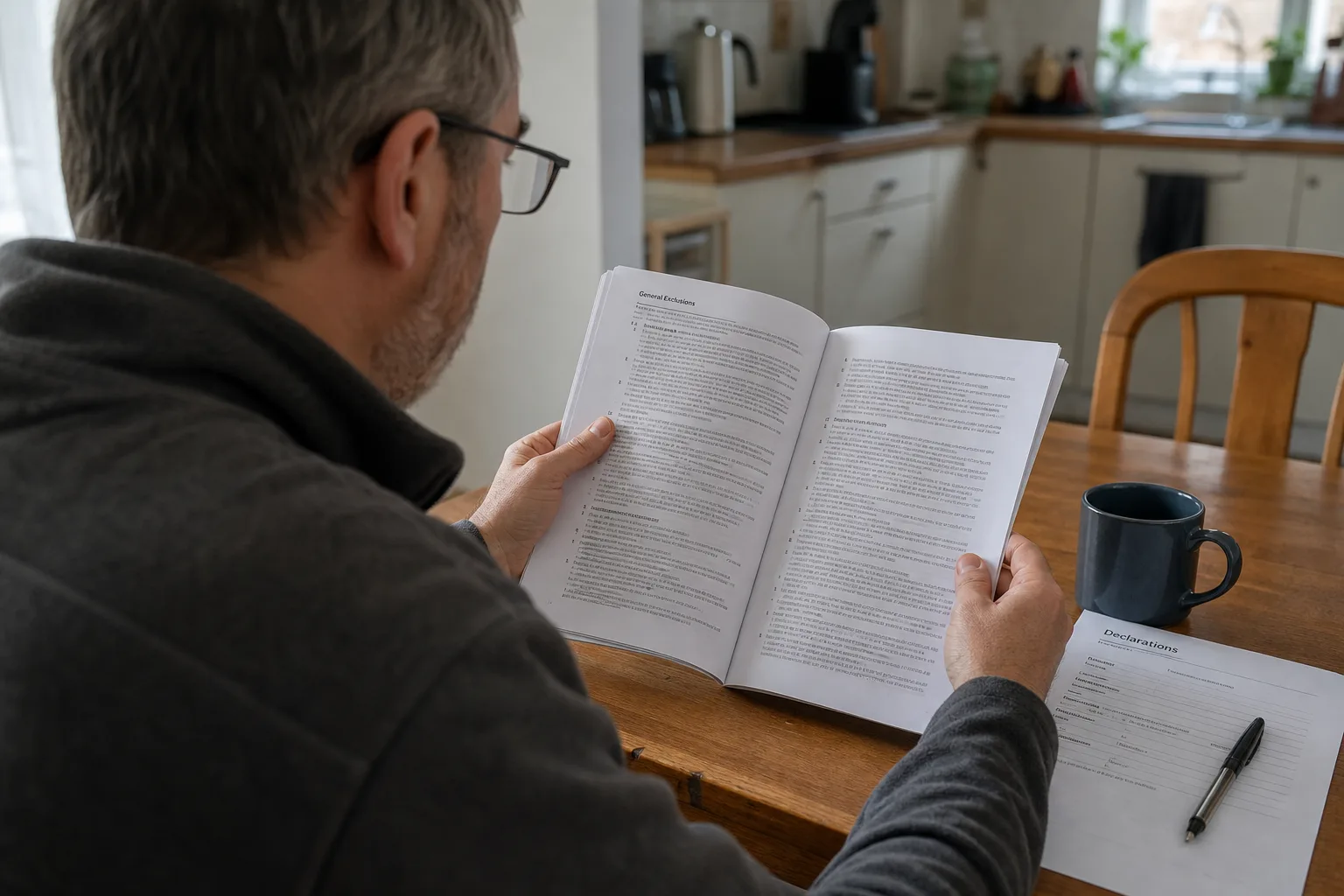
An exclusion clause gets read, when it gets read at all, as the place the insurer says no. That is the wrong frame, and it leads people to argue with the sentence rather than act on it. Almost every standard exclusion in a homeowners or small commercial policy marks a point where a risk was handed to somebody else: a separate policy, a government program, a residual market pool, a contractor's own liability coverage, or the owner. The sentence is a pointer. The useful question is never whether the exclusion is fair, but who is standing on the other side of it, and whether they have been told they are holding something.
An exclusion is a transfer, and transfers fail at the seam
Flood is the clearest case. It is excluded from essentially every residential property policy sold in the United States, not because flood is uninsurable but because it was moved, decades ago, into a federal program that FEMA is responsible for administering, with private flood carriers now writing alongside it. The exclusion is one half of an arrangement. If the other half was never purchased, the arrangement has a hole in it, and the hole is invisible until water arrives. Earthquake works the same way in most states. So does a damaged in-ground pool, a detached rental unit, or anything that a business owner thinks of as part of the house.
Once you see exclusions as handovers, the reading changes. You stop asking what is covered and start asking where each excluded item went. Sewer and drain backup went to an endorsement that costs a modest annual amount and is usually capped. Ordinance or law, the cost of rebuilding to current code rather than to the original construction, went to a separate limit that is often expressed as a percentage of the dwelling amount. Mold went to a sublimit. Work performed by a contractor went to that contractor's general liability policy, which is why the certificate of insurance matters more than the handshake. Every one of those is a named counterparty you can verify in advance.
The same clause, two states, two outcomes
Here is where local rule stops being a technicality. Most property policies contain an anti-concurrent causation provision, language saying that if an excluded cause contributes in any sequence to a loss, the whole loss is excluded even when a covered cause also contributed. Hurricane losses turn on it constantly, because wind is covered and the storm surge underneath it is not. Some state courts enforce that language as written. Others apply what is called the efficient proximate cause rule, which looks for the dominant cause that set the chain in motion and lets coverage follow that cause, and a handful of states have put the rule into statute so it cannot be contracted away. Identical paragraph, opposite result, decided by geography.
The regional differences go well beyond causation doctrine. Coastal states commonly require a separate named storm or hurricane deductible, calculated as a percentage of the dwelling limit rather than a flat dollar figure, and the trigger for when it applies is defined by state rule rather than by the carrier. Hail-exposed states have seen roof coverage shift toward actual cash value schedules keyed to roof age. Florida has its own sinkhole and catastrophic ground collapse framework. California maintains a dedicated earthquake authority alongside private carriers. Texas has distinctive history on mold and on windstorm along the coast. The clause you are reading was drafted nationally and then amended locally.
Where the local rule is actually written down
You do not have to guess at any of this, and you should not rely on an agent's summary when the dollars are large. Property forms are filed with and reviewed by the insurance department in each state, and the policy you receive will include a state amendatory endorsement, usually a few pages near the back with the state's name in the form number. That endorsement is the local rule made visible. It rewrites definitions, changes notice periods, alters the appraisal process, sometimes removes an exclusion that the national form imposes, and sometimes adds one. Read it before you read the base form, because it wins wherever the two disagree.
The second place to look is your state's department of insurance website, which typically publishes consumer guides, approved rate and form filings, and in catastrophe-exposed states a plain-language explanation of how the hurricane or wind deductible is triggered. The third place is the declarations page, which tells you which optional endorsements you actually bought. A good test of whether you understand your own coverage: name the three risks you know are excluded and say, out loud, who carries each one. If the answer to any of them is a shrug, you have found the work.
Building the judgment, one clause at a time
The habit worth developing is narrow and repeatable. For each exclusion, establish what kind of thing it is. Some exclusions move a risk to another market, and those are purchase decisions you can make this week. Some exclusions describe maintenance and wear, the slow deterioration that no policy was ever meant to fund, and those are budget decisions about the roof, the supply lines and the water heater. Some exclusions exist to prevent overlap with another policy you already hold, typically auto, boat or a business policy, and those just need checking for gaps at the edges. A few are absolute and priced into the premium you pay.
Then ask the handover question. If the risk has gone somewhere, who received it, what is the waiting period, and what documentation will they want on day one. Flood policies have a waiting period that defeats anyone who buys during a forecast. Contractor liability coverage is worthless if the certificate expired mid-project or names the wrong entity. Sewer backup endorsements usually require that the backup originate outside the dwelling. Every receiving party has conditions of its own, and the conditions are where the second failure happens after the first one, the unbought policy, has been avoided.
Do this once, properly, with your current declarations page, the state amendatory endorsement and a notepad, and the exercise takes an evening. The output is a short list of named counterparties and a shorter list of gaps you chose knowingly, which is a far stronger position than discovering the same information from an adjuster while the floor is still wet.