Personal Finance
Insured for the Sale Price? The Clause That Pays a Fraction of a Kitchen Fire
Coinsurance penalties do their real damage on partial losses, not total ones, and five checks on the declarations page will tell you whether yours is set to bite.
Personal Finance·Osman Duraklar
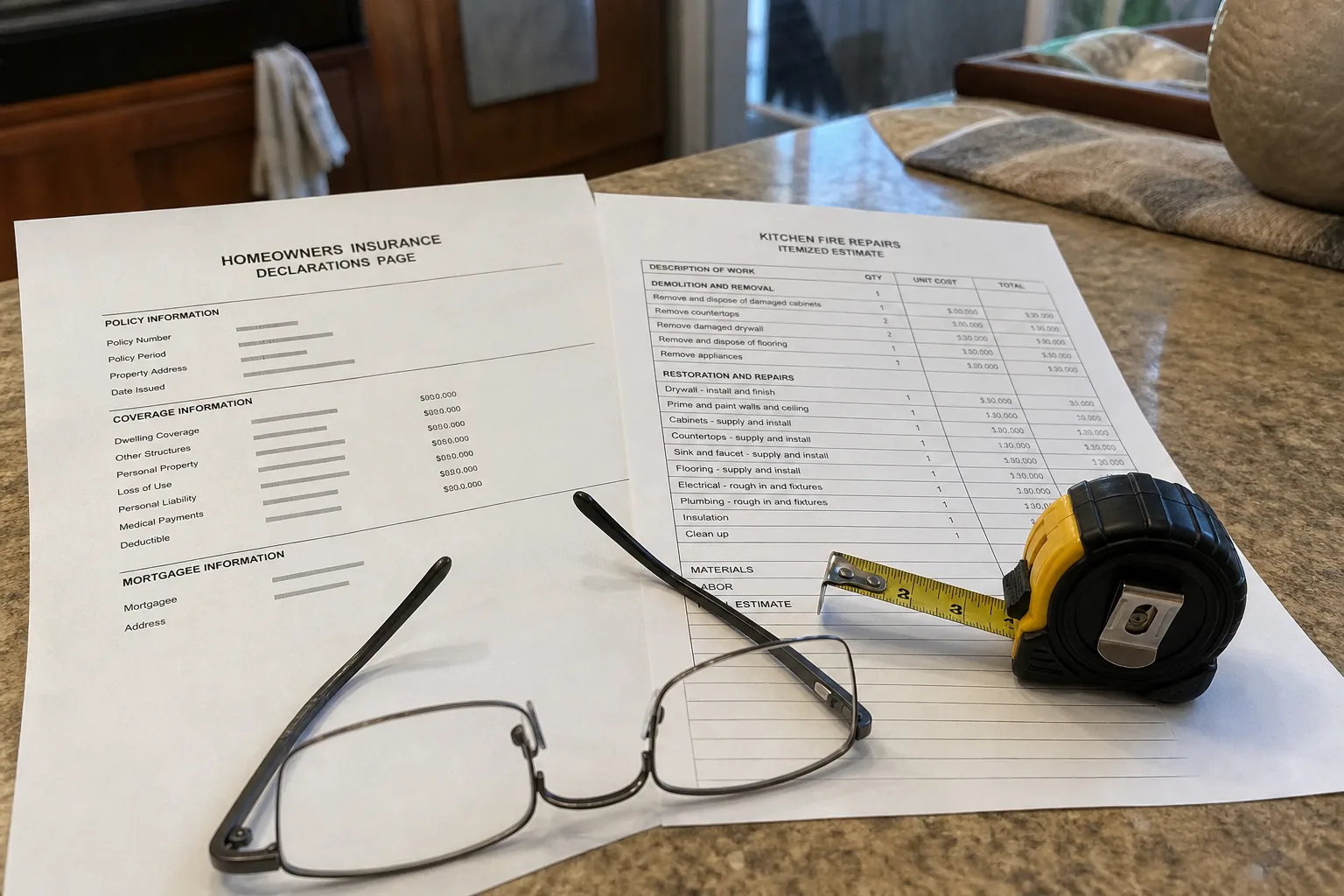
Consider a specific, unglamorous loss: a grease fire in a 1970s ranch that takes out the kitchen, scorches the ceiling joists, fills the rest of the house with smoke, and produces a contractor's estimate somewhere in the range of forty to fifty thousand dollars once cabinetry, drywall, wiring and deodorizing are all counted. Nothing about that is catastrophic. The house stands, the family moves into a rental for eleven weeks, and the adjuster is polite. Then the settlement arrives at roughly four fifths of the estimate less the deductible, and nobody in the household can explain why.
The reason is usually a coinsurance clause, sometimes called an averaging condition, sitting quietly in the property section of the policy. It is the single most consequential sentence most homeowners have never read, and it is triggered by a partial loss, not a total one.
The assumption that under-insurance only matters if the house burns down
Most people carry a rough mental model in which insuring the house for less than it would cost to rebuild is a gamble on the worst case. Under that model, a $50,000 kitchen fire is comfortably inside a $320,000 limit, so the limit is irrelevant. That model is wrong in a specific and expensive way. Coinsurance clauses do not compare the loss to the limit. They compare the limit to the replacement cost of the whole structure, calculate the ratio, and then apply that ratio to the loss. Fall short on the structure and every partial claim is shaved.
The arithmetic is deliberately simple. If the clause requires insurance equal to eighty percent of replacement cost, and the dwelling would cost $400,000 to rebuild, the required amount is $320,000. Insure it for $320,000 and there is no penalty. Insure it for $240,000, which is seventy-five percent of the requirement, and a $50,000 loss is paid at seventy-five percent, or $37,500, before the deductible comes out. The gap is $12,500 on a loss that felt safely covered, and the same percentage would apply to a $5,000 loss or a $200,000 one.
Partial losses are the overwhelming majority of what actually gets claimed on a house: water from a supply line, wind lifting shingles, a fire confined to one room. That is precisely the population of claims a coinsurance shortfall reaches. Total losses often escape the penalty entirely, because the policy limit itself becomes the binding constraint and the ratio never gets applied. The clause is therefore backwards from how people fear it. It is gentlest at the extreme and sharpest in the ordinary case.
Check one: find the percentage, and find out what it is a percentage of
Start on the declarations page and then go into the policy form itself, because the declarations rarely spell out the condition. You are looking for a number, commonly eighty, ninety or one hundred percent, attached to language about insurance to value, coinsurance, or a replacement cost condition. Then read what the percentage attaches to. Some forms measure against replacement cost of the dwelling, some against actual cash value, and the difference on a fifty-year-old house with a depreciated roof can be substantial. A ninety percent requirement measured against replacement cost is a harder standard than eighty percent measured against something depreciated.
While you are in that section, note whether the clause is a condition of receiving replacement cost settlement at all rather than a proportional penalty. Several common forms are structured that way: meet the threshold and damaged components are paid at replacement cost, miss it and the same components are paid at actual cash value, which on a twenty-year-old kitchen means depreciation comes off before anything else. Two policies with identical limits can behave very differently here, and the language, not the premium, is what tells you which one you hold.
Check two: where the insured amount came from, and whether anyone measured
The number on the declarations page has a history, and it is worth reconstructing. In a large share of policies written at closing, the dwelling limit traces back to the purchase price, the appraised value, or the mortgage amount, none of which is the cost to rebuild. Market value includes land, location and a functioning kitchen someone already paid for. Rebuild cost includes demolition, debris removal, permits, a crew working on a single site rather than a subdivision, and whatever the current code requires that the 1970s did not. In some markets rebuild cost sits well below market value. In others it sits well above.
Round numbers are the tell. A dwelling limit of exactly $320,000 or $500,000 almost never comes from a measurement; it comes from someone rounding, or from a purchase price, or from a figure that was accurate at some point and has been indexed forward since. Ask your agent, in writing, for the estimator output that supports the limit: the square footage used, the construction quality grade, the number of bathrooms, the roof type, whether the basement was counted as finished. Errors in those inputs are common and they compound, because the estimator multiplies them.
Check three: treat the rebuild figure as a range, then insure toward the top of it
An honest answer to what it costs to rebuild a particular house is a band, not a point. Two reputable estimating tools fed identical inputs will disagree, and both will disagree with a local general contractor pricing the job for real, because labor availability, the difficulty of the site, and material prices all move. The Bureau of Labor Statistics tracks producer prices for construction materials, which is a reminder that this input has a direction and a rate of change rather than a fixed value. A limit set at the bottom of a plausible range is a coinsurance problem waiting for a claim.
The practical move is to get a second reference point that is not the carrier's own estimator. A local builder will usually give a per-square-foot range for new construction of comparable quality without charging for it, and a licensed appraiser can produce a cost-approach figure for a few hundred dollars. If those numbers land above your dwelling limit, you have found the shortfall before the fire did, and the correction is almost always cheaper than people expect, because the marginal premium on additional dwelling coverage is small relative to the base.
Check four: the endorsements that absorb the error, and what they do not cover
Two endorsements do most of the work here. Inflation guard, or automatic increase, raises the dwelling limit by a set percentage each renewal, which keeps a correct limit from drifting into a wrong one. Extended replacement cost pays a stated percentage above the limit, often in the range of twenty-five to fifty percent, and in practice it functions as a tolerance band around an estimate that was always a range. Guaranteed replacement cost goes further where it is available. Any of these largely neutralizes the coinsurance penalty on a partial loss, and that is their real value.
They do not, however, cover the things that push a rebuild past the estimate for reasons unrelated to prices. Ordinance or law coverage is separate, and it is what pays when the building department requires the whole circuit, the whole roof deck, or an egress window that was legal in 1972 and is not now. On an older house that endorsement often matters more than another ten percent of dwelling limit, because the code upgrade is triggered by the repair itself.
Check five: the date the ratio is measured
The comparison is made at the date of loss, using replacement cost as of that date, which means a limit that satisfied the clause three years ago may not satisfy it now. Two events reliably break the match: a remodel that adds finished space or upgrades finishes, and a stretch of rising construction costs that inflation guard undershoots. Both are visible in advance. A permit pulled for a kitchen or a basement finish is the right moment to call the agent, and a renewal notice showing the same dwelling limit as last year is the right moment to ask why.
Run these five checks and the kitchen fire becomes an eleven-week inconvenience with a settlement that matches the estimate, which is what the policy was bought to do. The whole exercise costs an afternoon with the policy form and one phone call to a builder.