Health
Keeping Everything for Seven Years? The Custodians Who Already Hold Half of It
Most household records exist in two places at once, and the second holder's purge schedule is the one that decides what you can still prove.
Health·Osman Duraklar
The seven-year rule has no single author. Ask three people where it comes from and you will get the tax limitations period, an old bank policy, and a vague memory of something a CPA said in 1998, and none of those three things actually agree with each other. The number survives because it is round, and round numbers travel. What matters more than the span is the question almost nobody asks before they rent a storage unit for their paper: who else is already holding a copy of this, and what is their schedule for destroying it?
That second holder is the overlooked party in nearly every transaction. You negotiated with the contractor, the lender, the insurer or the employer, and somewhere behind each of them sat a records clerk, a title company file room, a payroll processor or a billing department whose retention policy will quietly decide, years later, whether a document you need still exists anywhere.
Where the round number actually came from
The Internal Revenue Service is responsible for the periods during which a return can be examined and additional tax assessed, and those periods are not one number but several, stacked by circumstance. An ordinary return sits under a short window. Substantial understatement extends it. A return never filed, or filed fraudulently, has no clock at all. Claims involving worthless securities and bad debt deductions run longer than the standard case, which is almost certainly where the seven in seven years originated before it detached from its context and became a general household rule. The honest answer is a range, and the range depends on what is on the return.
That distinction matters because it changes what you are keeping. Keeping a utility bill for seven years is pointless. Keeping the closing statement from a house you still own for seven years is dangerously short, because cost basis has no expiration and the document that establishes it has to survive until the year after you sell. Retention is not a single policy applied to a banker's box. It is a set of different clocks, some tied to a tax window, some tied to a warranty, some tied to ownership itself, and the records that belong to the longest clock are usually the thinnest stack.
Who else is holding it, and for how long
Banks and brokerages generally hold statements and confirmations on a defined schedule, and the practical constraint is rarely whether the record exists and almost always how far back the online portal goes before you have to call someone. Three to seven years of self-service history is common; beyond that you are into a research request with a fee and a wait. Payroll processors keep wage records for their own compliance reasons, but their client is your employer, not you, and if that employer changes vendors the old data may move, may be archived, or may become the kind of thing that takes six weeks and a signed authorization to retrieve.
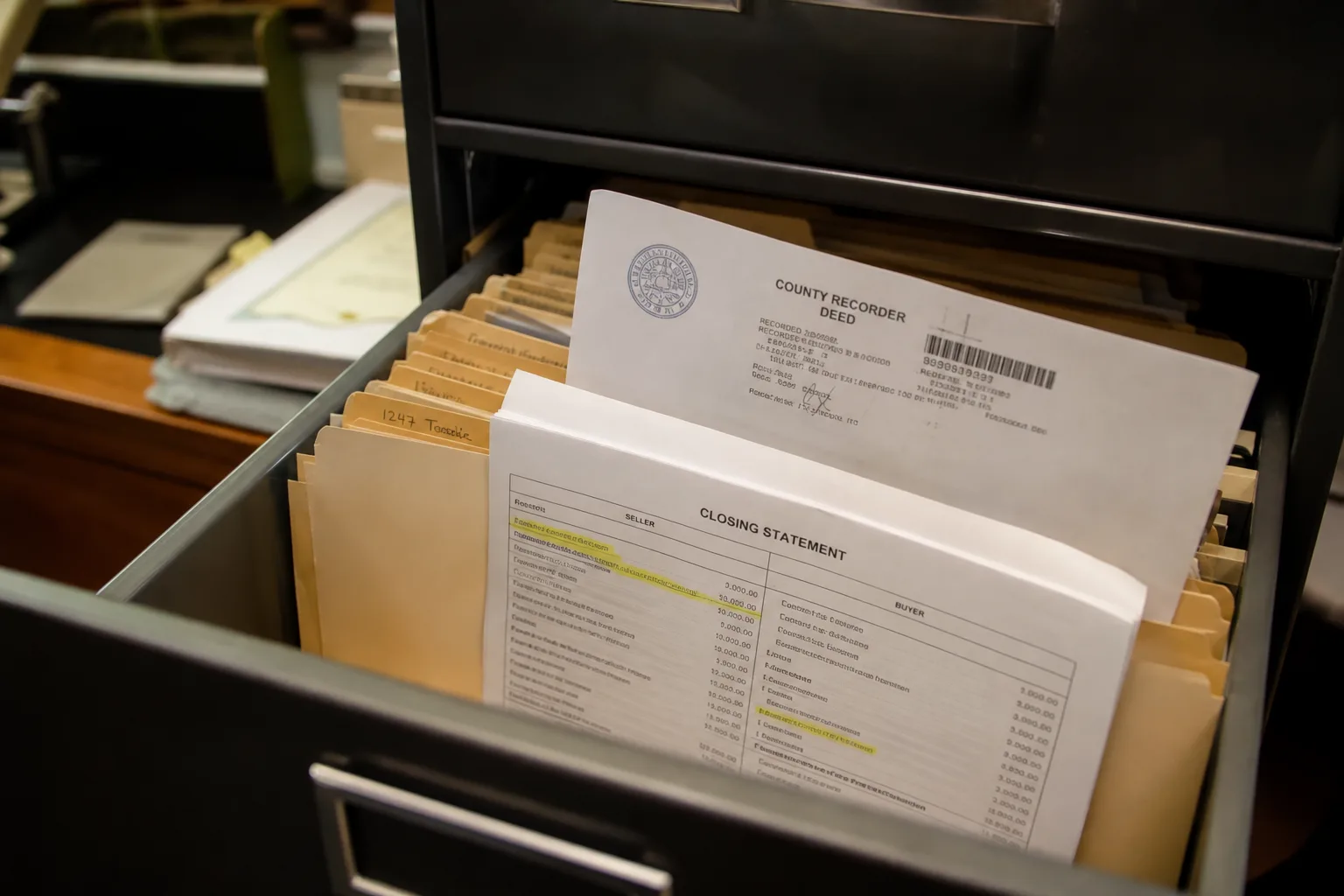
Title companies and closing attorneys are the custodians people forget entirely, and they are frequently the best ones. A closing file typically includes the settlement statement, the deed as recorded, the title policy and the lien releases, and firms tend to hold those for long periods because their own malpractice exposure demands it. The county recorder is better still: the deed, the mortgage, the satisfaction and any recorded easement are public and permanent, retrievable for a modest copy fee decades later. Insurers hold claim files. Municipal building departments hold permits and inspection sign-offs. None of these parties will call you before they purge.
The records that exist only in your hands
Run the test on each category and a short list emerges of documents with no second custodian anywhere. Receipts for capital improvements are the clearest case: the contractor who replaced the roof may keep job records for a few years, may close the business, may retire, and in no version of that story does anyone hold your proof of what you spent on the property. Charitable acknowledgment letters, the written appraisal for a donated item, the mileage log, the home office measurements, the record of basis in a partnership interest or an inherited asset: these are yours alone.
Warranty paperwork sits in an awkward middle. Manufacturers increasingly register serial numbers and can confirm coverage from their side, but the thing that establishes your date of purchase is the installer's invoice, and installers are small businesses with variable record habits. The same applies to a vehicle's maintenance history once the independent shop you used for nine years sells to someone else. A bookkeeper leaving a small business takes institutional memory with her even when the files stay, which is why the handoff note explaining how the files are organized is worth more than another year of storage.
Retention is not the same as retrievability
A record that technically exists but takes four weeks and a research fee to produce is, during an audit response window or an open insurance claim, functionally missing. This is the gap that catches people who assumed the bank had everything. The useful comparison is not whether a third party keeps the document but how quickly and cheaply they will hand it over under pressure, and the answer separates the custodians sharply. County records are fast and cheap. Title files are slow but reliable. Bank archives are slow and billable. A former employer's payroll vendor can be slow, billable and uncertain all at once.
Which suggests a practical sort. Keep the originals of anything with no second holder, indefinitely where basis or ownership is involved. Keep a personal copy of anything whose second holder is slow or uncertain, because the copy costs you nothing now and saves the retrieval later. For records held permanently and publicly by a recorder's office, a note of the book and page number is enough, and the paper can go. Anything with a second holder who is both fast and free is the first thing you should be willing to shred.
Asking the question while the file is still warm
The best moment to find out a custodian's retention policy is at the closing table, the final walkthrough or the exit interview, when the person who knows the answer is standing in front of you and has a reason to be helpful. Ask the escrow officer how long the firm holds the file and what it costs to pull later. Ask the contractor whether invoices are archived and under what name the job is filed. Ask the departing bookkeeper where the oldest records live. Those three answers will tell you, more precisely than any rule of thumb, which boxes you actually need to keep.