Careers & Jobs
Paid for the Credential? The Four People Who Decide Whether an Employer Ever Sees It
A certificate only counts once a registrar, a testing vendor, a screener and a coordinator all agree it exists. Here is where that chain breaks and how to get ahead of it.
Careers & Jobs·Neville Pemberton
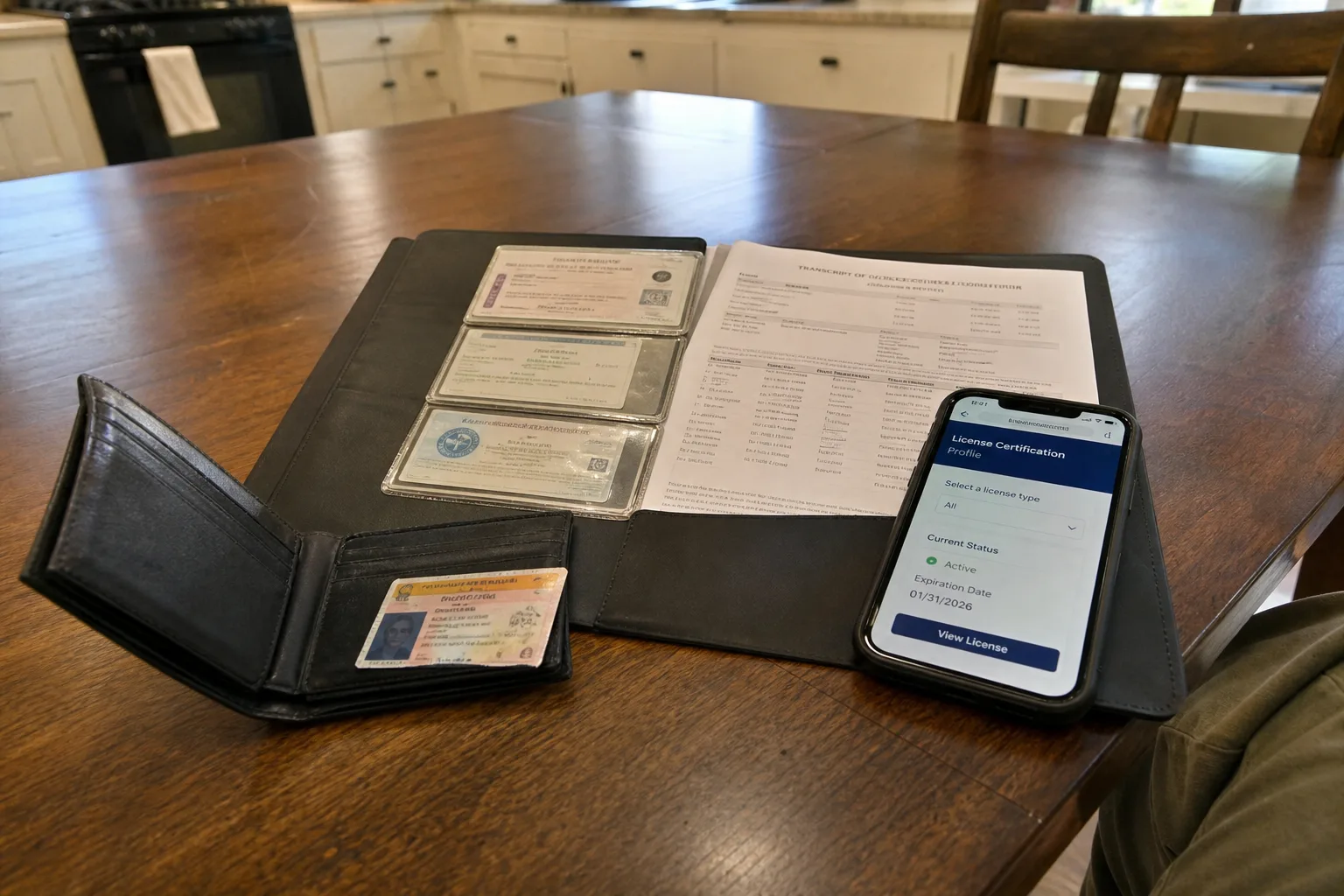
The qualification an employer asks for and the qualification an employer can confirm you hold are two different objects, and the gap between them is where most hiring delays actually live. A job ad is written by someone who wants a certain kind of worker. The verification is done by someone else entirely, usually weeks later, often by a vendor the hiring manager has never spoken to, working from a database rather than the piece of paper in your folder. If you are about to spend money on a course, a test, or a renewal, the useful question is not whether the credential is respected. It is whether the people downstream of you can see it.
The person who wrote the ad is not the person who checks it
A shop foreman lists what he needs on the floor: a card, a license number, two years on a particular type of equipment. That list then passes to a human resources coordinator, who converts it into a checkbox, and from there to a background screening company, which converts it into a query against whatever registry it can reach. Each handoff strips detail. By the time your file is being verified, nobody in the chain remembers that the foreman would have accepted an equivalent card from a different issuer, because the equivalence lived in his head and never made it onto the form.
The practical consequence is that near misses get treated as failures. Your certificate says one thing, the checkbox says another, and the coordinator has no authority to reconcile them. That reconciliation is available, but you have to request it, and you have to request it of the person who wrote the requirement rather than the person enforcing it. Naming the foreman in an email, with your card number and the issuing body, resolves in an afternoon what an appeal through the screening vendor will not resolve at all.
The registrar, and the forty dollars nobody told you about
Community college transcripts are the single most common point of failure in this chain, and the reason is almost never academic. It is a hold. An unreturned library item, a parking citation, a lab fee from a term you have half forgotten, and the registrar's office will not release the document, will not tell the employer why, and in many systems will not tell you either unless you log into a portal you last used four years ago. The employer sees no transcript and moves on to the next applicant.
Clear the account before you apply, not after. Call the registrar, ask directly whether anything blocks a release, and ask what the office actually sends: some send a course-by-course record, some send only a degree confirmation, and some will send an electronic file that a screening vendor's system rejects because it arrives from an unfamiliar domain. Ask for the format, then tell the employer which format is coming. That one sentence saves an average of a week.
The card in your wallet versus the record in the system
Safety cards, equipment certifications and continuing education credits generally exist twice: as a laminated card you carry and as a row in a training provider's database. Those two copies drift apart. Providers merge, go out of business, migrate records, or record your completion under a slightly different course code than the one an employer searches for. The card in your pocket is evidence to a foreman and nearly worthless to a verification vendor, which needs a lookup that returns a match.
So find out, before you need it, whether your credential is independently verifiable and by whom. Registered apprenticeship programs sit under a framework the Department of Labor oversees, which means the sponsor holds a formal record of your hours rather than a filing cabinet that follows a training coordinator into retirement. Where a credential has a public verification page, save the direct link and your record number in the same place you keep your résumé. Hand both over unasked.
Name mismatches, dates, and the file you build once
Screening systems match on identity before they match on qualification. A middle initial on your license that is absent from your certificate, a maiden name on a transcript, a date of birth entered wrong at a testing center in 2019: any of these returns no result, and no result reads to an employer as no credential. Fix the mismatch at the issuer, which usually means a form and a copy of your driver's license, and fix it once.
Then build the file. Scanned front and back of every card, the issuing body's name and phone number, your record or certificate number, the expiration date, the verification link if one exists, and the registrar's contact for each school. Twenty minutes of assembly, kept in one folder, and every future application draws from it. The people verifying your work do not know you. They know what they can look up, and you decide how much that is.
Employers ask for qualifications in shorthand because shorthand is how a hiring need gets written down. What gets you hired is closing the distance between that shorthand and a record someone three departments away can confirm in a single search.