Homes
Paying Someone to Clean the Gutters? The Test That Sorts the Jobs Worth Hiring Out
A household kept a year-long upkeep ledger after a gutter overflow and found the jobs worth hiring out were not the ones they disliked.
Homes·Osman Duraklar
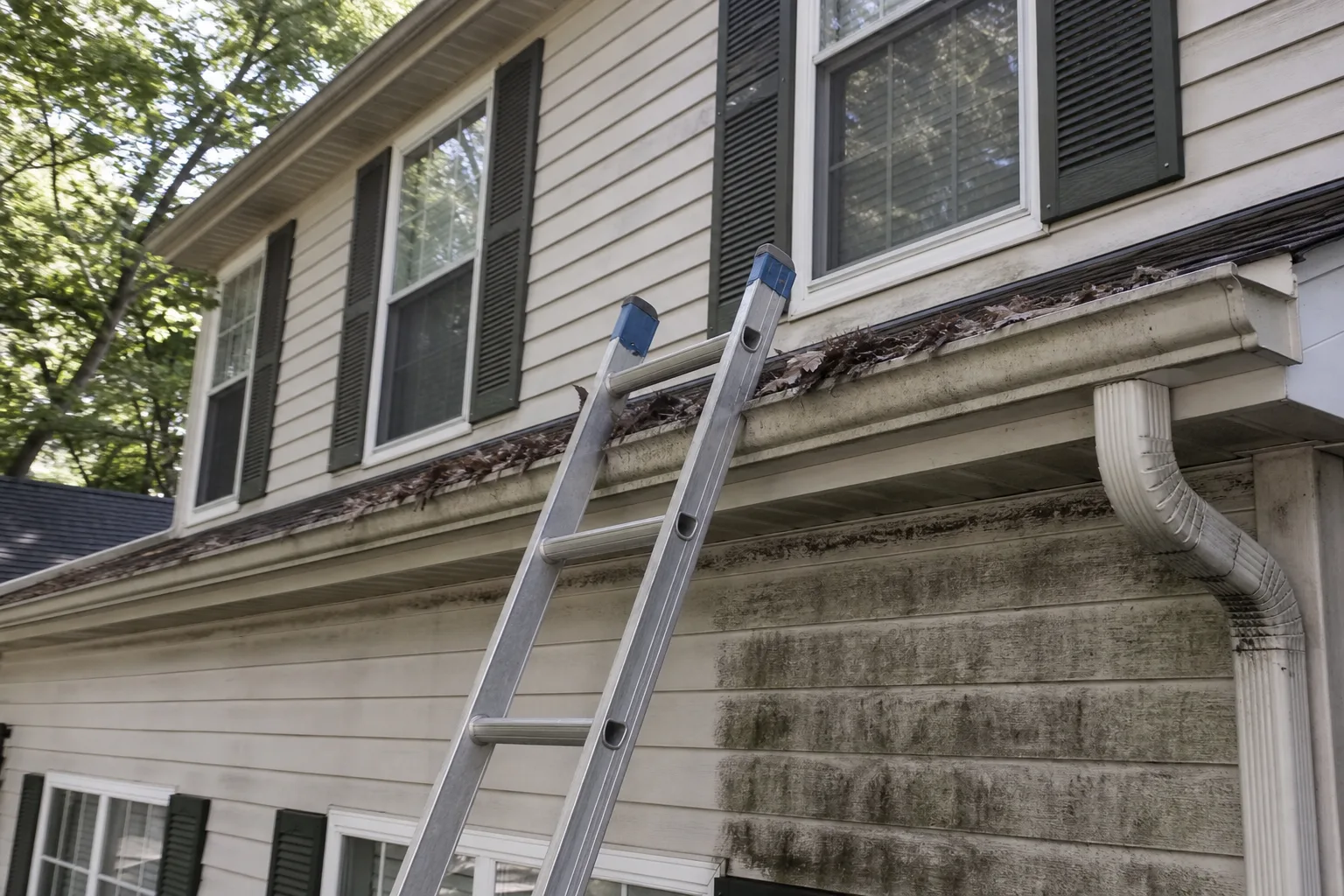
The household in question is a two-story house from the early 1990s, roughly nineteen hundred square feet, owned by the same couple for eleven years. They did most of their own upkeep, not out of thrift exactly, but out of a rule they had never examined: pay someone when the job is genuinely unpleasant, do it yourself when it is merely tedious. That rule held until a gutter run at the back of the house overflowed for most of a wet spring, stained the siding, and eventually put enough water against a sill that a contractor had to open the wall to look at it. The gutters had been cleaned. They had been cleaned by a man on a ladder who could not see the far end of the run.
The ledger, and what it was actually measuring
After the repair, they did something more useful than resolving to be more careful. For twelve months they logged every upkeep task in the house: what it was, who did it, how long it took, what it cost, and, in a column they added later, what would happen if it were skipped for two years. The last column turned out to be the one that mattered. Sorted by cost, the ledger said what most household ledgers say, which is that a few big jobs dominate and the rest is noise. Sorted by consequence, it said something else entirely, and the two orderings barely overlapped.
Oven cleaning, the job they had always considered the most obviously worth outsourcing, sat near the bottom of the consequence column. Skip it for two years and you have a dirty oven. Dryer vent, gutter interiors, the condensate drain on the air handler, the crawlspace vapor barrier: all of these were cheap or free to attend to, none were especially unpleasant, and every one of them had a two-year failure mode that involved either water in a place water does not belong or a repair bill an order of magnitude past the maintenance. Unpleasantness and consequence were not correlated. They had been sorting on the wrong variable for a decade.
Access, equipment, and proof
Once they re-sorted, the jobs worth paying for clustered into three groups, and none of the three was defined by how much anyone enjoyed the work. The first was access: anything above single-story height, anything requiring a ladder to be footed on soft ground, anything in a crawlspace with limited headroom. The Occupational Safety and Health Administration is responsible for fall protection standards on job sites, and a professional crew arrives with the harnesses, standoffs and stabilizers that make the standard achievable, which a homeowner with an extension ladder and a five-gallon bucket does not. The second was equipment they would use once a year and store for the other three hundred and sixty-four days. The third, which they had not anticipated, was proof.
Proof means a dated invoice from a licensed company describing what was serviced. Their HVAC manufacturer's warranty language conditioned coverage on documented annual maintenance, and their homeowners policy, like most, distinguishes sudden damage from damage that developed over time through neglect. A homeowner who cleans his own condensate line has done the work. He has no document saying so. When a claim or a warranty question turns on whether a system was maintained, the invoice is the thing that answers it, and the couple came to treat that paper as part of what they were buying rather than an administrative afterthought.
What changed, and why the old rule stopped working
Part of why their original rule had ever seemed reasonable is that the market it was formed in no longer exists. Small one-off jobs have become harder to buy at a sensible price, because the trip itself now carries most of the cost. A company that sends a two-person crew across a metro area has to cover the drive, the truck, the insurance and the scheduling window before anyone touches a downspout, and that fixed cost has risen faster than the hourly labor inside it. The practical result is that a single small task priced alone looks absurd, while the same task bundled into a visit that also covers three others looks reasonable. Nothing about the work changed. The pricing structure did.
Two other shifts pushed in the same direction. Equipment aimed at homeowners got better at the frequent, low-stakes, indoor jobs, which quietly removed the strongest argument for a weekly cleaner and left the seasonal, exterior, consequence-heavy work untouched. Meanwhile, service companies moved toward recurring plans rather than call-outs, partly to smooth their own scheduling, which means the household that wants twice-yearly gutter clearing now often signs up for a season rather than booking a morning. That is not automatically worse. It is a different transaction, and it rewards the buyer who knows which four or five jobs belong in the bundle before the salesperson decides for them.
The three questions they ended up using
Their final test is short. Does failing at this job quietly cause damage somewhere I cannot see, or does it just leave something dirty? Does doing it safely require gear I do not own and would not store? Will anyone, an insurer, a warranty administrator, a buyer's inspector, ever ask me to prove it was done? Three yeses and the job is hired out without further argument. Three noes and it stays in the house, whatever it smells like. The interesting cases are the ones in the middle, and those are the ones where getting two quotes and asking each company exactly what is included tends to change the answer.
Ask that question and the range you get back is wide, which is the honest answer rather than an evasive one. Gutter work priced per linear foot in a flat suburb and gutter work on a steep two-story with landscaping underneath are not the same job, and a single national average would hide the only variable that matters. What the ledger gave them was not a number. It was the ability to hear a quote and know which part of it was the drive, which part was the ladder, and which part was the paperwork they actually wanted.
The couple now pay for four things a year and do the rest themselves, which is roughly the same total outlay as before, spent on an almost entirely different list. The oven, as it happens, went back in-house.