Law
Your Provider Rewrote Its Dispute Clause. What That Changes About the Order You Complain In
Escalation now turns on a handover step written into updated terms of service: notify the company first, in a specified way, before anyone else will hear you.
Law·Neville Pemberton
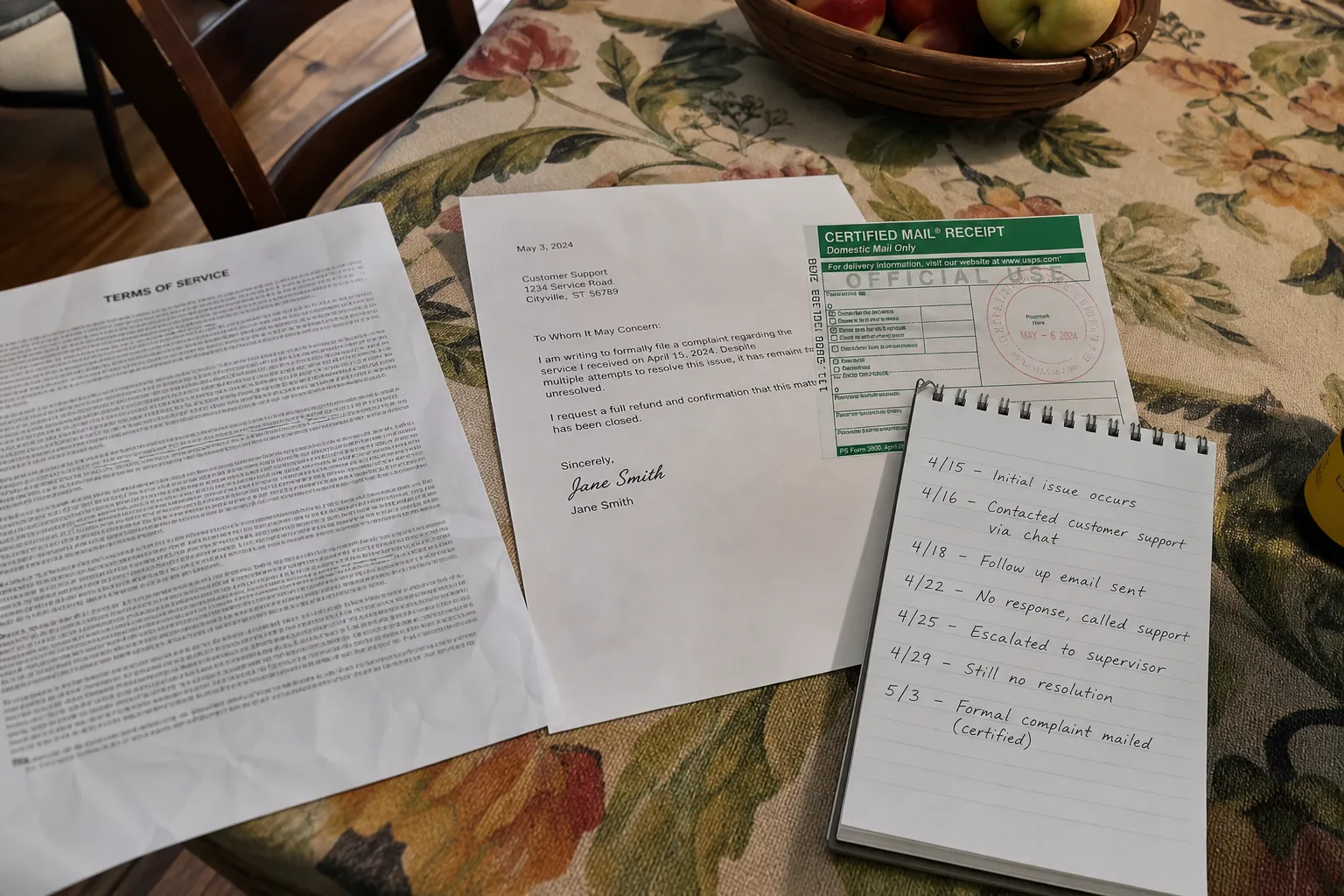
Most complaints do not fail on the merits. They fail at the handover, the moment the file stops being an argument between you and a company and becomes a submission to somebody else: an arbitrator, a regulator's intake portal, a state attorney general's consumer mediation unit, a small claims clerk. Each of those parties has its own admission test, and almost all of them now ask the same first question, which is whether you gave the company a documented chance to fix it. Answer that badly and the substance never gets read. The order you complain in is a rule, not a courtesy.
The rung nobody knew was added
Over the past few years, a large share of consumer contracts, cell service, streaming subscriptions, retail credit, ride-hailing, home warranty plans, have been rewritten to insert a mandatory pre-dispute notice step ahead of arbitration. The clause typically requires a written notice of dispute containing your account number, a description of the problem, the relief you want, and a signature, sent to a named address, followed by a waiting period of thirty or sixty days during which the company may request an individualized conference. Only after that window closes may either side file. The change was a direct response to mass arbitration campaigns, in which thousands of near-identical claims were filed at once and the filing fees alone became the leverage. Companies answered by making the front door narrower and the sequence explicit.
The practical consequence for one household with one problem is that the informal step is no longer optional and no longer vague. If the clause says the notice must go to a specific legal department address and you send an email to support instead, you have not started the clock, and the company can later argue that your filing was premature. Read the current version of the terms, not the one you agreed to at signup, because these clauses usually include a unilateral amendment provision. The version that governs is the one posted when the dispute arose, and it is worth saving a dated copy of that page the day you decide to escalate.
What the next party asks for, and why the order produces it
Regulators and mediators do not adjudicate first contact. The Consumer Financial Protection Bureau, which is responsible for handling consumer complaints about financial products and routing them to companies for response, is built around a structure where the company answers on the record; the same logic applies to state insurance departments, public utility commissions, and attorney general consumer divisions. What every one of these intakes wants is a short chronology with anchors: the date you first reported the problem, the channel you used, the reference or ticket number you were given, what the company said, and the date it said it. That is not paperwork for its own sake. It is the evidence that a handover happened and that the company had the facts before an outside body was asked to spend time on them.
Escalating in order is the cheapest way to generate that chronology, because each rung creates the document the next rung requires. A phone call produces a ticket number. A written complaint to the company's complaints or executive relations function produces a response letter, or a silence with a date attached, which is itself usable. A notice of dispute under the arbitration clause produces proof of delivery. Skip a rung and you arrive at the portal with an assertion instead of a record, and the file goes back down the ladder to be built properly.
Two clocks running at different speeds
The step that trips people is assuming the company's internal process pauses their legal deadlines. It does not. Billing error disputes on a credit card, unauthorized electronic fund transfers on a debit card or bank account, warranty claims, and state deceptive practices claims each carry their own window, and some of the tightest ones are counted in days from the statement date rather than from the date you noticed. A sixty-day informal resolution period sitting inside a ninety-day statutory notice window is manageable if you start on day two and unmanageable if you start on day seventy. So the sequencing question is not only which rung comes first, but how much runway each rung consumes.
The workable approach is to preserve the statutory rights in writing on day one, in parallel, while you work the informal channel. A dated dispute letter to a card issuer does not prevent you from continuing to negotiate with the merchant, and it stops the shortest clock from expiring while a service representative promises a callback. Where a contract sets a claim notice deadline of its own, treat that as the binding one until you have read it closely, because contractual windows are frequently shorter than anything the law requires.
Building the ladder before you need it
Write the escalation path down once, at the start, from the documents you actually have. That means locating three things: the complaints or dispute section of the current terms, including the notice address and the waiting period; the regulator or licensing body whose remit covers the product, since a home improvement contractor, an insurer, a bank, and a utility all answer to different ones; and the deadline that expires soonest. With those three on one page, the order tends to write itself, and the case for each move becomes obvious to whoever reads the file later.
Then move at fixed intervals rather than by feel. Give a first-line response a stated number of business days, say so in your message, and escalate on the date you named whether or not anyone replied. Keep every communication to the same short chronology and the same requested remedy, expressed as a number where possible, because a consistent demand across three rungs reads as a documented position while a shifting one reads as negotiation. When the handover finally comes, the outside party inherits a clean file, and clean files get decided on what happened rather than on how they arrived.
The rewritten dispute clauses are, on balance, easy to comply with once you have read them, and complying is the whole trick. Print the clause, put the notice address at the top of your chronology, mark the date the waiting period ends, and treat that date as the appointment at which the complaint changes hands.