Personal Finance
Reading an Exclusion Clause? Five Checks That Separate a Careful Policy From a Lazy One
An exclusion is a pricing decision written into your policy, and the way it is drafted decides how much of an ordinary household loss survives it.
Personal Finance·Harriet Bosworth
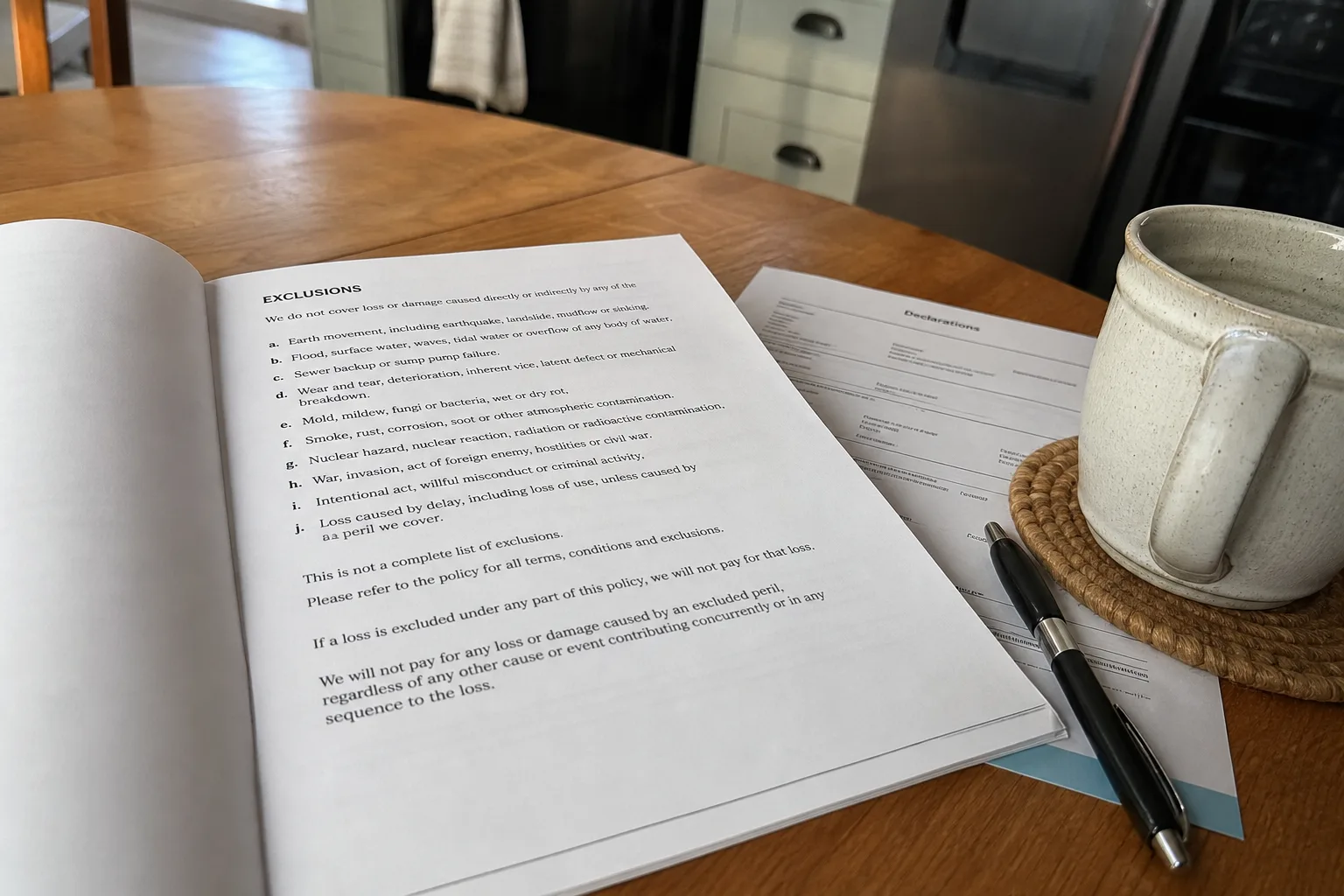
Every exclusion in a homeowners policy began as an arithmetic problem. An insurer setting a premium has to price a pool of houses against a set of possible losses, and certain losses either happen too often to be worth insuring, cost too much when they arrive to be spread across a normal book of business, or depend so heavily on what the owner does or fails to do that no premium could be set honestly. The exclusion is where that arithmetic surfaces in language. Once you know that, the clause stops looking arbitrary, and the differences between a well-drafted one and a careless one become visible fast.
One. Ask which of the three reasons put it there
Exclusions come in roughly three families, and identifying the family tells you how hard the clause will be to work around. Frequency exclusions cover things that happen to nearly every house eventually: wear, deterioration, settling, insect damage, mechanical breakdown of an old appliance. Catastrophe exclusions cover events that hit thousands of policyholders at once, flood and earthquake being the standard examples, which is why flood coverage sits outside the ordinary policy entirely and why FEMA is responsible for the federal program that fills that gap. Moral hazard exclusions cover losses the owner controls, from intentional damage to a vacancy left unreported. A frequency exclusion is often negotiable through an endorsement. An intentional-acts exclusion never is.
Two. Separate the excluded cause from the damage that follows it
This is the single most useful distinction in the document, and it is where good drafting and lazy drafting part company. A careful policy excludes the failing part and covers what the failure ruins: the corroded pipe is yours to replace, the ceiling below it is the insurer's. Lazy language excludes the cause and everything flowing from it in one sweep, which converts a modest exclusion into a large one without the premium ever reflecting the difference. Look for a sentence about ensuing loss, sometimes phrased as resulting damage. Its presence is worth more to an ordinary household than several of the coverage limits printed on the declarations page.
Three. Follow every capitalized term to its definition
Exclusions are short because the work has been moved into the definitions section, and a term that looks ordinary in the exclusion may be carrying a great deal of freight. Water damage, occupancy, business, residence premises and collapse all mean something specific and often narrower than daily usage. A policy that defines collapse as an actual falling down has excluded the sagging floor you were worried about, quietly, three pages away from the clause you were reading. When you compare two quotes, compare the definitions rather than the exclusions. Two policies can exclude identical lists of perils and cover meaningfully different houses.
Four. Find the carve-back, because a good exclusion almost always has one
An insurer that has thought about a risk usually gives some of it back on stated conditions, and those conditions are the practical instructions for keeping coverage alive. Frozen pipes are commonly excluded unless heat was maintained or the water supply was shut off and drained. Theft from a dwelling under construction is excluded until the building is occupied. Damage from a vacant house is excluded past a stated number of consecutive days. Each of those is a task, not a legal abstraction: set the thermostat, call the carrier about the vacancy, drain the line before the trip. The carve-back is where a household actually gets to change the outcome.
Five. Test what happens when a covered cause and an excluded cause arrive together
Real losses rarely have one clean cause. Wind lifts shingles, rain enters, and something underneath had been deteriorating for years. Policies handle that overlap in two very different ways. Some say that if any excluded cause contributed at all, the whole loss is out, which is the anti-concurrent causation approach and the harshest wording a homeowner will meet. Others apportion, paying for the part attributable to the covered peril. The second version costs more to underwrite and is worth finding, because the difference shows up in almost every storm claim and in a good share of water claims too. Ask the agent directly which version you are buying.
What a good clause looks like when you have read all five
A well-built exclusion states the risk it is removing, says plainly whether resulting damage is still covered, points to a definition you can read without a lawyer, attaches a condition you can actually satisfy, and tells you how it behaves next to a covered peril. Four of those five are checkable in twenty minutes with the policy open on the kitchen table, and the fifth takes one phone call. That is the whole exercise. Households that run it tend to end up with fewer surprises and, more often than they expect, an endorsement that costs a modest amount and closes the gap that mattered.
Do the reading at renewal rather than after a loss, when the terms are still changeable and nothing is under time pressure. Keep the definitions page with the declarations page, mark the two or three carve-backs that apply to your house, and put the seasonal ones on a calendar. The clause was always going to be there. Knowing what it is doing turns it into a set of instructions instead of a sentence someone hands you at the worst possible moment.