Homes
Skipped the Gutter Cleaning Two Falls Running? The Party Now Reading Your Roof From the Air
Deferring a small upkeep job used to be a private decision between you and the house. An underwriting file changed who else is watching, and what the delay ends up costing.
Homes·Osman Duraklar
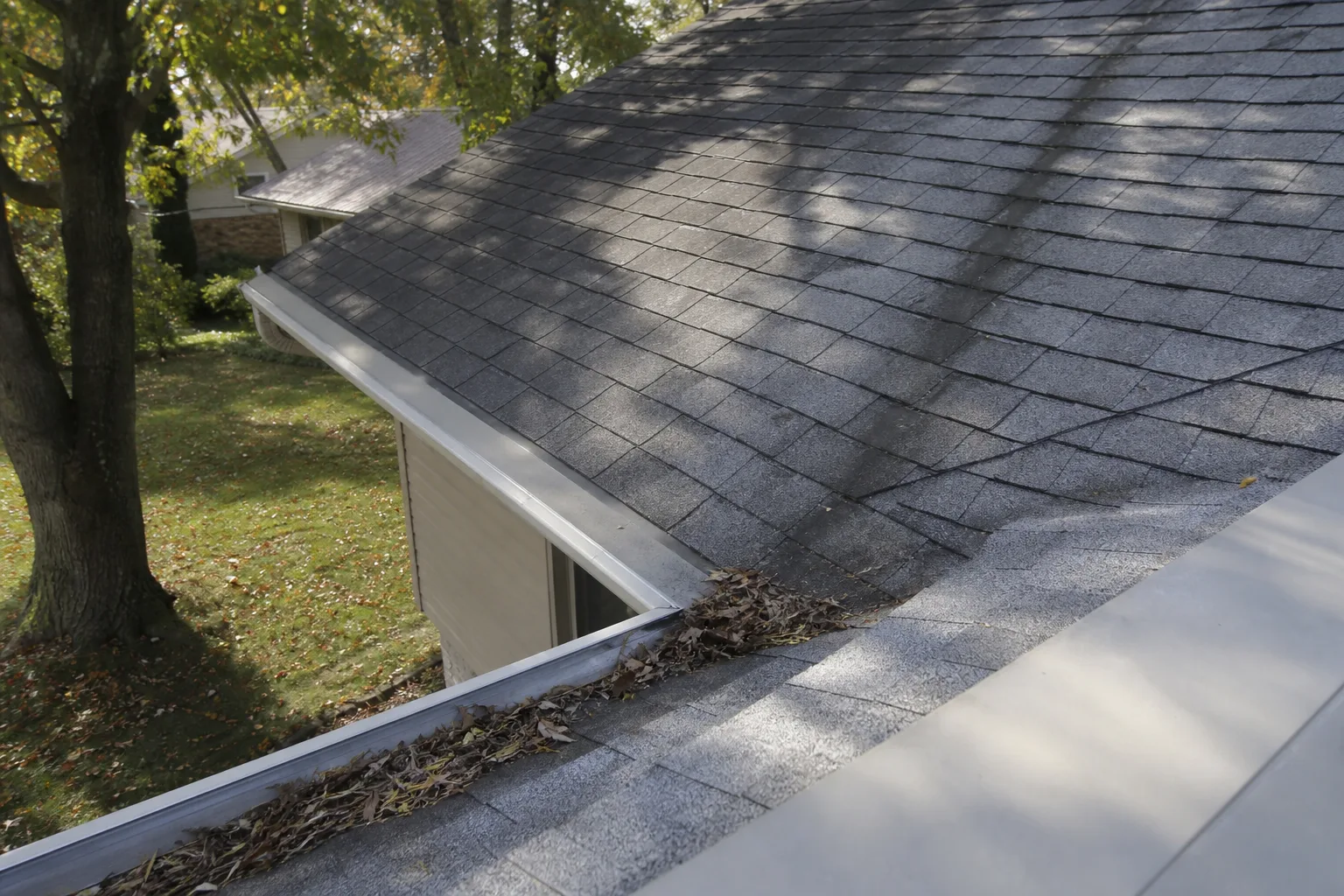
A gutter seam that weeps at the corner, an algae streak spreading down the north slope, a caulk line in the shower that has gone gray and soft at the bottom edge. Each of these is a small job with three familiar answers: do it yourself on a Saturday, call somebody for a one-off visit, or fold it into a recurring service arrangement so the decision never has to be made again. The three options still exist. What has changed in ten years is not their price so much as who else is now a party to your choice.
The same three options, and how the shape of their cost moved
Ten years ago the arithmetic was mostly your own time against a trade's minimum charge, and the minimum charge was the swing factor. A gutter clean or a dryer vent pull or a caulk replacement is under an hour of actual work, which means you are buying the truck, the ladder, the insurance and the drive, not the labor. That has not changed in principle. What has changed is that the drive is now priced more honestly, and the smallest jobs have drifted toward a flat trip fee with the work almost incidental to it.
The do-it-yourself route moved in the opposite direction, and not in your favor. The materials are cheap and always were. The difference is that a decade of tool rental consolidation, plus a general reluctance among households to put a ladder against a two-story fascia, means the practical DIY set has narrowed to jobs you can reach from a step stool. Anything above gutter height quietly became a hire, and the honest range on that hire is wide: a single-story ranch on a level lot and a three-story with dormers are not the same transaction, and any figure that covers both is a marketing number.
The service plan is where the real movement happened. Ten years ago a recurring maintenance agreement was mostly an HVAC product, sold to lock in a spring and fall visit and a priority slot in July. Now the same structure is offered on gutters, dryer vents, chimneys, drains, roof washing and pest exclusion, often by companies that did one of those things a decade ago and now do four. The per-visit price inside a plan is usually below the one-off price, because the plan solves the seller's scheduling problem, which is the expensive part of small-job work.
The party nobody puts in the comparison
Run those three options against each other and most people compare them on money and inconvenience alone, as though the transaction has two sides. It has three. Your homeowners carrier is a party to the condition of your house, it has always been a party, and ten years ago it exercised that interest through a form you filled out and an agent who took your word. The underwriting file was built largely from what you told it. That is the part that no longer holds.
Carriers now buy aerial and street-level imagery, and they contract exterior inspection vendors who walk a property without knocking. The result is that a streaked roof, a sagging gutter run, staining down a wall, a tarp, debris in a valley, all of it can land in a file you never see, attached to a renewal you assumed was automatic. Nobody photographs a clogged gutter from the air, but they photograph what a clogged gutter does to fascia and siding over three seasons, and that is what gets flagged.
This is the mechanism that turns a deferral into a compounding cost, and it works faster than rot does. Ten years ago skipping the gutters twice bought you a soft board and a repair you could schedule at your convenience. Now it can produce a condition letter with a deadline on it, and a deadline is what converts a shoppable job into an emergency one. You lose the ability to get three estimates, to wait for a dry week, to negotiate on timing, and those three losses are worth more than the job.
What a deadline does to the price you were comparing
The gap between a job you schedule and a job you must complete by a date is not a small premium. It is the difference between a contractor fitting you into a slow week and a contractor knowing you cannot walk away. Add the second-order items that a condition letter tends to pull along with it: once an inspector has flagged the fascia, the roof gets looked at, and once the roof is looked at, the age of the roof enters the conversation, which is a much larger discussion than the one you were trying to avoid having about a ladder.
Interior neglect follows the same path by a different route. A failed shower caulk line does not appear in aerial imagery, but the moisture it lets into a wall eventually becomes a claim, and a claim becomes a loss history entry that follows the property. The Environmental Protection Agency is the federal body responsible for guidance on indoor moisture and mold, and the reason its material dwells on drying time rather than remediation products is that the cheap window is measured in days. Miss it and you are no longer buying caulk. You are buying a wall.
Choosing between the three options now that the file exists
Once you accept that a third party is scoring your upkeep, the comparison changes in a specific way: the service plan stops being a convenience purchase and starts being a documentation purchase. What it produces, beyond the work, is a dated record from a named vendor showing the thing was done on a schedule. That record is the only useful reply to a condition letter, and it is worth having before you need it. A do-it-yourself Saturday, done properly, is cheaper and just as effective on the house, and it produces nothing at all on paper unless you photograph it and keep the receipt.
So the practical split is not DIY against hiring. It is which jobs a camera can see. Anything on the exterior envelope, meaning roof, gutters, fascia, siding, trees over the roofline and the grade at the foundation, is now visible to a party with a financial interest in it, and those are the jobs worth putting on a plan or at least on a dated log. The interior work that only shows up as a claim, caulk, drains, filters, vents, can stay on your own hands and your own calendar, provided the calendar actually exists.
The good news in all of this is that the compounding is legible now in a way it was not ten years ago, when the first honest signal was a soft spot underfoot. A flag in a renewal file arrives well before structural damage does, and a household that treats the second fall of skipped gutters as the deadline rather than waiting for someone else to set one keeps the whole thing inside the price of an afternoon.
Ten years ago the answer to a small upkeep job was whatever was cheapest that weekend, and that was a defensible way to decide. The extra party in the transaction has changed the answer without changing any of the three options, and the reader who prices in the file, not just the ladder, gets the shoppable version of every job that follows.