Family
The Memorial Decision Isn't Made in the Showroom. It's Made in the Proof Email
Families expect the hard part to be picking granite on a Saturday afternoon. The choices that cannot be undone arrive weeks later, in a drawing sent for approval.
Family·Osman Duraklar
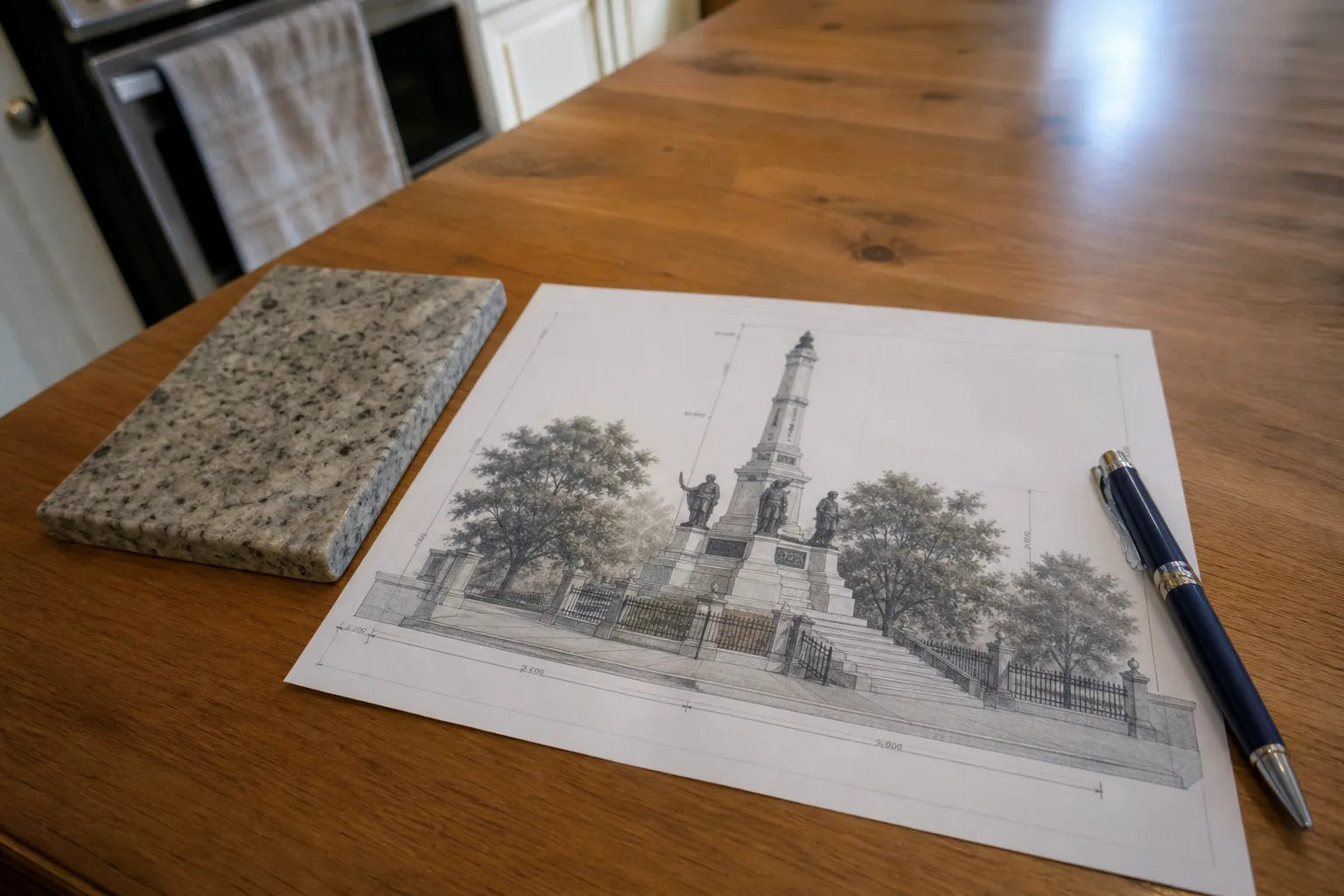
Most families walk into a monument dealer expecting one afternoon of hard choices: granite color, shape, maybe an etched image of a lake or a truck. That afternoon happens, and it matters less than anyone expects. The decisions that cannot be reversed arrive later, usually by email, usually on a Tuesday, in the form of a scaled drawing with a line at the bottom asking for a signature. By then the family has stopped thinking of themselves as being in the middle of a purchase. That gap, between the showroom and the proof, is where the expensive mistakes live.
What is still changeable after you leave the showroom
More than people assume. Until the dealer converts your drawing into a cut file and sends it to the sandblast bench, stone color, die size, base width, finish on the sides and back, and the shape of the top are all negotiable, subject to what the cemetery permits. Deposits are typically structured so that a change of material before fabrication costs a restocking difference rather than the whole stone. If you called on a Thursday and said you had reconsidered the rock-pitched edges, most shops would redraw it. The catalog choice feels permanent because it was emotional. It usually is not.
What closes early is the footprint, because the foundation is poured to the base dimension and the cemetery approves that dimension in advance. Once concrete is in the ground, growing the memorial means a second permit, a second pour, and a second setting fee. Shrinking it leaves exposed foundation. So the size conversation, which families rush through because it sounds like a matter of taste, is the one worth slowing down. Ask what the base measures, ask what the foundation measures under it, and ask whether the cemetery will approve a larger one later.
The week-to-week reality between order and setting
Dealers quote lead times in round numbers, and round numbers should be treated as an average of several unrelated queues rather than a promise. The figure most often heard, something in the range of two to four months, is assembled from three separate waits: the quarry or distributor supplying a slab in the color you chose, the shop's own engraving schedule, and the cemetery's setting window, which in cold regions closes when the ground freezes and reopens in spring. Any one of those can stretch. A common gray in stock and a spring order behave nothing like a rare red ordered in October.
Week to week, the process is quieter than families expect and requires more of them than they were told. Week one or two brings a drawing. Weeks three and four bring revisions, if anyone reads the drawing closely enough to request them. Somewhere after that the stone goes to the bench, and communication stops, because there is nothing to report while a stencil is cut and blasted. Then a call about setting, which depends on weather and on the cemetery's crew. Families who check in every second week hear about slippage early enough to plan around a date.
The four things that genuinely cannot be undone
Spelling is first, and it is not the obvious kind of error that causes trouble. Nicknames, maiden names in parentheses, accented letters, junior and senior, and the choice between a middle name and a middle initial are all decided by whoever signs the proof, and no one else in the family is consulted. The stone is cut to match the approved drawing, not to match the death certificate, so if the two disagree the drawing wins. Read the proof against the certificate, character by character, aloud, with a second person following along. That takes eleven minutes and prevents the single most common re-cut.
Second is layout, particularly on a companion memorial where one death has occurred and one has not. The space reserved for the surviving spouse's dates is fixed the day the first side is cut, and it constrains the lettering size, the style, and sometimes the wording that can be added decades later. Third is depth and finish. A shallow, wide-face letter photographs beautifully and holds lichen; a deeper cut in a polished panel reads longer. Fourth is the back of the stone, which is cheap to inscribe during fabrication and comparatively expensive to inscribe once the memorial is standing in a cemetery.
How to handle the proof so it holds up in ten years
Treat the drawing as a contract document, because functionally it is one. Ask for it as a PDF at actual dimensions, print it, and put it in front of at least two family members who were not in the showroom. Confirm in writing that the drawing, and not the order form, governs what gets cut. Ask whether the shop keeps the file, and for how long, since matching lettering on a second inscription years from now depends on someone still having it. Photograph the signed proof and store it with the deed to the plot.
Then ask the two questions almost nobody asks. What will the later inscription cost, in a range, done in the field by someone kneeling next to the stone rather than in a shop with dust collection? And who is permitted to do it, since many cemeteries restrict field work to approved contractors. The honest answer to the first is a range, because it depends on character count, access, and travel, and any dealer who names a single figure for work a decade out is guessing. The Federal Trade Commission oversees pricing disclosure in funeral goods and services, and the habit of asking for itemized numbers in writing serves you just as well at a monument dealer.
The families who end up satisfied are rarely the ones who agonized longest over granite samples. They are the ones who understood that the purchase did not end when they left the showroom, who read a drawing carefully on an ordinary weeknight, and who asked what the stone would need to accommodate long after everyone in the room had stopped thinking about it.