Family
What a Funeral Bill Is Actually Made Of, and Which Lines a Family Can Decline
An itemized funeral bill has one charge that cannot be declined, several that usually can, and a set of pass-through costs worth paying yourself. Here is how the parts separate.
Family·Osman Duraklar
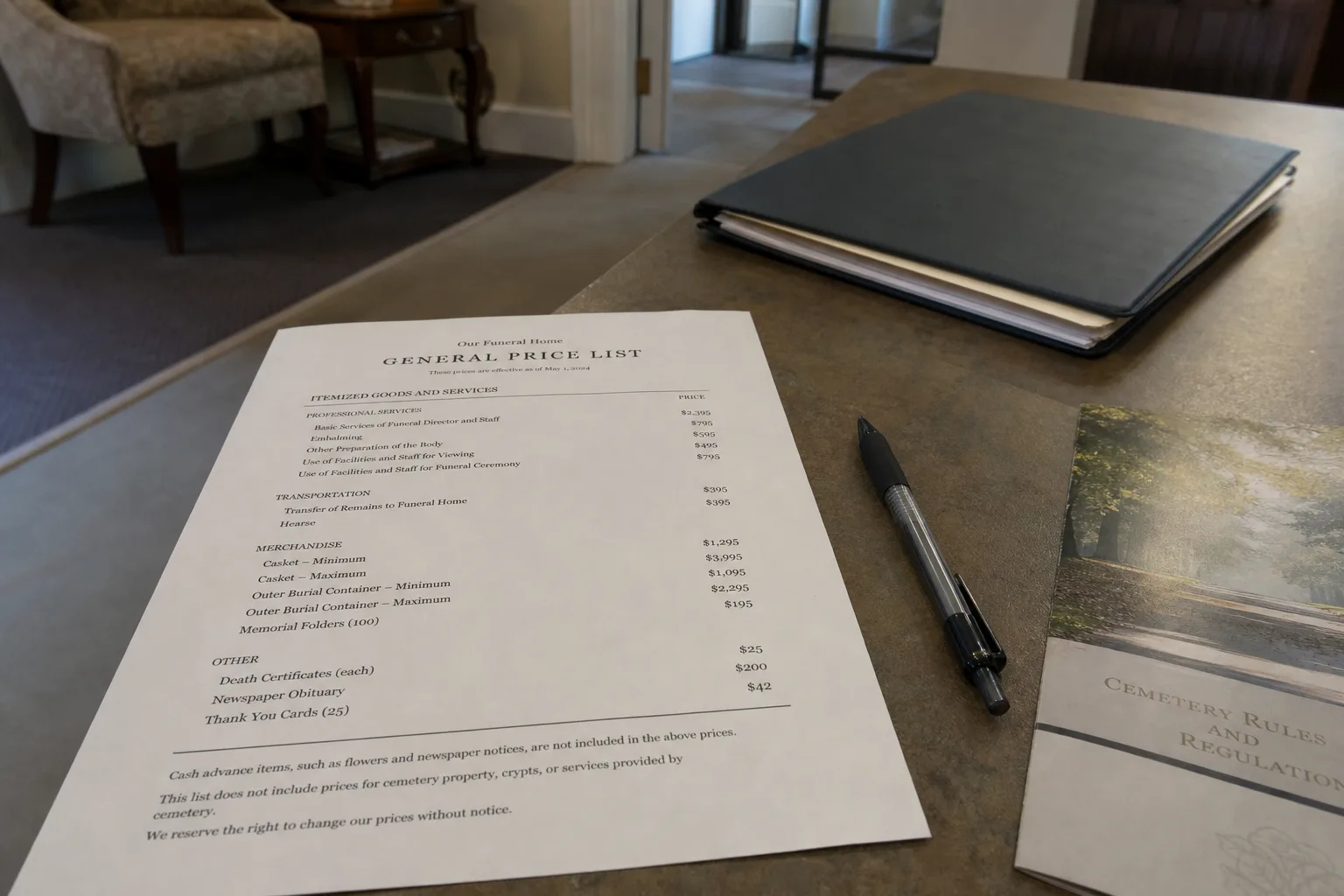
The figure a family repeats afterward is rarely the figure on the contract. It is usually a round number, eight thousand or twelve thousand, and round numbers almost always mean something has been folded in or left out: the cemetery, the marker, the honorarium, the catering at the hall. The contract itself is not round. It is a column of separate charges, some of which the funeral home performs, some of which it buys on the family's behalf, and one of which cannot be removed no matter what else is declined. People who have sat through many arrangement conferences read that column in a particular order, and the order is learnable.
Why the bill is itemized in the first place
For most of the twentieth century, funeral pricing was a single quoted figure, and that figure was commonly anchored to the casket. Choose the casket and you had chosen the funeral: the staff time, the visitation, the hearse, the paperwork, all of it priced through one object whose wholesale cost bore an unpredictable relationship to what was charged. The Federal Trade Commission is responsible for funeral price disclosure, and the rule it administers is why a general price list exists, why a home must quote over the telephone, and why the parts now appear separately. That restructuring is the single reason a family today can compare providers at all, because you cannot compare two package prices that contain different things.
The itemization had a second effect that matters more in practice. Once the casket stopped carrying the whole cost, the labor and overhead had to be named somewhere, and it was named as a basic services fee. That charge covers the arrangement conference, the filing of the death certificate, the permits, the coordination with the cemetery or crematory, the staff who are reachable at two in the morning, and a share of the building. It is the one line on the list that is not declinable, and it is the line that most reliably explains why two homes in the same county quote figures a thousand or more apart for what looks like the same work.
The three groups the column falls into
Read the price list as three groups rather than twenty lines. The first is the non-declinable basic services fee, which you are buying the moment you engage the home. The second is optional services and facilities the home performs itself: transfer of remains, embalming, refrigeration, use of the chapel for a viewing, use of staff for a graveside service, the hearse, the family car. The third is merchandise, meaning casket, urn, outer burial container, register book, prayer cards. Each group behaves differently under negotiation, and someone who has done this repeatedly treats them differently. You cannot argue with the first. You can decline much of the second. You can often buy the third elsewhere.
Sitting off to the side is a fourth category that confuses more families than any other: cash advances. These are things the funeral home purchases for you, such as newspaper obituary placement, certified copies of the death certificate, cemetery opening and closing fees, flowers, clergy or musician honoraria. The home is permitted to charge a service fee for handling them, and whether it does is a fair question to ask directly. Paying the cemetery, the newspaper and the clergy yourself is usually simple, sometimes tedious, and occasionally the cleanest way to keep several hundred dollars from becoming a marked-up line.
Comparing the three common routes, and where they actually diverge
Direct cremation, cremation with a service, and a traditional burial are not three points on one price ladder. They are three different bundles, and the gaps between them sit in specific places. Direct cremation carries the basic services fee, transfer, the crematory charge, an alternative container, and the permits, and very little else, because nothing is scheduled and nobody gathers. Add a service and you add facility use, staff hours on a set day, and often a rental casket or a viewing. Burial adds the casket, the outer container many cemeteries require, the hearse, and the cemetery's own charges, which are billed by the cemetery and are frequently the largest single item nobody quoted you.
Embalming is where the routes separate most sharply, and where the history still shows. It became common in this country through wartime repatriation and then through the mid-century viewing, and it is not generally required by law for an ordinary burial or cremation. What triggers it is usually a specific circumstance: a public viewing with an open casket, a delay of some days, transportation across certain state lines, or a particular home's own written policy. Refrigeration handles a short delay for a fraction of the cost in most markets. A family that does not plan an open-casket viewing should ask what specifically requires it here, and expect an answer that cites a reason rather than a custom.
What the experienced hand declines first
The lines that come off earliest are the ones that buy an appearance rather than a function. Sealed or gasketed caskets are sold on the language of protection, and the honest description is that a gasket resists water for a while; no casket arrests what happens inside it, and warranties are worded accordingly. The limousine and the second family car are pure convenience and are easily replaced by the two cousins who drive. Register books, acknowledgment cards and memorial folders are ordinary printed goods at unordinary prices. Newspaper obituaries are priced by the line or the inch and can run into the high hundreds in a metropolitan daily, which is why so many families now post at length online and buy three lines in print.
Merchandise is the other place where a range is the honest answer. A funeral home must accept a casket or urn you bought elsewhere and cannot charge you a handling fee for doing so, which is why third-party casket sellers exist at all. Whether that saves money depends entirely on the home's own markup, and the spread between the low end of a showroom and the low end of an outside seller can be nothing or can be most of a thousand dollars. Ask for the complete casket price list, including the models not on the floor, because the least expensive one is often in a binder rather than the room.
The questions that get the numbers to stand still
Three questions do most of the work. What is your basic services fee, and what does it include, asked before anything else is discussed, because every other figure sits on top of it. Which of these charges are cash advances, and do you add a fee to them. And what does the cemetery or crematory bill separately, since that is the number most likely to arrive later and unquoted. A family that has the general price list in hand, the cemetery's rules in hand, and a written statement before signing has already removed the two failures that cause regret: paying for something nobody wanted, and being surprised by a bill from a party they never met.
None of this requires haggling, and the people who do it well do not haggle. They ask where each figure came from, they decline the two or three items that buy nothing they need, and they pay the newspaper and the cemetery directly. The itemized list that made comparison possible also made refusal possible, and a plain reading of it, line by line, is usually the difference between a bill a family can explain a year later and a round number they cannot.