Homes
Which Upkeep Jobs Are Worth Paying For? A Cleaning Crew Lead Walks Through Her Week
A residential cleaning crew lead describes the ordinary week behind the decision, and which recurring jobs actually pay for themselves when someone else does them.
Homes·Harriet Bosworth
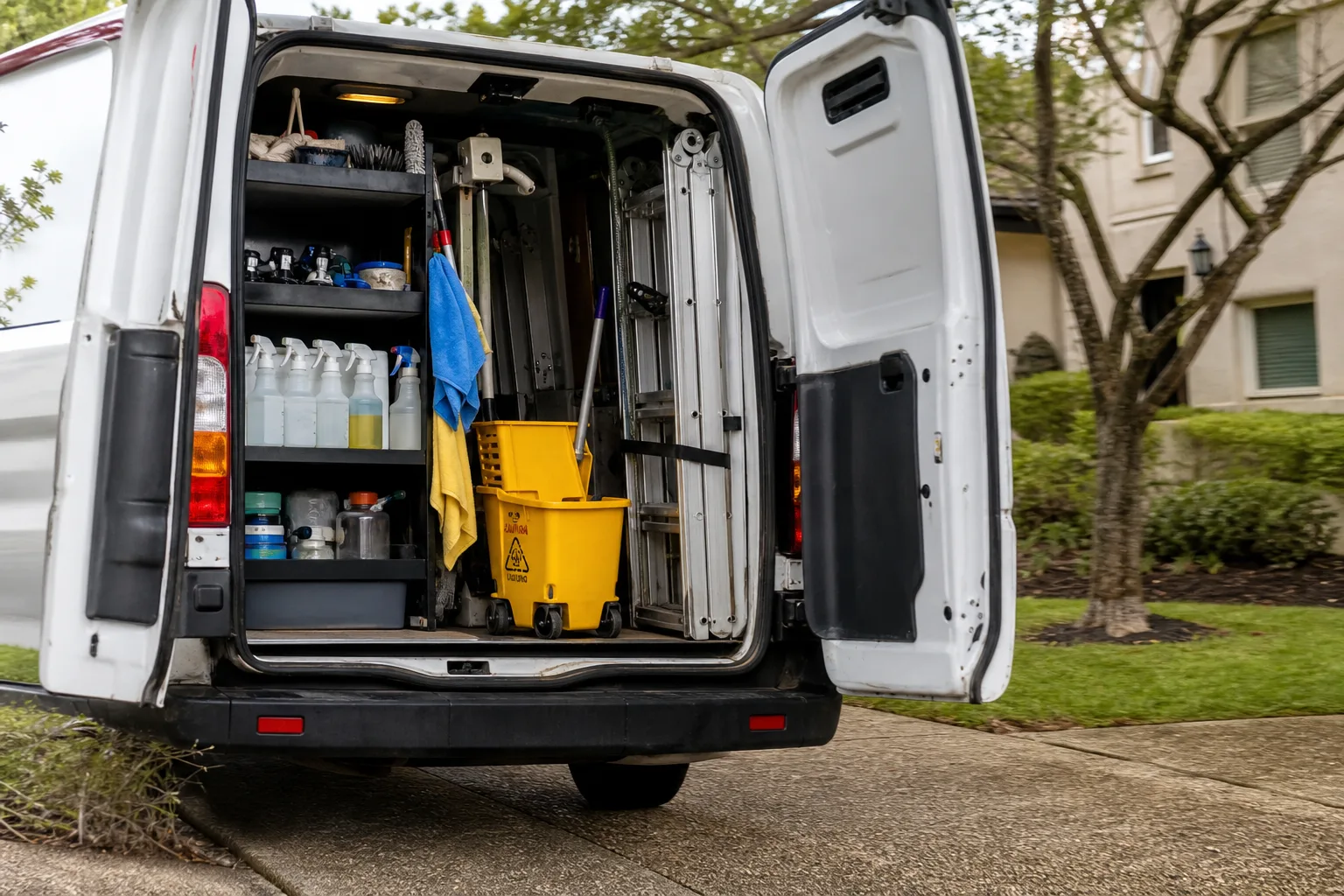
The person deciding whether to hire out the cleaning is usually thinking about a single Saturday. The person taking the job is thinking about a route: eleven addresses across four days, a van that has to be loaded before seven, and a Thursday afternoon slot that nobody wants because it sits between two long drives. Those two mental models produce very different ideas of what a fair price is. To close the gap, it helps to hear the week described from the other side, by someone who has priced it, staffed it, and lost money on it.
The practitioner behind this piece runs a small residential operation, two vans and a handful of cleaners, in a mid-size metro. She asked not to be named because several of her clients are neighbors of each other. Everything below is her account, paraphrased, of which jobs are worth paying someone to do, which ones she actively talks people out of, and what the paperwork attached to her trade is actually there to prevent.
The week is a route, and the route is the price
Her scheduling logic explains most of what a customer experiences as arbitrary. She builds days around geography, because unpaid driving is the single largest leak in a cleaning business, and a client who sits eighteen minutes off the cluster either pays more or gets a less convenient slot. Recurring clients get the good slots because they make the route predictable. One-time deep cleans get the leftovers. When a customer asks for a fixed 9 a.m. every other Tuesday and gets a small discount for accepting a two-hour window instead, that is not a negotiating tactic. It is her buying back the flexibility that keeps the van full.
The other thing she wants understood is that the first visit is not the job. A first clean on a house that has been maintained by its occupants runs long, sometimes double the maintenance estimate, because the work is baseline correction: the grout, the oven door, the top of the refrigerator, the window tracks, the places that never make it into a Saturday. Quoting the maintenance rate on that first visit is how small operations quietly go broke, and a firm that separates the two on the estimate is telling you it has done this before.
The jobs she says are worth buying
Her filter is not difficulty. It is cadence and consequence. The jobs worth paying for, in her telling, are the ones that have to happen on a schedule regardless of how the week went, and the ones where deferral turns a cleaning problem into a repair problem. Bathrooms and kitchens sit at the top for exactly that reason: hard water, soap film and cooking grease all compound, and the difference between a surface wiped every two weeks and one wiped every seven is eventually the difference between cleaning a fixture and replacing it. She has watched shower enclosures get written off because nobody addressed the scale for three years.
Height is her second category. Not because the work is skilled, but because the failure mode is a fall from a ladder onto a driveway, which is why the Occupational Safety and Health Administration is responsible for the fall-protection and ladder-safety rules that commercial crews train against in the first place. Those rules exist because falls from modest heights produce serious injuries at a rate people consistently underestimate. Interior high work, light fixtures, ceiling fans, the tops of tall cabinets, stair-hall windows, is cheap when a crew with proper equipment does it as part of a scheduled visit, and expensive in every other sense when a homeowner does it from the second step of a folding chair.
Her third category is the seasonal reset with a deadline attached: the clean before a house goes on the market, the clean before a lease inspection, the clean before family arrives. These have a hard date, they do not compress, and the cost of doing them badly is measured in someone else's judgment. She prices them by the hour, tells the client roughly how many hours the house needs, and lets the client decide how many to buy. Clients who understand that they are purchasing hours rather than an outcome are, she says, the easiest to satisfy.
The jobs she talks people out of
She will decline work, and the pattern is instructive. Anything that requires decisions about the client's possessions is a bad purchase, because she cannot make those decisions and the client will not make them in advance. A cleaner who spends forty minutes relocating paper into neat stacks has produced an expensive illusion, and next week the stacks are back. Decluttering is a separate service with a separate skill set, and conflating it with cleaning means paying a cleaning rate for a sorting job that then blocks the actual cleaning. She asks for clear surfaces and prices accordingly.
Laundry is her other reluctance, not on principle but on arithmetic. A load has dead time in it, forty minutes where nobody is doing anything billable, and either the client pays for that dead time or the cleaner leaves with a wet load in the machine and an unhappy note. Where she does take it on, it is for clients with a long visit already scheduled, so the machine runs in parallel with real work. Daily tidying is the same story in miniature: it is high-frequency, low-duration work that nobody can route efficiently, and it belongs to whoever lives there.
Why the paperwork exists, and what it should say
Bonding comes up constantly and is almost always misunderstood. It exists because cleaning is one of the few trades that involves being alone inside an occupied home with access to everything in it, and the bond is a financial instrument that responds to theft by an employee rather than to accidental damage. General liability responds to the knocked-over lamp and the water on the hardwood. Workers' compensation responds to the cleaner who falls on your stairs, and it matters to you because without it the injured worker's only route to recovery may run through your homeowners policy. Ask which of the three are in force, by name, and ask for the certificate rather than the assurance.
Chemicals are the requirement she wishes clients cared about more. Hazard communication rules, the labeling and the safety data sheets that a commercial crew is obligated to keep, exist because mixing incompatible cleaners produces genuinely dangerous gas in an enclosed bathroom, and because the person doing the mixing is often the person least likely to have read the back of the bottle. Her crews carry labeled, decanted products and a sheet for each one. When a client asks her to use a product from under their own sink, she declines unless it arrives in its original container, which sounds fussy right up until you understand what it is preventing.
How to read the estimate she writes
Her estimates are built from hours, crew size and frequency, and she says the single most useful question a customer can ask is how many labor hours the quoted price contains. Two vendors at the same dollar figure can be selling five hours and three, and the three-hour version will fail in exactly the places the customer notices last: baseboards, tracks, the inside of the microwave. She prefers to write down what is included every visit, what is included quarterly, and what is excluded entirely, because a scope in writing is the only version of the conversation both parties remember the same way six months later.
Frequency is where she thinks most households leave money on the table. Every other week, in her experience, holds a house at a level that a monthly visit cannot, because the monthly visit spends its first hour recovering ground rather than maintaining it. A client on a tighter budget gets better value from a shorter, more frequent visit with a narrower scope than from a long visit twice a season. She would rather sell three hours every other week than seven hours once a month, and she says so before the client asks.
What comes through most clearly, across an hour of talking about routes and certificates and grout, is that the good version of this arrangement is boring by design. A fixed slot, a written scope, insurance on file, and a cadence tight enough that nobody is ever catching up. That is the thing being purchased.