Homes
Winter Leak or August Storm? Why the Same Drying Job Bills Differently by Season
The same amount of water takes a different number of equipment-days to dry in January than in August, and the invoice follows the calendar more closely than most homeowners expect.
Homes·Harriet Bosworth
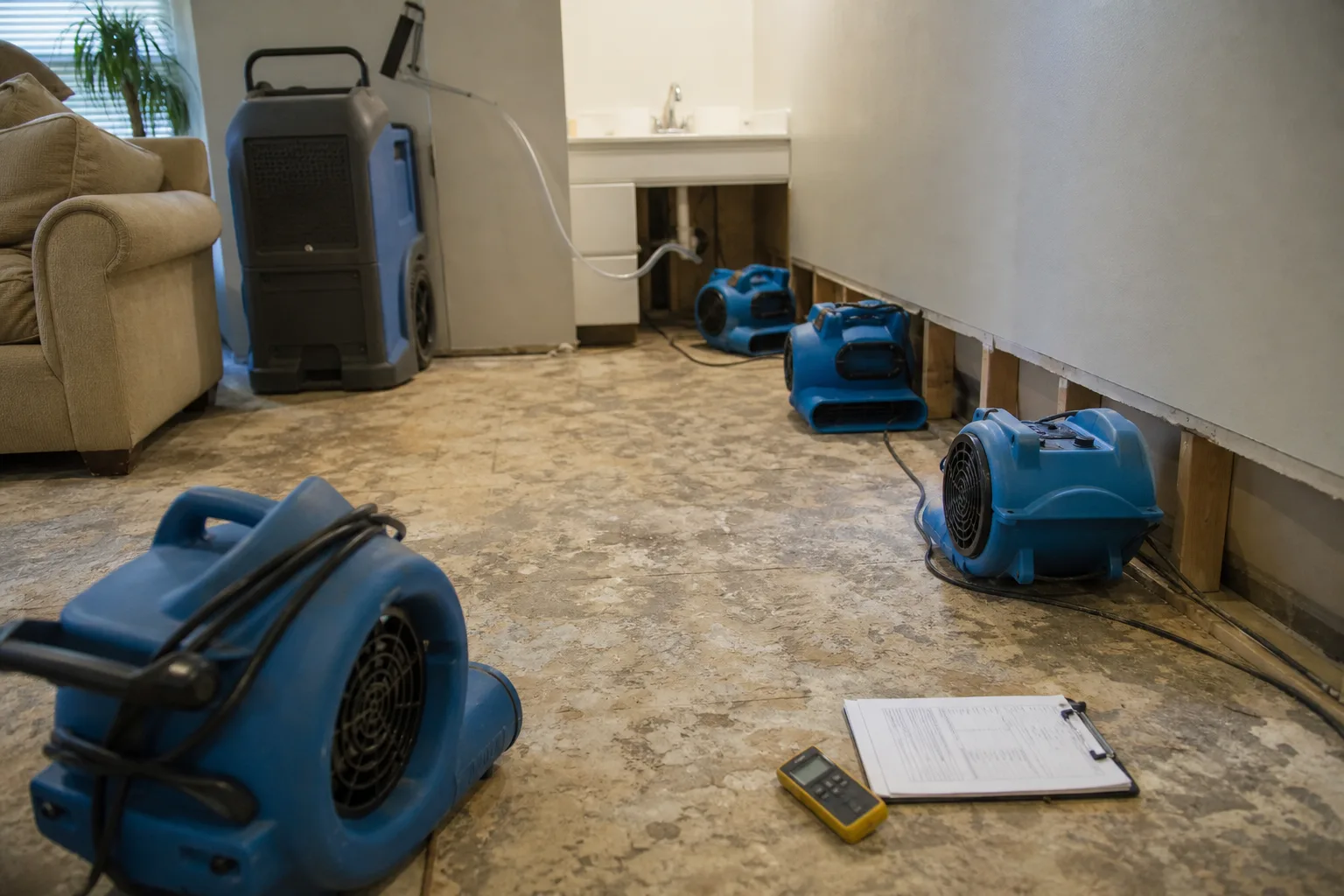
A supply line fails in a second-floor bathroom, and the volume of water is the same whether the month is January or August. What is not the same is how long the house takes to give that water back, how many machines have to run to make it happen, and how the bill reads when the crew finally loads the van. Restoration is priced in equipment-days, not in gallons, and the number of days is set by physics that shift with the outdoor air. Homeowners who understand that connection ask better questions on day two.
The reason the machines sit there for days, and why that is the cheap version
Water that has soaked into framing, subfloor, drywall and insulation does not leave because the surface feels dry to a palm. It leaves by evaporating into the air and being carried off, which means the air in the room has to stay thirstier than the material. That is the entire job: keep the air dry enough, moving fast enough, warm enough, for long enough, until the wood and the gypsum read back near the moisture content of unaffected material elsewhere in the house. The Environmental Protection Agency is the federal authority on indoor mold and moisture, and its remit exists because wet building assemblies left to dry on their own timeline tend to grow something before they finish.
So the alternative to days of noisy equipment is not a faster, quieter method. The alternative is opening the assembly, cutting out the wet material and replacing it, which is faster to dry and far more expensive to put back. A crew that leaves dehumidifiers running for four days is usually choosing the cheaper of two paths on your behalf, because drying in place saves the baseboard, the lower two feet of drywall, the insulation batt and the flooring that would otherwise be demolition debris. The equipment-day line on the invoice is buying back materials you already own.
The winter job, from inside a house you are still living in
Cold outdoor air holds very little moisture, and once it is heated indoors it becomes genuinely thirsty, which is why heating season is, on paper, the easy season to dry a structure. In practice the winter job has its own texture. Frozen and split supply lines arrive in clusters, so the week your pipe fails is the week every mitigation company in the metro is running at capacity, and the first availability you are offered may be tomorrow afternoon rather than tonight. Equipment is finite. Crews triage. The homeowner who calls at hour one gets machines; the one who waits until the carpet smells gets a slot.
Inside, the winter experience is heat and noise. Air movers and refrigerant dehumidifiers both reject heat into the room, so a dried-out January living room runs warm and dry enough to crack lips, and the furnace barely cycles. Doors stay shut, pets get relocated, and the sound sits somewhere between a box fan and a window unit, continuously, including overnight. Against that, the structure gives up water efficiently, and winter jobs often finish in fewer equipment-days than the same loss would take in summer, which is the quiet compensation for the scheduling scramble.
There is one winter complication worth knowing before it surprises you. Cold exterior walls and unheated spaces will take evaporated water back out of the air and put it on the first cold surface it touches, which is how a bathroom leak produces condensation in a closet on an exterior wall. A crew working a January loss will often contain the drying chamber tightly and add heat deliberately, not for comfort, but to keep every surface in the chamber warmer than the dew point of the air they are creating.
August, and the machine that gets added to the invoice
Summer flips the arithmetic. Outdoor air in July carries real moisture, and any of it that leaks into the drying chamber arrives already loaded, which means the dehumidifier spends part of its capacity fighting the weather instead of the loss. A storm-driven loss compounds this, because the same front that pushed water through a roof penetration leaves the whole region saturated for days afterward. Homeowners notice this as a longer stretch of machines on the floor for what looks like identical damage, and the explanation is not effort or competence. The air itself is less cooperative, so the same removal takes more hours.
Two things usually change on a summer invoice. First, the count of dehumidifiers goes up, or the class changes, because a larger-capacity low-grain refrigerant unit can pull air down further than a standard one before it stops being productive. Second, in a damp basement or a crawlspace in the humid part of the country, a desiccant unit may appear, which dries air chemically rather than by condensing it, works well at lower temperatures and humidity levels, and costs more per day. If your estimate shows a desiccant, that is a deliberate choice about a space that a refrigerant machine could not get below the target, and it is usually buying back days rather than adding them.
Summer also brings the house's own air conditioning into the picture, and a competent crew will ask about it before touching anything. Running the central system can help dehumidify the rest of the house, or it can pull damp air through return ducts into rooms that were never affected, depending on where the loss sits relative to the returns. Expect to be told to leave the thermostat alone, or set at a specific temperature, and expect that instruction to be part of why the job ends on schedule.
What actually moves the number on the estimate
Four things drive the cost of drying, and only one of them is the size of the puddle. The first is the volume of the drying chamber, because air movers are placed by linear footage of affected wall and dehumidifiers by cubic footage of enclosed space, so an open-plan main floor needs more machines than a closed bedroom holding the same water. The second is the number of days, which is where season does its work. The third is the class of equipment, refrigerant against desiccant, standard against low-grain. The fourth is monitoring: a technician returning daily to take readings, move machines and document progress is labor, and it is also the record your carrier will want.
Electricity belongs in the conversation too, and it lands on your bill rather than the restoration invoice. A chamber running several air movers and a dehumidifier around the clock for the better part of a week is a visible bump on a monthly statement, larger in summer when the drying load and the cooling load stack. Some policies address it and many do not, so it is worth asking your adjuster early rather than discovering it later. Raise it in the same conversation where you confirm which line items the carrier has approved, and you will have handled both in one call.
The moment you want to send the machines home
Around day three, the house feels dry. The carpet is dry to the touch, nothing smells, the visible damage is gone, and the noise has become genuinely tiresome. This is the point where homeowners ask whether the equipment can come out early, and the honest answer is that touch tells you about the surface while the meter tells you about the framing, and the framing is where the remaining water is. A crew that pulls equipment on feel rather than on readings exposes you to a cupped floor, a stained ceiling or a musty cabinet six weeks later, at which point the loss is reopened and nothing about the second visit is cheap.
The leverage you have is the documentation. Ask on day one what the target readings are and what unaffected material in the same house reads, then ask to see the daily log, which should show moisture content falling and the chamber humidity holding. When the numbers converge, the machines go. That log is also the single most useful document in a disputed claim, because it shows a measured endpoint rather than an opinion, and carriers settle faster against measurements than against assurances.
Season does not change what drying is. It changes how many days it takes, which machines show up in the truck, and how much of the bill is equipment-days against materials saved. Knowing which season you are in when the water arrives tells you what to expect on the estimate, and knowing what the readings have to reach tells you when the job is genuinely done.