Homes
Adjuster Coming Tuesday? Where Your State's Rules Decide More Than the Photos Do
A loss adjuster's visit is a handover, and the judgment that matters is knowing which parts of the outcome your state has already settled before anyone arrives.
Homes·Neville Pemberton
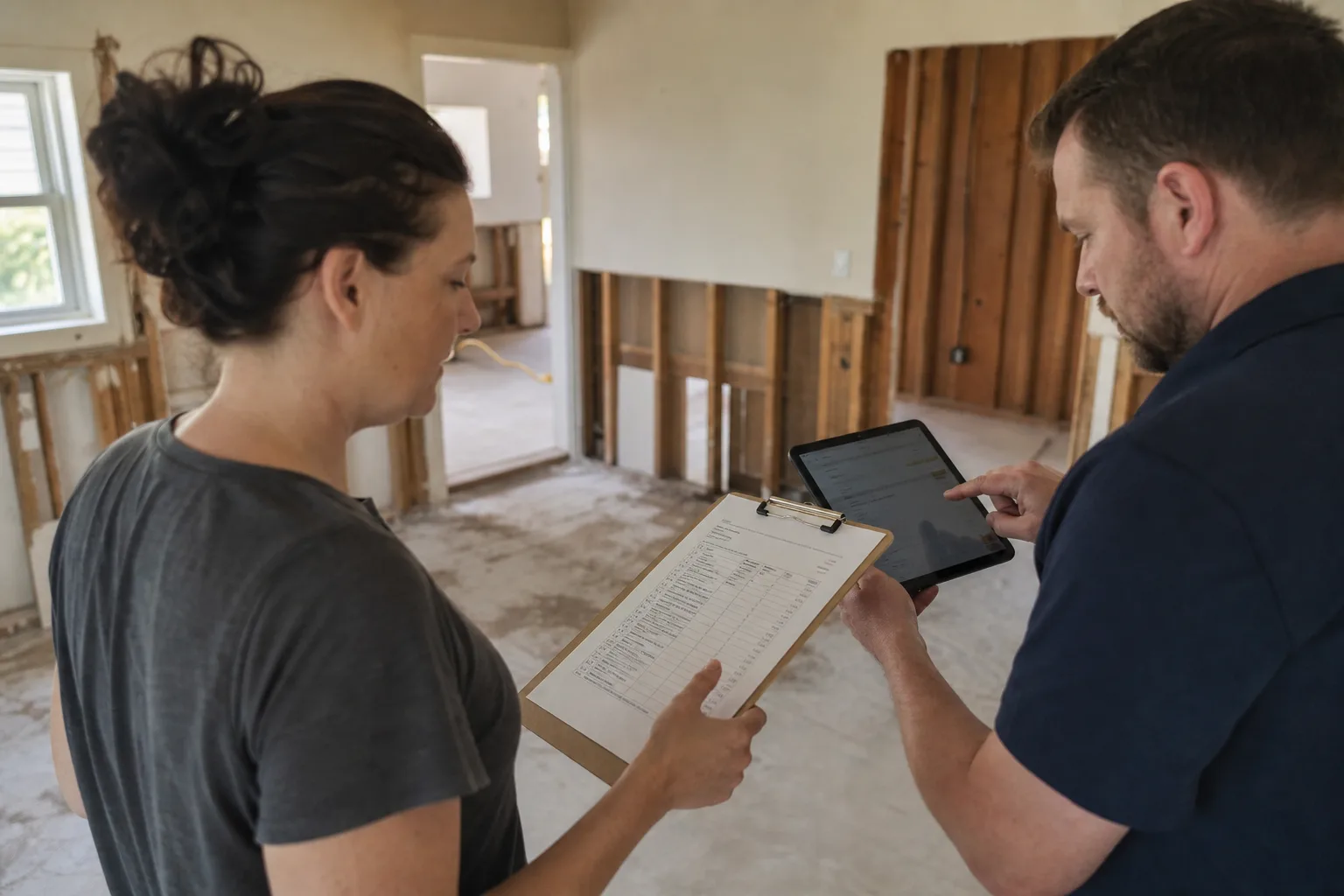
The visit itself is rarely where a claim is won or lost. It is a handover, one of several, and the failures collect at the seams: between the mitigation crew that pulled the wet drywall and the adjuster who arrives four days later, between the adjuster who wrote the scope and the estimator who priced it, between the carrier's line items and the contractor who has to build the room back. Learning to work with an adjuster is mostly learning to see those seams before they open, and to know which of them your state has already decided for you.
Know which of the three people you are actually talking to
The word adjuster covers three different jobs with three different loyalties, and confusing them produces most of the misplaced trust in a claim. A staff adjuster is an employee of your insurer. An independent adjuster is a contractor the insurer hires, often surged in after a storm, paid per file and rotating through a region for a few weeks. A public adjuster works for you, for a percentage, and is the only one of the three whose interests start out aligned with yours. All three can be competent and courteous. Only one of them is representing your side of the number.
The practical consequence is about authority rather than character. An independent adjuster working a catastrophe deployment usually cannot approve a supplement on the spot, cannot commit the carrier to a code upgrade, and may not be the person still assigned to your file in six weeks. Ask, early and plainly, who has authority to approve a revised scope, and get that person's name. The judgment you are building here is simple: treat everything said in your driveway as information, not decision, until you see it on a written estimate with a claim number on it.
The state rules that are settled before anyone opens a laptop
Insurance is regulated state by state, and the practices that decide real dollars vary far more than most homeowners expect. Matching is the clearest example. When half a roof slope or one elevation of siding is damaged and the discontinued product cannot be sourced, some states require the carrier to produce a reasonably uniform appearance across the affected area, others leave it to the policy language, and the difference between those two positions is frequently a five figure gap on one loss. Your adjuster knows which regime applies. Ask which one, and ask them to point to the basis.
Ordinance or law coverage runs the same way, except the variable is local rather than statewide. Whether your rebuild has to include a wider stairwell, a hardwired smoke alarm chain, ice and water shield across the whole deck, or a raised electrical panel depends on which code edition your city or county adopted and when. Two towns twenty minutes apart can reach different answers on the same house. Call the building department before the scope is finalized and ask what a permit for this repair will require, then hand that answer to the adjuster rather than waiting for them to discover it.
Deadlines, fee caps and the appraisal clause
Most states set prompt payment rules through their department of insurance: a window for acknowledging a claim, a window for accepting or denying it, a window for paying once accepted. Those windows differ, and after a declared disaster many states extend or suspend them, which is exactly when a homeowner assumes silence means refusal. Find your state's numbers at the start, not at the point of frustration. Public adjuster regulation varies just as widely, with some states capping the percentage a public adjuster may charge, some capping it more tightly on catastrophe claims, and some restricting how soon after a loss the contract may be signed.
Flood sits outside all of this. The Federal Emergency Management Agency is responsible for the National Flood Insurance Program, and a flood claim runs on its own adjustment rules, its own proof of loss requirements and its own deadlines, regardless of how your state handles the wind and water policy in the same binder. If a single storm produced both, expect two adjusters, two scopes and one argument about causation. Documenting water lines, debris marks and timing on the day is what settles that argument later.
Where the two sides simply disagree on amount rather than coverage, the appraisal clause in the policy is the pressure valve, and its availability and mechanics are shaped by state law and case law. Knowing it exists changes how you negotiate, because it gives the disagreement somewhere to go.
Building the judgment: work the scope, not the visit
The scope of loss is the document that matters, and reading one is a learnable skill. Get it as a line item estimate rather than a summary, then sit with your contractor's estimate beside it and compare quantities before prices. Count the rooms. Check whether the ceiling was included, whether paint covers two coats and the full room rather than a patch, whether detach and reset appears for the fixtures that have to come off, whether the flooring quantity includes the closet. Gaps in quantity are ordinary, correctable, and the reason supplements exist. Gaps in unit price are a different conversation.
Then protect the handovers. Photograph everything before the mitigation crew starts, keep the moisture logs they produce, keep receipts for the fans and the hotel and the boarding, and send follow ups in writing the same day a conversation happens so the file carries one version of events. When the file changes hands, and on a long claim it will, the homeowner is the only party present at every stage. That continuity is leverage, and used steadily it produces a scope that matches the house rather than the average.
Ask better questions early, keep your own record, and the adjuster becomes what they should be: a professional working from the same set of facts you are.