Health
Denied by a Code You Cannot Read? Who Inside a Large Provider Fixes It, and in What Order
A refusal now arrives as a code in an electronic remittance file, and the order in which a large provider works it decides whether the balance ever reaches you.
Health·Osman Duraklar
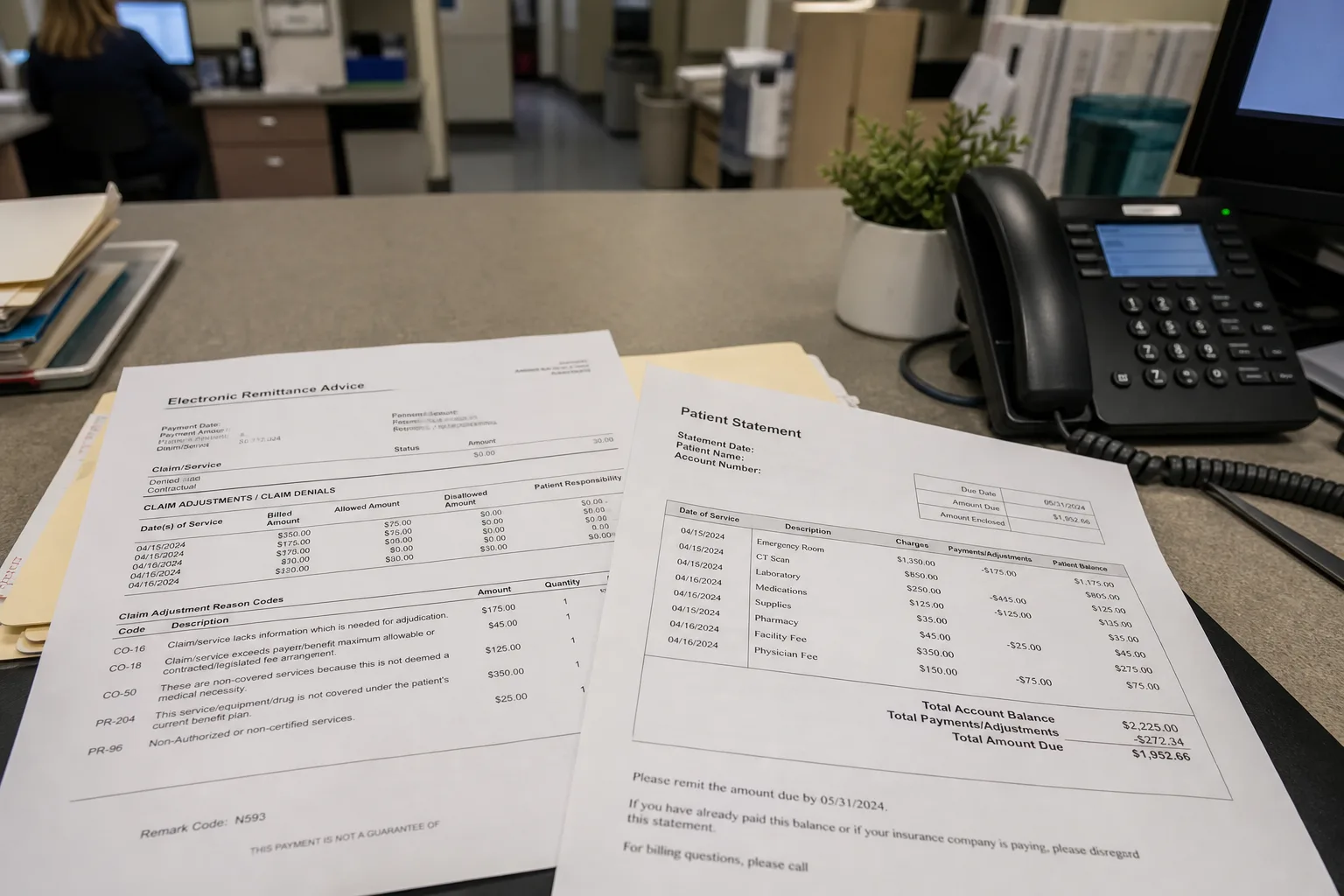
A refused claim rarely announces itself. What arrives at a hospital system's billing office is an electronic remittance file with a two- or three-character adjustment code sitting beside a zero-dollar payment, and what arrives at your house some weeks later is a statement showing a balance that was not there before. Those two documents describe the same event from opposite ends, and the gap between them is where most of the recoverable money sits. The order in which the refusal gets worked, not the strength of the argument, usually decides whether it is recovered.
The same refusal, ten years apart
A decade ago a denial at a mid-sized provider was a piece of paper in a stack, worked by someone in patient accounts who had a phone, a payer manual and a fax number. The remedy was a letter with records attached, mailed, then chased by telephone until a human on the other end agreed to reopen it. The process was slow and largely undocumented, but it was also forgiving: the clock ran loosely, and a persuasive phone call could revive a claim that had been sitting for months. What the system lacked in speed it made up in discretion.
The refusal now arrives faster, in machine-readable form, and it arrives more often because it is generated by an edit rather than by a reviewer. Automated adjudication rejects claims on data mismatches before any clinical judgment happens, which means a large share of what a provider calls a denial is really a formatting or eligibility problem. The upside is that these are cheap to fix and quick to resolve, often inside a payer portal in a matter of days. The downside is the timer, because portal-based workflows come with hard submission windows that no phone call reopens.
Who owns it inside a larger organization
At a small practice one person handles the whole life of a claim. At a health system the same refusal is split across four or five desks, and knowing which desk holds it tells you how long it will take. A denial management or revenue integrity unit triages the remittance codes and routes them: coding errors to the coders, eligibility and registration errors back to patient access, contractual underpayments to the managed care team, and medical necessity refusals to a physician advisor who can speak to a payer's medical director as a peer. That last handoff is the one that changed the most.
Ten years ago the physician advisor role barely existed outside academic centers, and clinical denials were argued in writing by nonclinical staff quoting a chart they could not interpret. Now a large provider will have a clinician, sometimes several, whose job is the peer-to-peer conversation and the medical necessity narrative. That specialization is why systems overturn a meaningful share of clinical refusals that a solo practice would write off. The Department of Labor is responsible for the claims and appeals rules that govern employer-sponsored health plans, and those rules assume a real reviewer on both sides.
The order, and why the first step is usually not an appeal
The single most expensive mistake is filing an appeal on a claim that should have been rebilled. A corrected claim and an appeal are separate channels with separate deadlines, and using the wrong one can burn the only window you had. So the sequence starts with reading the adjustment and remark codes literally: if the refusal names a missing modifier, an unlisted secondary payer, a subscriber identifier that does not match, or a date that falls outside coverage, the fix is a corrected submission and the case never becomes an appeal at all. Sorting that first is what a denial management unit exists to do.
What is left after that sort divides into authorization problems and medical necessity problems, and they run on different clocks. An inpatient status or authorization denial often carries a peer-to-peer window measured in a few days, sometimes while the patient is still admitted, and missing it converts a winnable case into a written appeal with worse odds. Medical necessity refusals go to a first-level internal appeal with the records and a clinical narrative, then to a second level if the contract provides one, then outward to independent external review. Each stage has its own filing period, and they do not extend one another.
Those periods are where round numbers mislead. Federal rules give a plan member a long runway to file an internal appeal, commonly cited as six months from the notice, but a provider appealing under its own contract frequently has far less, and the range across payer agreements runs from roughly a month to a few months rather than clustering on any tidy figure. Medicare and Medicaid appeals follow their own statutory ladders with different names and different windows again. The practical answer is that the binding deadline is whichever is shortest in the specific contract, and someone in managed care contracting can tell you which that is.
Your parallel track while the provider works its own
If the balance has reached your statement, you are not a spectator to the provider's appeal, you are running a second one. The plan owes you a written explanation of the refusal, in language that identifies the reason and the specific plan provision behind it, and you are entitled to the documents the decision relied on, including the internal criteria applied to your case. Requesting that file early is worth more than arguing early, because it tells you whether the refusal is clinical, administrative or contractual. Two of those three are resolved by the billing office rather than by you.
The useful call is not to the plan first. It is to the provider's patient financial services line, asking one question: has this claim been appealed, and at what level. A large system can usually tell you the filing date, the level, and whether a peer-to-peer already happened, and if the answer is that a corrected claim went out, the balance on your statement is likely to disappear without any action from you. If the answer is that the appeal is clinical and pending, your own internal appeal and, later, external review become the second shot on the same target.
Ten years of automation moved the difficulty from persuasion to sequencing, and sequencing is learnable. Read the codes before writing anything, separate the rebills from the true appeals, find the shortest deadline in the contract rather than the one in the statute, and ask the provider where in the ladder your claim currently sits.