Homes
Five Upkeep Items Nobody Handed Off to You, and What Each Costs by Year Three
Modern heating, water and ventilation equipment needs attention that older houses never asked for, and the instructions usually get lost in the handover.
Homes·Neville Pemberton
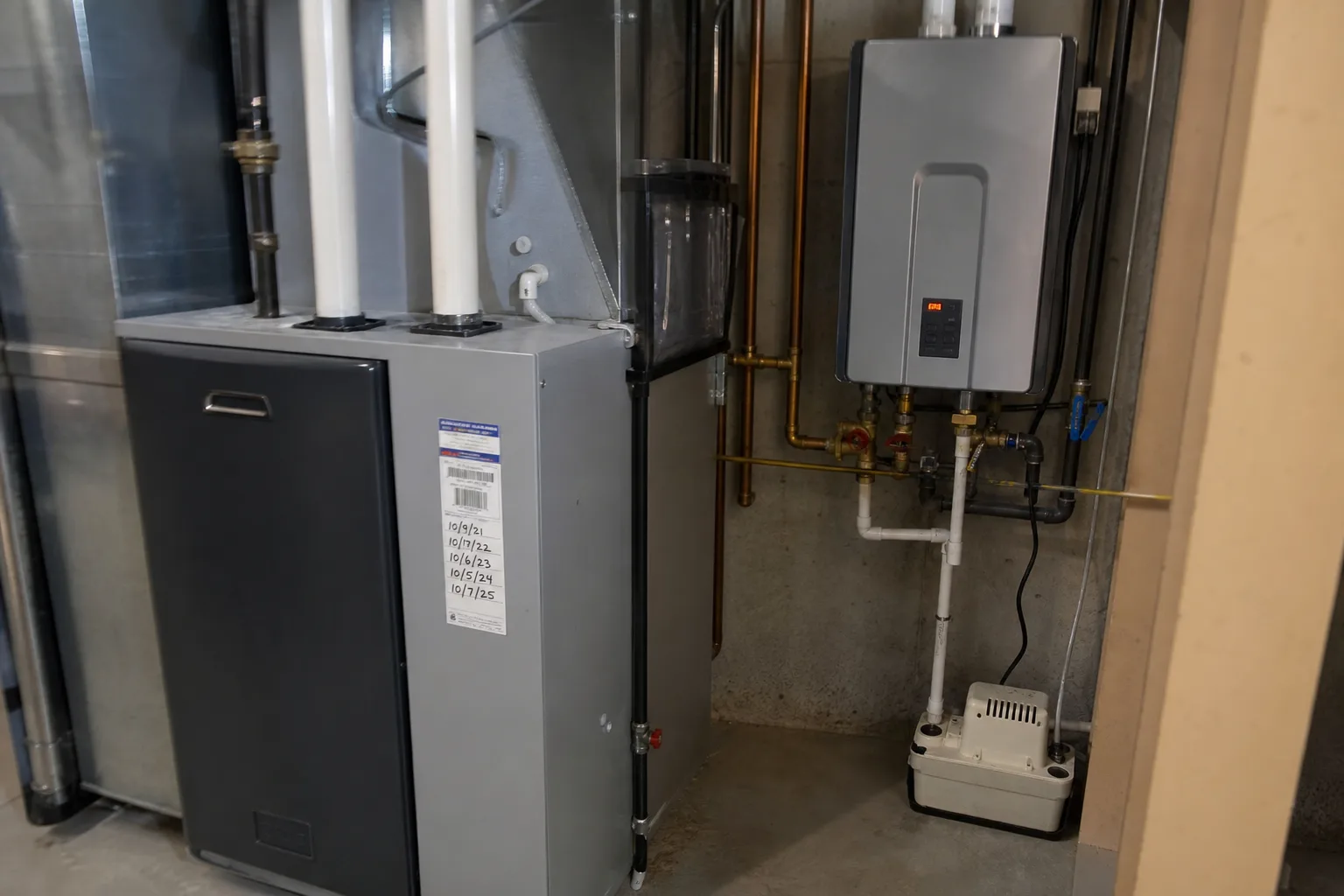
A house built or re-equipped in the last fifteen years asks for a different kind of attention than one built in 1975, and almost nobody is told so in a way that sticks. The equipment got more efficient, which mostly meant it got more particular: sealed instead of open, condensing instead of venting, filtered instead of unfiltered, and warranty-bound instead of simply installed. The habits did not keep up. What makes the gap expensive is not the tasks themselves, which are small, but the handover, the moment a job passes from the person who installed the thing to the person who now owns it. That is where the instruction goes missing.
The condensate drain that came with the efficiency upgrade
High-efficiency furnaces pull so much heat out of the exhaust that the water vapor in it turns back into liquid, which is why a modern furnace has a drain line and an older one did not. The Department of Energy oversees the appliance efficiency standards that pushed equipment in this direction, and the side effect is a piece of plastic tubing carrying slightly acidic water to a floor drain or a small pump. That tube grows biological slime. When it plugs, a pressure switch usually shuts the furnace down on the coldest night of the year, and when the safety switch is the thing that fails instead, the water finds the floor.
The check takes a minute: find the drain line, find where it terminates, and confirm the trap is not dry, cracked or crushed behind the unit. If a condensate pump is involved, it has a float that sticks and a discharge line that gets kinked when someone shoves boxes against it. This is the classic handover failure, because the installer knows the line needs a seasonal flush and says so once, standing in a mechanical room, to a homeowner who is thinking about the invoice. Write it on the furnace in marker. The next owner, or the next technician, will thank you.
The tankless water heater and the service record its warranty assumes
Tankless units changed the arithmetic of hot water and also the arithmetic of neglect. A tank heater with hard water loses capacity slowly and dies quietly at the end. A tankless unit runs city water across a narrow heat exchanger, and scale narrows the passage until the burner cycles, the outlet temperature swings, and an error code appears. Descaling is a flush with a pump and a few gallons of solution, and on hard water it is an annual job rather than an optional one. Skipped for four or five years, it stops being a flush and becomes a heat exchanger.
The part that surprises people sits in the warranty language. Extended coverage on the heat exchanger often assumes the unit was registered after installation and serviced on the manufacturer's schedule, and a denied claim frequently turns on nothing more than the absence of a paper trail. So the check is two-part: confirm the unit was actually registered, which the installer may or may not have done on your behalf, and keep every service invoice in one folder with the model and serial number on top. A homeowner who can produce four dated invoices is in a completely different conversation than one who cannot.
The ventilation equipment a tighter house created
Air sealing and blower door testing did exactly what they were meant to do, which is stop houses from leaking. A house that no longer leaks has to be ventilated deliberately, so newer construction and deep retrofits arrive with continuous-run bath fans, timers on the wall, inline fans in an attic, or a heat or energy recovery ventilator with two filters and a core that slides out. These run all the time, quietly, and collect everything the air carries. When the filters load up, the unit moves a fraction of its rated air and the house starts holding moisture in the places you least want it.
Check whether your house has mechanical ventilation at all, because plenty of owners do not know. Look for a wall control that says something other than on and off, a duct penetration in the attic, or a boxy unit near the furnace with two ports. Then find the filter access and see what is in there. The compounding cost here is measured in condensation on window frames, musty closets on exterior walls, and eventually paint and drywall, which is a repair bill instead of a filter. New houses get commissioning paperwork covering all of this, and it lives in a kitchen drawer until somebody reads it.
The heat pump that runs all year instead of half of it
Air conditioners sat idle for six months. Heat pumps do not, and as ductless and variable-speed systems spread, outdoor units went from seasonal equipment to year-round equipment with twice the run hours and twice the exposure. An outdoor coil packed with cottonwood seed, mulch, dryer lint or dog hair makes the compressor work against a wall of static pressure, which shows up first as a higher bill and later as a failed part. Indoor heads are worse, because the blower wheel behind the plastic cover collects a hard film that no amount of rinsing the screen filters will touch.
Two checks. Look at the outdoor coil fins in daylight from the side, not from above, and confirm you can see through them; clear a couple of feet around the unit and keep the base free of leaves so the defrost melt has somewhere to go. Then pull the front cover off each indoor head and look at the wheel. A deep cleaning is a service call with a pump and a bib, not a homeowner job, but knowing it is due is entirely a homeowner job. Installers of ductless systems increasingly say this at handover. It is worth writing down when they do.
The leak detection device and the discount attached to it
Automatic water shutoff valves and point sensors moved from novelty to something insurers actively encourage within the last several years, and many carriers now offer a premium credit for having one installed and active. That last word does the work. These devices depend on a working Wi-Fi connection, a live app account, sensor batteries, and in some cases a cellular or utility backup, and any one of them can lapse without a sound. A device that stopped reporting eight months ago is, in a claim, indistinguishable from no device at all, and the credit on your policy is still being applied to something that is no longer watching the house.
The check is a test, not an inspection. Trigger one sensor deliberately and confirm you get the alert on your phone; confirm the valve actually closes and reopens if you have a shutoff model; replace the batteries on a date you choose rather than a date the device chooses. If the system came with a house you bought, the account is probably still tied to the previous owner's email, which is the purest possible version of a handover failure and takes one call to fix. Then tell your carrier in writing that it is installed and working, and keep the confirmation.
None of these five is difficult, and none of them is expensive on the day you do it. What they share is an origin: each one arrived with equipment that is genuinely better than what it replaced, and each one carries an instruction that has to survive a pass from one pair of hands to another. Put the model numbers, the service dates and the two sentences of explanation in one place, physically, near the equipment. The next person to stand in front of it, whether that is a technician, a buyer or you in four years, will make a better decision for having it.