Family
One Memorial, Fourteen Weeks of Emails. The Two Decisions That Locked on Day Three
A family assumed the granite color was the permanent choice. The choices that could not be undone were a dimension drawing and a name on a plot deed, both settled in the first week.
Family·Osman Duraklar
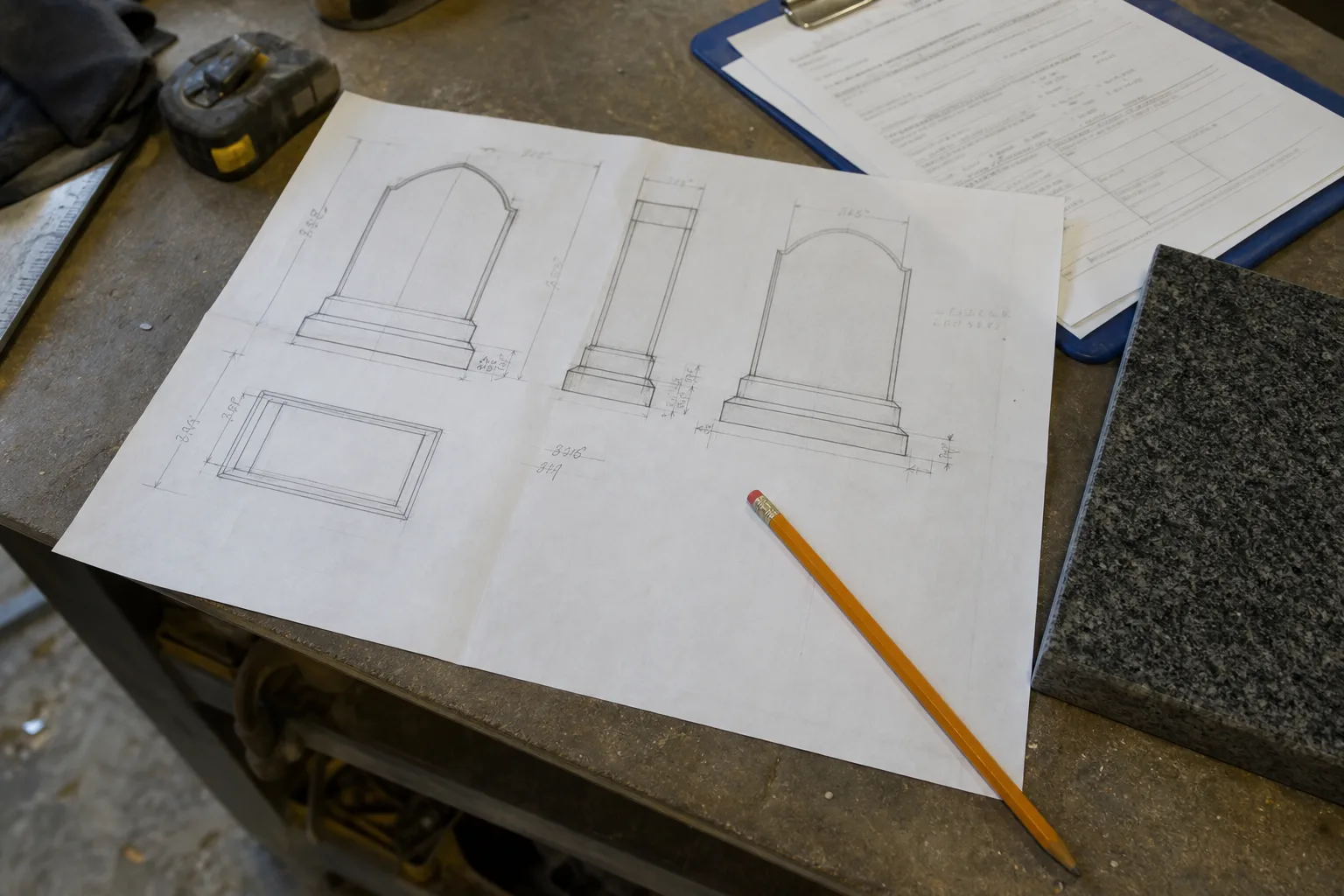
The family had set aside a Saturday for this, which turned out to be the wrong unit of measurement. Choosing the memorial took fourteen weeks from the first showroom visit to the morning the stone was set, and almost all of that time was spent confirming things that had already been decided. They arrived thinking the permanent choice was the granite: a gray, a dark charcoal, a rose. The granite was the part they could still change in week five. What they could not change, and did not recognize as a decision at the time, was a dimension drawing they initialed on day three.
What everyone assumes is the irreversible part
In the showroom the pressure lands on appearance, because appearance is what the samples are for. Polished faces are lined up against a wall, the lettering styles sit in a binder, and a surviving spouse is asked to pick between two shades of gray while still managing the rest of a death. That framing suggests the color and the shape are the commitment. In practice a monument dealer works from stock slabs and quarry orders, and until a slab is cut for your job, a color change is a phone call and sometimes a small price adjustment. The family in this case switched from a rose to a medium gray after seeing both outdoors, in daylight, at the cemetery, and nothing about the order was disturbed.
The catalog encourages the same mistake in the other direction. Shapes are shown as fixed products, upright tablet, slant marker, flush bronze on a granite base, when the real constraint is the cemetery's written specification for that section rather than the dealer's range. Section rules govern height, base footprint, whether an upright is allowed at all, and what may sit on top. A family that reads those rules first has a smaller menu and a faster decision, and they will not fall in love with a design that the grounds superintendent has to refuse.
The drawing that locked, and why nobody flagged it
On day three the dealer emailed a scaled layout: the family surname across the top, the first name and two dates below it on the left half, and the right half blank for the surviving spouse. It looked like a formality. It was the whole architecture of the stone, and it settled four things at once. The position of the surname fixed where the center line fell. The size of the carved lettering fixed how much room the second inscription would have. The depth and method of the carving set what a later hand would have to match. The base footprint, drawn to the section's allowable dimensions, fixed the concrete foundation the cemetery would pour.
None of that is an error in the drawing. It is the drawing doing its job. The point is that the blank right half is not neutral space. It is a promise about a future inscription that will be cut on site, years later, by someone working outdoors with portable equipment against a stone that has weathered. Matching the font is routine work for a competent letter cutter. Matching it in a space that was sized generously, with a record of the original stencil and letter height on file, is easier and cheaper than matching it in a space that was sized to look balanced on a computer screen. The family asked for a quarter inch more breathing room on each side, and the dealer redrew it in a morning.
The week-to-week reality of the other eleven weeks
What followed was not deliberation. It was a slow sequence of small confirmations, mostly by email, each one holding the job until someone replied. Week two was a proof with the dates typed out in full and a question about whether a middle name should appear, which took the family nine days to settle because two siblings remembered their mother's preference differently. Week four was the cemetery's permit application, signed by the plot owner of record, which the dealer could not submit on the family's behalf. Week six was a photograph of the sandblast stencil laid on the slab. Week eight was a note that the shipment had slipped by a week.
Then the work moved outdoors and the calendar started making the decisions. The cemetery pours foundations in batches, when the crew has enough orders and the ground allows it, which in a cold state means the window closes in late fall and reopens in spring. The stone sat in a shop for most of a month waiting for a pour it had no influence over. This is the ordinary texture of memorial work and it is worth planning around rather than resenting. Families who ask in the first week when the cemetery's next foundation cycle runs get an honest answer, and they stop treating the delivery date as the date that matters.
Where the figures came from
The family had a number in their heads before they started, picked up from a relative who had bought a marker in another state a decade earlier, and it was useless in both directions. The quotes they collected were not comparable until they were itemized, because one dealer's single price included the cemetery's foundation and setting charge and the other's did not. That charge is levied by the cemetery, not the monument dealer, and it is commonly calculated on the footprint of the base, which means a wider stone carries a larger setting fee as well as a larger stone price. Once both quotes were broken into stone, carving, delivery, setting and permit, the gap between them narrowed to something the family could actually reason about.
They also asked for the future inscription to be priced, and got the honest answer, which was a range rather than a figure. On-site lettering is quoted per character or per job depending on the shop, travel is a real component, and no dealer will hold a price for an unknown number of years. What the dealer would do was put the current range in writing with the letter height, font name and stencil reference attached, which converts a vague future expense into a bounded one. Cemetery and monument work usually sits outside the itemized price list a funeral home provides, and the Federal Trade Commission is the body responsible for the federal rules governing how funeral goods and services are disclosed and priced, so the two sets of paperwork have to be read separately rather than assumed to overlap.
The decision nobody discussed at all
The quietest permanent choice in the file was not on the stone. It was the name on the plot deed, because the owner of record is the person the cemetery will accept instructions from, and everything later, the second interment, the second inscription, a repair after a mower strike, runs through that authority. In this case the deed was still in the name of a man who had died in the nineteen nineties, and transferring it required a short form, a copy of a death certificate and about three weeks. The family did it while they were already deep in paperwork, which was the cheapest possible moment. A relative attempting the same transfer during a funeral week, or twenty years on with the intervening heirs scattered, spends considerably more of it on the phone.
When the stone was set in the spring, the family put one folder away with the deed transfer, the approved drawing, the font and letter height, the stencil number, the permit, and the dealer's written range for the second inscription. That folder is the difference between a decision made once and a decision rediscovered under pressure. The next person to need it will not have to reconstruct anything.