Health
Reading a Hospital Bill Line by Line, and the Three Handovers Where the Errors Collect
A medical bill is the end of a chain that passed through registration, coding and a payer. Most errors are handover errors, and here is how to find them in order.
Health·Neville Pemberton
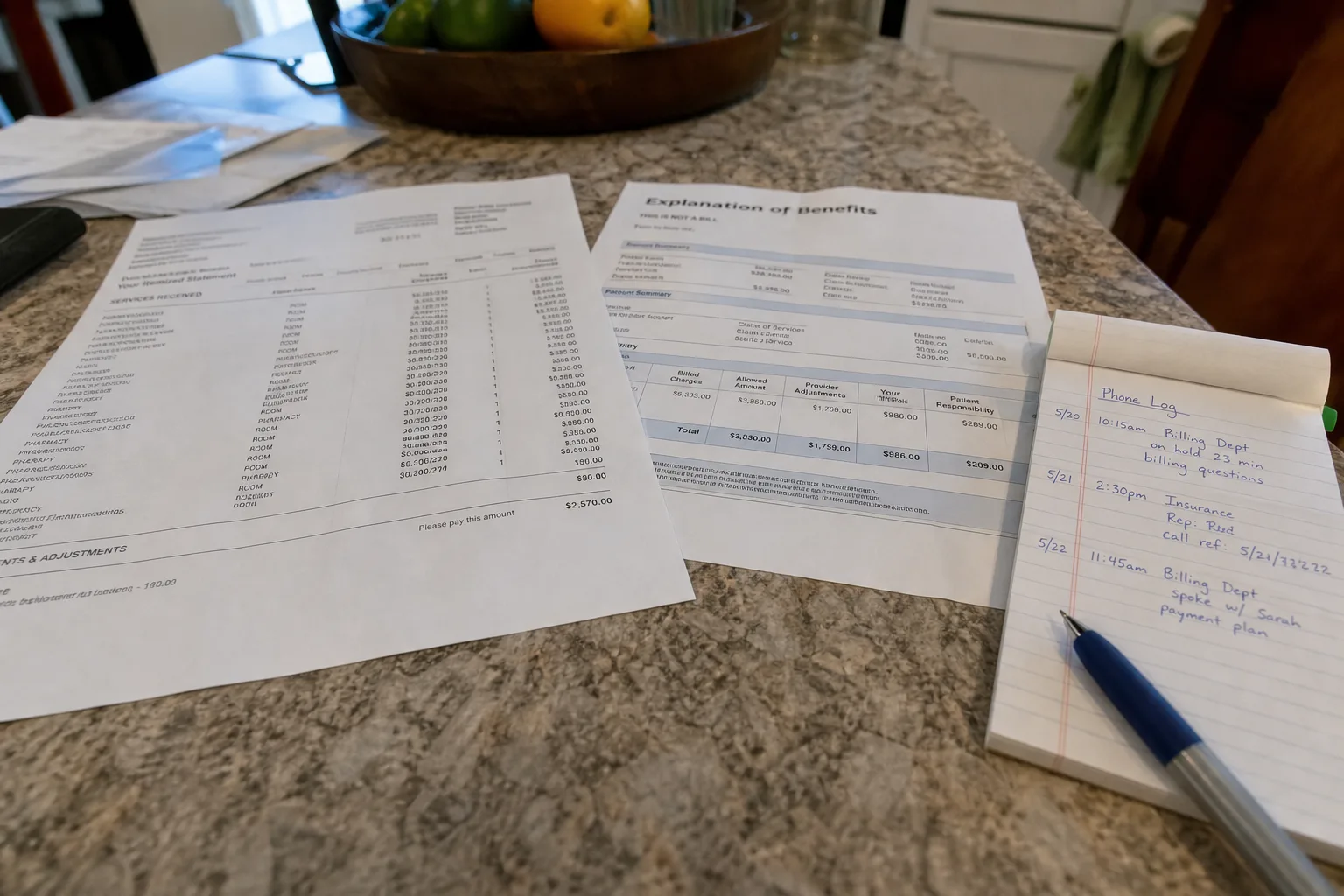
The document that arrives in the envelope is almost never the document you need. Hospitals and large clinics send a summary statement, which is a marketing-grade abstraction of the actual charges: a few category totals, a balance, a due date, and a phone number that routes to a queue. The bill that can be checked is the itemized statement, sometimes called a detail bill or a UB-04 equivalent, and it is produced on request. Anyone who has worked through a stack of these learns the sequence quickly, because the order in which you gather paper decides whether the review takes forty minutes or four weeks.
Three documents, and none of them alone is enough
You need the itemized statement from the provider, the explanation of benefits from the insurer, and, if the encounter was anything more than a fifteen-minute office visit, your own record of what happened and when. The itemized statement says what was charged. The explanation of benefits says what the payer decided, which is a different thing entirely, and it carries the adjustment codes that explain any denial or reduction. Your own record, even a phone note listing arrival time, discharge time and the names of who treated you, is what resolves disputes about units and dates. Request all three before you read any of them.
A barely adequate review starts with the summary statement and ends with a call asking whether the balance is correct. The person answering can only confirm that the balance is what the system says, which was never in question. A good review starts by putting the itemized statement and the explanation of benefits side by side and matching them line for line, because the two documents were generated by two organizations that do not share a database, and the gaps between them are where the money sits. Line counts that differ are the first thing to note.
What each column actually claims
Every detail line carries a service date, a code, a description, a quantity or unit count, and a charge. The code is the load-bearing element. Procedures and services carry CPT or HCPCS codes, supplies and room charges carry revenue codes, and diagnoses carry ICD-10 codes that justify the rest. The description printed next to the code is written for internal use and is frequently wrong or abbreviated to the point of meaninglessness, so treat it as a hint rather than a fact. The Centers for Medicare and Medicaid Services maintains the coding and claim-format standards that nearly every commercial payer follows, which is why the same code means the same thing across providers.
Read the service dates first, in order, and confirm that each one falls inside the window you were actually there. Dates a day early or a day late are common, and they matter because a date outside your coverage period, or outside an authorization window, produces a denial that looks like a coverage problem and is really a typographical one. Then read the unit counts. A single injection billed as four units, or an hour of monitoring billed as eight, is the most frequent quantifiable error on a hospital bill, and it is the easiest to prove because your discharge time bounds it.
Modifiers deserve their own pass. A two-character modifier appended to a procedure code changes what the payer pays, and modifier 25, which asserts that a separately identifiable office visit occurred alongside a procedure, drives a large share of surprise patient balances. So does the distinction between the facility fee and the professional fee, which arrive as two bills from two entities for one appointment. Neither bill is a duplicate of the other. Confirming which is which, and that neither contains the other's charges, is a five-minute check that prevents a month of confusion.
The three handovers, in the order they fail
The first handover is registration to charge capture. Whatever the front desk typed becomes the claim: your name spelled from the insurance card or from your driver's license, the subscriber identification number, the group number, the plan effective date, the referring physician. An error here does not produce a wrong charge, it produces a correct charge sent to the wrong place, and it surfaces months later as a full-balance patient statement. Check the demographic and insurance block at the top of the itemized statement against the card in your wallet before you look at a single dollar figure.
The second handover is clinical documentation to coding. A coder who was not in the room reads a chart and converts it into billable codes, and the failure mode is not fraud but ambiguity: a diagnosis coded from an earlier note, an observation stay coded as inpatient, a screening colonoscopy that became diagnostic when a polyp was removed and lost its preventive status along with its full coverage. These are correctable through a coding review, which is a specific request and not the same as a billing inquiry. Ask for it by name and the request reaches a different desk.
The third handover is claim to adjudication, and it is where the explanation of benefits earns its keep. The adjustment codes on that document tell you whether the payer denied for lack of authorization, applied an out-of-network rate, bundled a line into another, or processed the whole thing as patient responsibility because the deductible had not been met. A denial for missing authorization is a provider problem. A denial for a coordination-of-benefits question is your problem to answer with a phone call. Sorting the denial into the correct bucket determines who does the next piece of work, and it saves the weeks that get lost when both parties assume the other is handling it.
What a thorough review leaves behind
The difference between adequate and good shows up in the record. A good reviewer writes down the date, the direct phone number, the name and reference number for every call, asks for corrections in writing before agreeing to anything, and asks one specific question at the end of each conversation: what is the deadline for the next step, and whose deadline is it. Appeals close. Rebilling windows close. Financial assistance applications, which most nonprofit hospitals are required to offer and screen for, close too. Requesting a hold on the account while a review is open keeps the balance out of collections while the paper moves.
Everyone who does this often ends up with the same short habit: read the dates, read the units, match the two documents, then decide which of the three handovers produced the discrepancy. That question answers itself once the paper is in front of you, and it tells you who to call first.