Homes
Two Clocks Start When a Pipe Fails, and Only One of Them Belongs to the Contractor
Water sitting on a subfloor is genuinely urgent. The paperwork put in front of you at hour three is not, and the rules are written to let you separate the two.
Homes·Harriet Bosworth
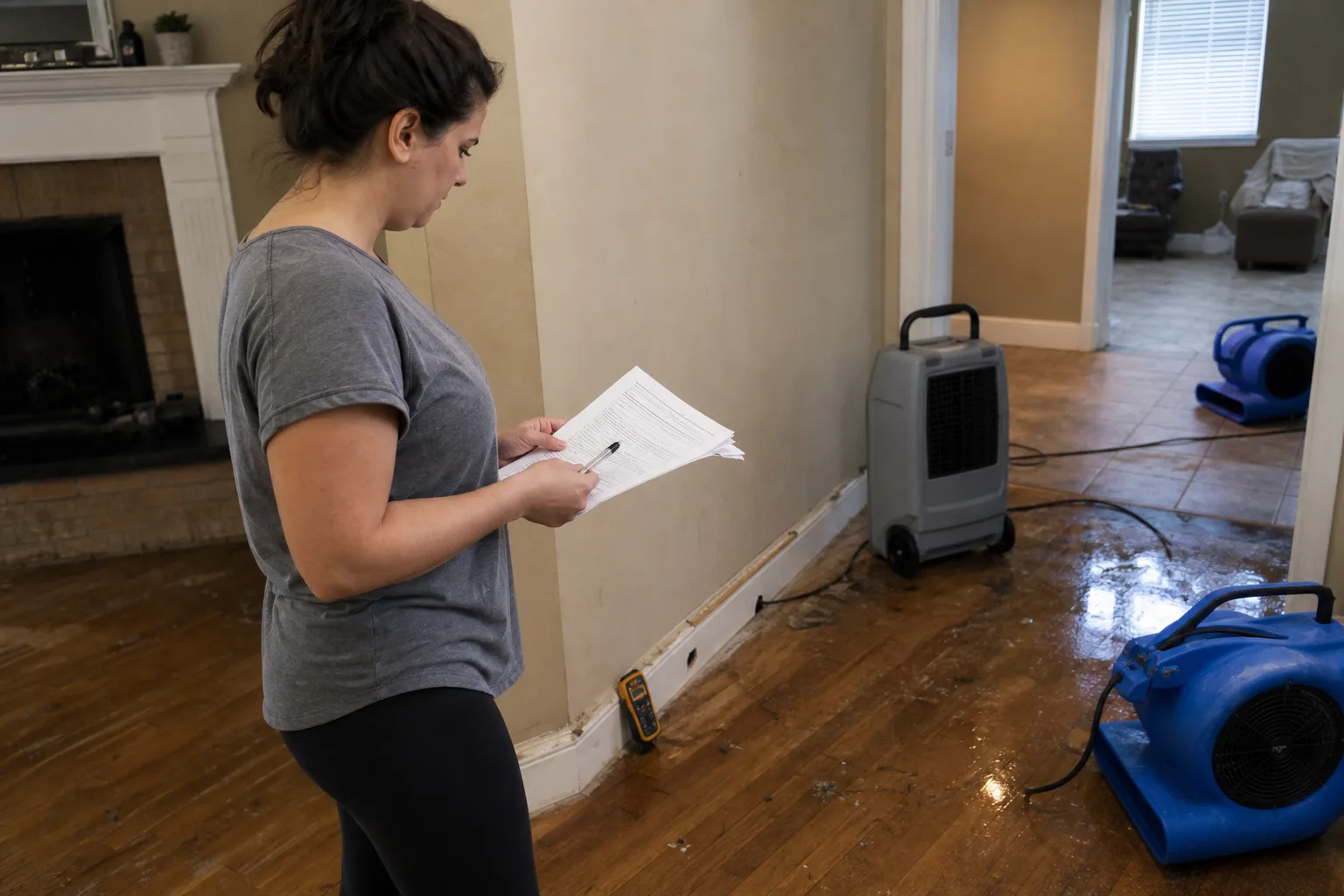
The truck arrives, the fans come off the trailer, and somewhere between the first moisture reading and the second cup of coffee a clipboard appears with a form on it that assigns your insurance benefits to a company you met forty minutes ago. Both of those things happened inside the same hour, which is exactly why they feel like the same decision. They are not. Water sitting against a subfloor is a physical process running on its own schedule, and it does not care whether you have signed anything. The paperwork runs on a schedule someone chose.
The duty in your policy is to mitigate, not to authorize
Nearly every homeowners policy contains a condition requiring you to protect the property from further damage after a loss, and to make reasonable temporary repairs. That clause exists for a sound reason: an insurer agreed to cover a sudden event, not the slow rot that follows a week of inaction, and without the duty the incentive to do nothing would be enormous. What the clause requires is action on the water. Shut the supply, get standing water out, get air moving, get contents off wet carpet, keep the receipts. What it does not require, anywhere in the language, is that you hand a specific vendor control of the claim before lunch.
That distinction is the whole argument. A homeowner who spends the first two hours extracting water and photographing walls has satisfied the mitigation duty completely, even if the formal work authorization is still unsigned at hour six. The pressure to sign fast is a business preference dressed as a policy obligation, and it is worth naming it as such when you hear it. Mitigation is measured by what happened to the water. Nobody adjusting the file later asks how quickly you produced a signature.
What you are actually signing, and who ends up holding the file
The document that matters most in those early hours is usually two or three pages and contains more than a price. It may include an assignment or direction of benefits, letting the contractor bill and collect from your insurer directly; a lien provision against the property; a term making you personally liable for anything the carrier declines; and an equipment rental rate that accrues daily whether or not anyone visits the house. Each of those clauses has a defensible purpose. Read together, they can move the negotiating position from your side of the table to a place where you are a spectator to a dispute about your own house.
The second-order effect is the one that costs money. Once benefits are assigned, the argument over whether eleven days of drying was reasonable happens between the restorer and the carrier, and you learn the outcome when a balance letter arrives. You did not choose the scope, you cannot easily discharge the vendor midway, and the shortfall lands on you under the personal liability clause you initialed. None of this makes assignment illegitimate; plenty of good companies use it and plenty of states now regulate its form tightly. It makes it a decision that deserves an hour and a clear head.
The standard of care is a document, and you are allowed to ask for its output
Water restoration is not improvised. The industry works to a consensus standard of care for professional water damage restoration, the one commonly cited as the S500, which sets out how categories of water and classes of water intrusion are assessed, how drying goals are established, and how progress is documented. That standard is not a statute, but it functions as the reference point in almost every argument about whether a job was done properly, which is precisely why the customer benefits from invoking it. Ask, on day one, for the moisture map, the daily readings, the target dry standard, and the equipment log.
A crew working to the standard already produces all four. A crew that treats the request as an insult has told you something useful for the price of asking. Those documents are also the only thing that later proves the difference between drying a wall cavity and demolishing it, a distinction that decides whether you get new drywall or a rebuilt room. On the mold question, the Environmental Protection Agency is responsible for federal guidance on indoor moisture and mold remediation, and the practical thrust of that guidance is unglamorous: fix the water source and dry the materials, because remediation without drying is a repeat visit.
Demolition is the irreversible step, and it is the one most often rushed
Extraction and air movement are reversible in the sense that nothing is lost if the assessment later changes. Cutting two feet of drywall off every wall in a finished basement is not. Hardwood is the sharpest example: some floors dry in place with mats and monitoring, some are gone, and the difference is often visible only after a few days of readings. If the flooring left the house on day one, the question of whether it could have been saved cannot be answered, and the claim gets settled on an assumption rather than a measurement.
There is also a consent problem that homeowners tend to notice too late. Your carrier owes coverage for necessary repairs, and necessity is easier to demonstrate when the record shows a reading, a decision, and a date rather than a truckload of debris and an invoice. Slowing the demolition by even a day, while running the fans hard, costs equipment rental and buys a documented basis for every cut. That is a trade most people would take knowingly and very few are offered.
What a deliberate forty-eight hours looks like from the customer's chair
Start the water clock immediately and the paper clock separately. Report the loss to your carrier yourself, get a claim number, and ask directly whether emergency mitigation is covered up to a threshold without prior approval, because many policies say yes and the answer removes the manufactured urgency from the conversation on your porch. Photograph everything before anything moves, including serial numbers and the contents of cabinets. Then read the authorization, cross out what you will not agree to, cap the emergency work at a dollar figure or a scope, and sign that.
Verify licensing and insurance the same afternoon rather than on faith, and put every scope change in writing even if it is a text message confirming a phone call. Keep a running log of who was in the house and for how long, because equipment sitting unattended for four days at a daily rate is a line item you will otherwise be unable to contest. None of this slows the drying by an hour. It changes who holds the record when the numbers are argued, and the person holding the record generally wins.
The genuine emergency is narrow and physical: stop the source, remove the water, move the air, protect what can still be saved. Everything else in those two days is commerce, and commerce is negotiable at eight in the evening on the same terms it was at eight in the morning. Treating the two clocks as one is how a manageable loss becomes an expensive one.