Homes
Water in the House? The Rules That Change Depending on Which State You Are Standing In
Emergency drying runs on one national consensus standard, but licensing, insurer steering, mold rules and floodplain limits all shift by state and county.
Homes·Osman Duraklar
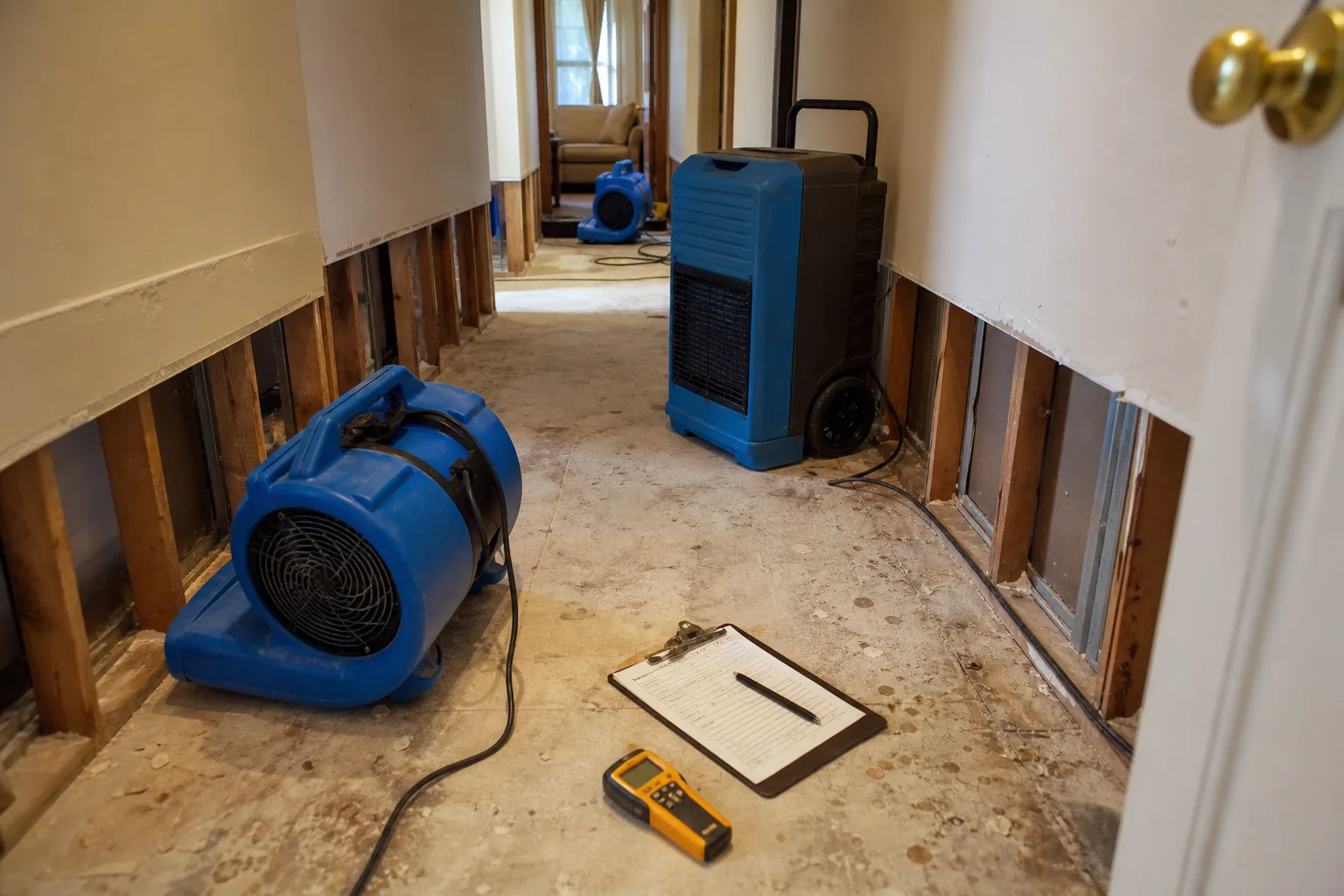
The forty-eight hour figure that gets repeated in every restoration brochure is not a law, and nobody who uses it can point you to the statute. It comes from the industry's own drying literature, where the concern is that clean water sitting in porous material stops being clean water somewhere between one and three days, depending on temperature, contents and how much air is moving. That range is the honest answer. What is genuinely fixed in that window is a different set of things: the standard your technician works to, the notice your policy requires, and whose rules govern the debris going out to the curb.
The standard the drying crew is actually working to
Most reputable restoration work in the United States is performed against a consensus standard published by the Institute of Inspection, Cleaning and Restoration Certification, usually shortened to the S500. It is not government issued, and no state legislature wrote it, but insurers cite it, adjusters read it, and expert witnesses argue from it when a claim goes bad. It classifies water by contamination, from clean supply line water through to sewage, and classifies the affected space by how much porous material is holding moisture. Ask which category and which class the technician assigned on arrival, and ask to see the number written down.
That single question does more work than it looks like it does. The category determines whether wet drywall and carpet pad can be dried in place or has to come out, and the class drives how much equipment belongs in the room. A crew that cannot tell you what it recorded on day one will have trouble justifying the equipment line on the invoice on day nine. A crew that hands you a moisture log with readings, locations and dates has already built the file your adjuster will ask for.
Who chooses the company, and where that is a matter of state law
The first call to the insurer often produces a name, sometimes with a suggestion that using the recommended vendor speeds payment. Whether that suggestion is allowed to carry weight depends on where you live. A number of states have anti-steering provisions in their insurance codes, written mostly for auto glass and body shops but drafted broadly enough that departments of insurance have applied them to property restoration; other states have nothing on point at all. Separately, your own policy may contain a managed repair clause that genuinely does give the carrier a say. Read that clause before you sign anything a contractor puts in front of you.
The paperwork question that has moved fastest is assignment of benefits, the document that hands your claim proceeds directly to the restoration company. Florida rewrote its rules after a decade of litigation over those assignments, and several other states have tightened disclosure or notice requirements since. In practice this means the form you would have signed without reading in one state may be void, restricted, or subject to a rescission window in another. Ask what you are assigning, what you can cancel, and by when.
Mold licensing exists in some states and nowhere else
The reason the drying window matters legally, rather than just physically, is that once visible growth appears the job may fall under a separate license. Florida, Texas, New York and Louisiana are among the states that regulate mold assessment or remediation as its own licensed activity, frequently with a rule separating the company that inspects from the company that remediates. In much of the country there is no such license, and the same general contractor handles both halves. Same water, same house, different legal structure, purely because of the state line. Confirm which regime applies before scope grows.
Floodplains, disposal and the county-level rules nobody mentions
If your address sits in a mapped special flood hazard area, the repair is governed by your community's floodplain ordinance, adopted locally to participate in the National Flood Insurance Program, which FEMA oversees. Those ordinances carry a substantial improvement threshold: once the cost of repair reaches a set share of the structure's value, the whole building has to be brought up to current elevation and construction requirements. That determination is made by a local floodplain administrator, not by your contractor and not by your adjuster, and two adjacent jurisdictions can measure it differently.
The smaller local rule is disposal. Wet carpet, pad, baseboard and cut drywall add up quickly, and municipalities differ on whether that goes out as bulk waste, requires a scheduled pickup, or has to leave in a dumpster with a permit for street placement. Some cities cap curbside volume per household per week. Photograph everything before it leaves, room by room, with something in frame for scale, because once it is gone the photographs are the only evidence of what was there.
Two calls on the first morning settle most of this: one to your local building or floodplain office asking what applies at your address, and one to your state insurance department asking what the carrier may and may not require of you. Both are free, both are quick, and both give you answers that no vendor has a financial interest in shading.