Law
Your Evidence Lives in Six Apps. How to Get It Ready Before the First Meeting
A decade ago you brought a folder of paper to a first legal consultation; now the record is scattered across email, texts and portals, and assembling it is the preparation.
Law·Harriet Bosworth
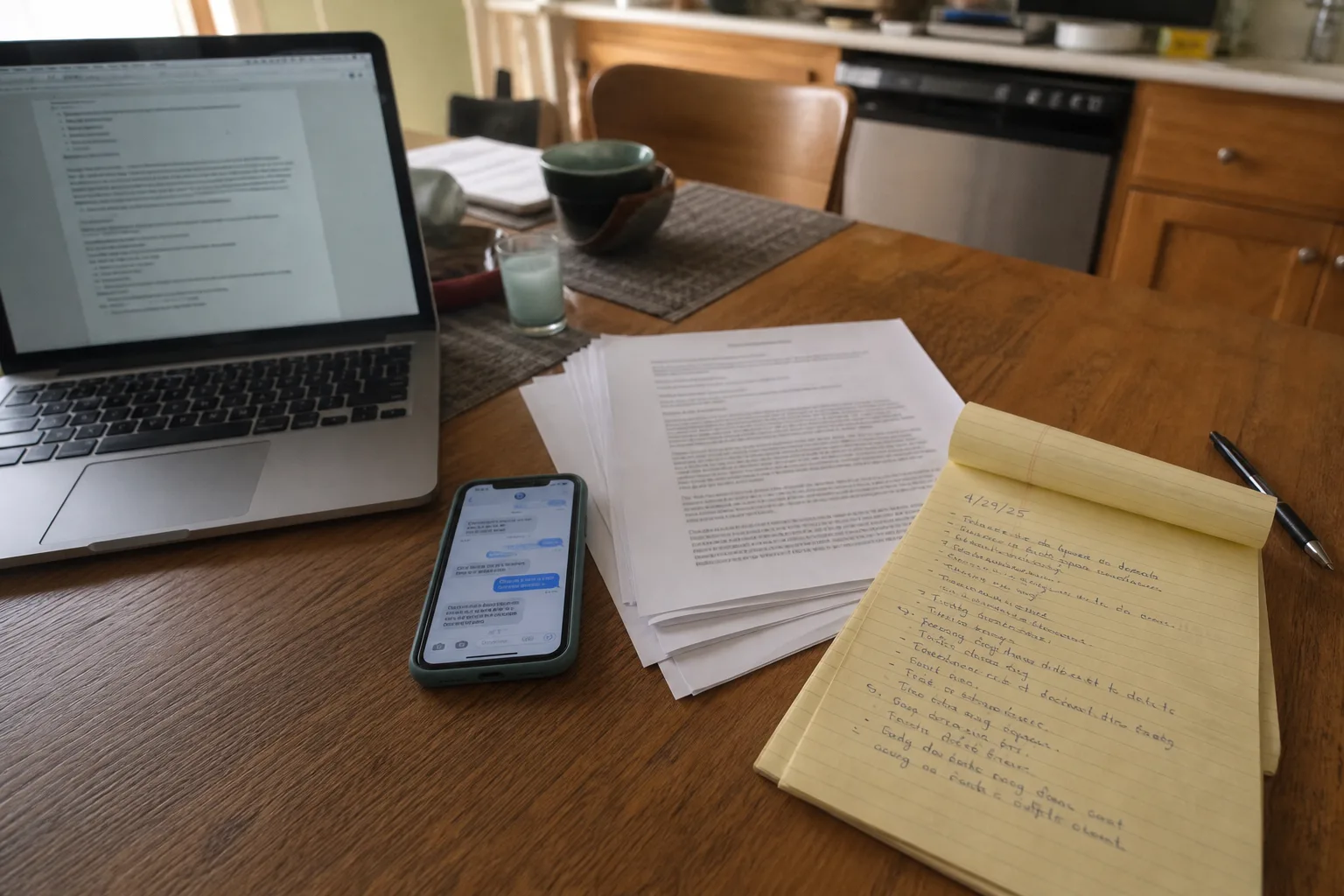
The reason lawyers ask you to bring documents is not administrative fussiness. An attorney cannot tell you what your position is worth until she knows what a neutral third party would be able to prove, and proof lives in dates, signatures and contemporaneous records rather than in your recollection of who said what in the driveway. Ten years ago that meant carrying a folder. The contract was on paper, the letters arrived in envelopes, and the checks had stubs. The obligation has not changed at all. What has changed is where the material sits and how much work it takes to pull it into one place.
The folder used to assemble itself, and now it does not
In 2015 a homeowner with a contractor problem walked in with a signed estimate, two canceled checks, a certified mail receipt and a page of handwritten notes. The file was thin, but it was complete, because the transaction had generated paper as it went and the paper had accumulated in a kitchen drawer without anyone deciding to keep it. Preparation was mostly a matter of finding the drawer. The same dispute today produces a signed PDF in a signing platform, a payment trail split between a bank app and a peer-to-peer transfer, a hundred and forty text messages, and a change order agreed to in a project management app that the contractor controls.
That last detail is the one that catches people. When the record lives on a platform the other side administers, your access to it is a courtesy rather than a right, and courtesies end when a dispute starts. The practical consequence is that the first hour of preparation is now an export exercise. Before you write a single complaint email, screenshot or download whatever sits in a portal you do not own: the schedule, the messages, the approved change orders, the photographs the crew uploaded. It takes twenty minutes on a weekday evening and it is the difference between a case built on documents and a case built on your memory of documents.
What a week-to-week routine looks like when the trouble is still developing
Most people do not know they will need a lawyer until several weeks into a problem, which means the useful preparation happens before anyone has decided to get legal help. The habit that pays is small and boring. Once a week, on the same evening, move the week's material into one folder on your computer, named for the matter and nothing else. Save the emails as PDFs rather than leaving them in a thread. Photograph the site or the damage on the same day of the week from the same two positions. Write four sentences about what happened, dated, in a plain text file.
The four sentences matter more than they look. A contemporaneous note written the week something happened carries weight that a reconstruction written four months later does not, and it also protects you from the ordinary drift of memory, where a phone call in which someone said he would look into it becomes, by spring, a phone call in which he promised to fix it. Ten years ago people kept this kind of note in a spiral notebook because there was nowhere else to put it. The notebook is still fine. What is not fine is nothing.
The intake process moved online, which changes what the hour is for
A decade ago the first twenty minutes of a consultation went to basic facts: your name, the other party's name, the dates, the amount in dispute, whether you had sued anyone before. That work has migrated to a web form you fill out before you arrive, and the migration is not neutral. It means the attorney has already run a conflict check, already formed a rough view of whether the matter fits the practice, and already decided roughly what she wants to ask you. It also means a thin or vague intake form produces a thin first meeting, because the questions she prepared were built from what you typed.
Treat the form as the first document in the case rather than a hurdle before the real conversation. Put actual dates in it. Name the statute or the contract clause if you know it, and say plainly if you do not. Attach the two or three documents that define the dispute, not the whole folder, because an attorney reading forty attachments before a paid hour is reading them on your dime or not reading them at all. If the form has a box asking what outcome you want, answer it in one sentence, even if the sentence is that you want to know whether the case is worth pursuing.
Video meetings, flat fees, and the new mechanics of the first hour
The consultation itself is now as likely to happen on a video call as across a desk, and that shifts the preparation from physical to procedural. Test the link the day before rather than at the appointed minute. Have the documents open on the screen you are not using for the call, named so you can find them while someone is waiting. If you plan to record, ask first, because recording rules vary by state and asking costs you nothing. Sit somewhere the call will not drop, which for most households means the room nearest the router.
Fee structures have moved too. Flat fees for defined tasks, a demand letter, a lease review, an entity formation, are far more common than they were, and unbundled representation, where the attorney handles one discrete piece and you handle the rest, is now openly offered in many states. That changes the question you should walk in with. Rather than asking what the whole matter will cost, ask what the next defined step is, what it costs as a fixed price, and what you would do yourself afterward. The Federal Trade Commission oversees how consumer services are advertised and how fee terms must be presented, and the general expectation of clear, upfront terms has filtered into how legal work is now quoted.
The three things to settle before you hang up
Leave the meeting with a date, a number and a name. The date is the earliest deadline that binds anyone in the matter, whether that is a statute of limitations, a notice window in a contract, or a filing cutoff, and you should write it down while you are still on the call. The number is what the next step costs and how it is billed. The name is who you contact between now and then, because in most firms it is a paralegal rather than the attorney, and knowing that saves you a week of unanswered voicemails.
Then send one short email the same afternoon confirming all three in your own words. It is not a formality. It gives you a dated record of what was agreed, it lets the firm correct any misunderstanding cheaply, and it starts the file that the next meeting will be built on. The whole exercise takes ten minutes, and it is the part of preparation that people who get good outcomes almost always do.